
Drivetrain · CV axle and differential
Open vs limited-slip differential: what's the difference?
An open differential always sends the same torque to both driven wheels, so if one wheel loses grip, the drive to both falls to what that wheel can take. A limited-slip differential resists one wheel turning faster than the other, which lets more of the drive go to the wheel with grip. Most everyday cars have an open differential.
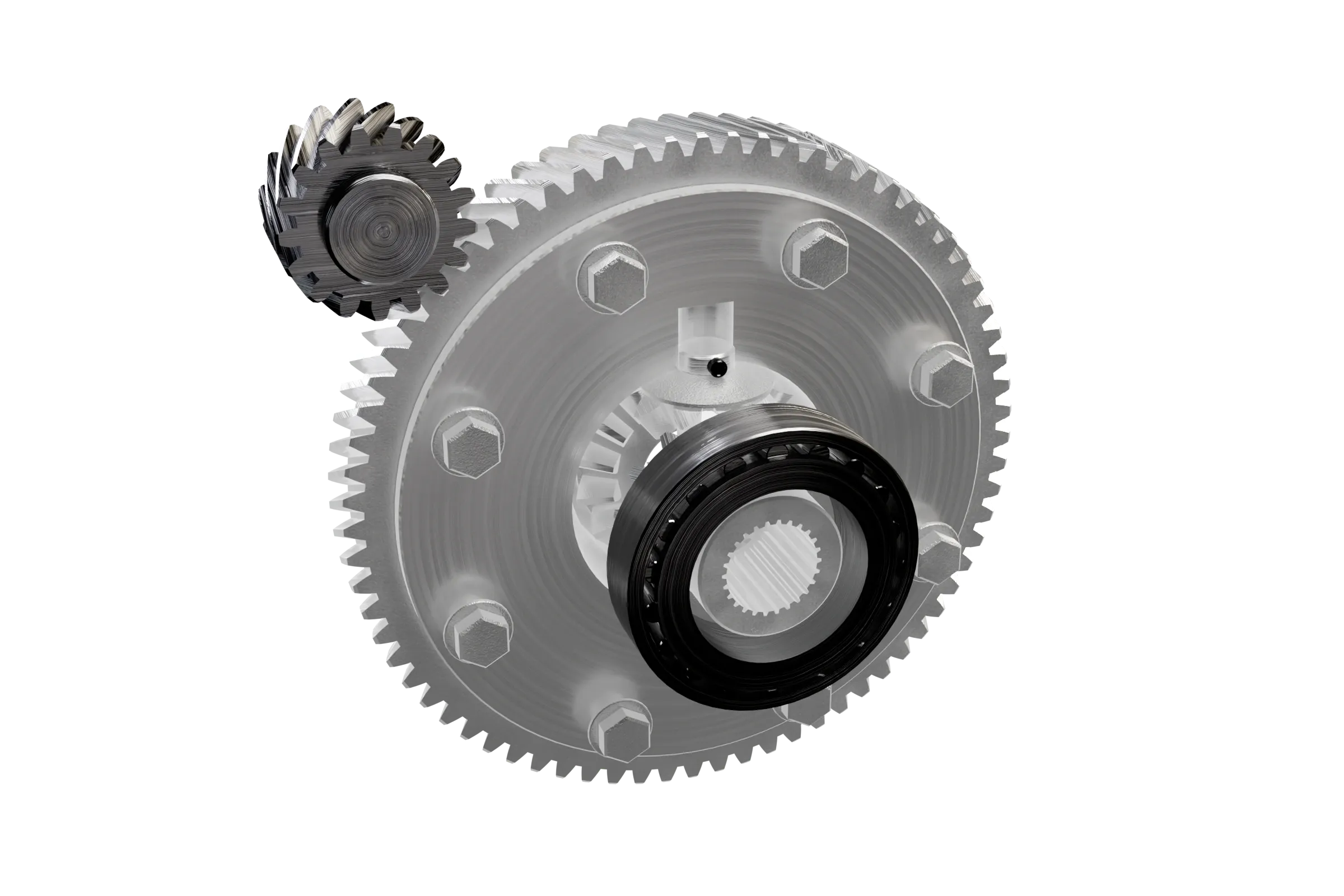
- Ring gear
- Differential case
- Spider gear
- Side gear
At a glance
| Open differential | Limited-slip differential | |
|---|---|---|
| Torque to each wheel | Always equal | Can be unequal: more goes to the slower wheel, the one with grip |
| One wheel on ice | That wheel spins and the other gets almost no drive | Some drive still reaches the wheel with grip, depending on the type |
| In an ordinary corner | The wheels turn at different speeds freely | They still can, against a little resistance |
| Accelerating out of a tight bend | The unloaded inside wheel can spin | Both wheels keep driving, though a front-wheel-drive car's steering can tug |
| Inside the case | Spider gears and side gears | Clutch plates or a fluid coupling added, or special gears in place of the spider gears |
| Usually found on | Most everyday cars | Many performance cars and some four-wheel drives |
Drive round a corner
Interactive- Left wheel
- 167 rpm
- Right wheel
- 167 rpm
- Ring gear and case
- 167 rpm
- Spider gears
- Not turning
- Final-drive pinion (from the gearbox)
- Ring gear
- Differential case
- Spider gears
- Side gears
- Inner CV joint (tripod)
- Outer CV joint (Rzeppa)
- Half-shaft
Why does an open differential lose drive?
Because it splits the torque equally, however differently the wheels are turning. That is what lets them run at their own speeds in a corner, and it is also its weakness: the drive to each wheel can never be more than the wheel with less grip can take. Press “Left wheel on ice” in the diagram above and the car stops: the wheel on the ice spins at 334 rpm, twice the speed of the case, while the wheel with grip stays still. The same happens when a wheel lifts clear over a kerb, or when the inside wheel, lightened by the car’s lean, spins as you accelerate out of a tight bend.
The app’s differential is an open one, like those in most front-wheel-drive cars, with 10-tooth spider gears between 16-tooth side gears. How a CV axle and differential work goes through its gears.
How does a limited-slip differential work?
It adds resistance between the two sides, so one wheel can only run faster than the other by overcoming it. The resistance holds back the faster wheel and passes that torque to the slower one, which is the wheel with grip. Three kinds are common.
A plate type has packs of friction plates, some splined to the case and some to a side gear, squeezed together by springs and by the drive torque itself, so the harder the car accelerates, the more firmly the two sides are tied together.
A geared type, often called a Torsen, replaces the spider gears with worm or helical gears whose friction rises with the torque they carry, so it can send several times as much torque to the wheel with grip as to the other. It is smooth and has no plates to wear, but it multiplies whatever the slipping wheel can take, and a wheel in the air or on sheet ice takes almost nothing. That is why many cars pair it with traction control: braking the spinning wheel gives the differential something to work against.
A viscous type is a sealed coupling of closely spaced plates in a thick silicone fluid, half joined to each side. When one wheel spins faster, the plates shear the fluid, which resists more the bigger the difference. It is smooth and simple but slower to act.
Why do most cars manage without one?
Because an open differential does all an everyday car needs, and traction control covers most of the rest. When a driven wheel spins, the ABS unit brakes it, and because an open differential always sends equal torque to both wheels, the braking effort on the spinning wheel lets the same torque reach the one with grip. Some makers call this an electronic differential lock. It is slower and less smooth than a mechanical limited-slip differential and puts heat into the brakes, but it needs no extra parts. Mechanical ones are fitted where the engine has more torque than the inside wheel can put down out of a slow corner.
Questions people ask
Is traction control the same as a limited-slip differential?
No, though it does a similar thing another way. Traction control brakes a spinning wheel, often while cutting engine power, so the open differential can pass torque to the other wheel. A limited-slip differential does it mechanically, inside the differential, without using the brakes.
What is the difference between a limited-slip and a locking differential?
A limited-slip differential only resists a difference in speed, so the wheels can still turn at their own speeds in a corner. A locking differential, used off road, makes both wheels turn together when it is engaged, which suits low speeds on loose ground but scrubs the tyres on tarmac.
What do 1-way, 1.5-way and 2-way mean?
They describe when a plate-type limited-slip differential locks. A 1-way locks only under acceleration and acts like an open differential when you lift off; a 2-way locks equally under acceleration and on the overrun; a 1.5-way locks fully under acceleration and partly on the overrun.
Does a limited-slip differential wear out?
Plate types do, slowly: the plates wear and the locking fades, though they can be rebuilt, and many judder in tight turns without the right oil or additive. Geared types have little to wear; viscous couplings can lose their effect with age.
