
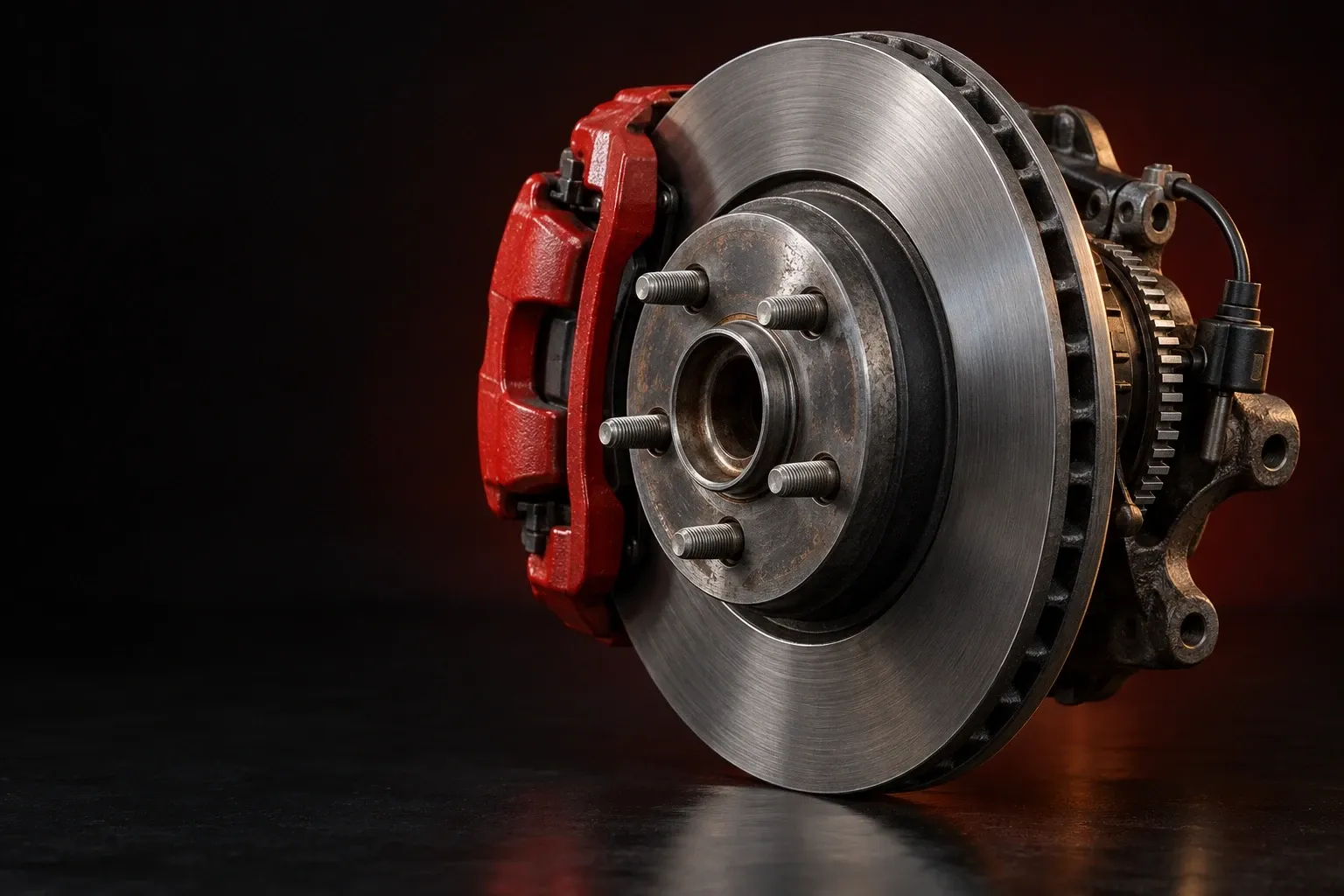
Brakes · Floating disc caliper
How do disc brakes and ABS work?
Pressing the brake pedal pushes fluid to a caliper at each wheel, where a piston squeezes two friction pads against a disc that turns with the wheel. The friction turns the car's movement into heat and slows it down. ABS watches the speed of every wheel and, if one starts to lock, eases the pressure on that wheel for a moment, many times a second, so the tyre keeps gripping and you can still steer.
In 3D Mechanic you run the brake test on a complete front brake corner and read the clamp force and brake torque live, then wear the pads down and strip the corner apart.
Squeeze the brake
Interactive- Clamp force
- 15.3 kN
- Brake torque
- 1,526 N·m
- Force at the tyre
- 4.8 kN
- Brake disc (vented)
- Inner pad
- Outer pad
- Piston
- Caliper housing
- Fluid from the master cylinder
Stop hard from 100 km/h
InteractiveCar speed Wheel speed Brake pressure
- Car speed
- 0 km/h
- Wheel speed
- 0 km/h
- Brake pressure
- 77 bar
- Stopping distance
- 42.9 m
What happens, step by step
-
Your foot pushes the master cylinder
The pedal is a lever, and a brake servo adds to your effort. The master cylinder turns that push into hydraulic pressure in the brake lines.
-
Pressure reaches every caliper
Brake fluid barely compresses, so the pressure arrives at each wheel almost at once. In the app's model every bar of pressure pushes the 57 mm piston with 255.2 N.
-
The pads clamp the disc
The piston pushes the inner pad onto the disc. The caliper housing floats on two guide pins, so the reaction slides it the other way and its fingers pull the outer pad on with the same force.
-
Friction turns speed into heat
The pads rub on both faces of the disc. At 60 bar the model clamps with 15.3 kN and makes 1,526 N·m of brake torque at that wheel.
-
The vanes carry the heat away
The disc is vented: 37 long and 37 short curved vanes between its two faces pump air outwards as it turns, so the brake keeps working on a long descent.
-
Letting go frees the disc
When the pressure drops, the piston's square-section seal springs back and pulls the piston in by about 0.1 mm, so the pads stop dragging.
What does a disc brake actually do?
A moving car carries energy, and the brakes have to get rid of it. They do it with friction: pads rub on a disc that turns with the wheel, and the car’s movement becomes heat in the disc and the pads. One hard stop from motorway speed can warm a front disc by tens of degrees in a few seconds, and repeated stops on a long descent can take it to several hundred, which is why front discs are vented, with cooling vanes between their two faces.
The front brakes do most of the work. As the car slows, its weight shifts forwards onto the front tyres, so they can take more braking force than the rear ones. That is why the front discs are usually larger, and why the rear brakes on many small cars are still drums.
How much force is inside a brake caliper?
More than you might expect. The clamp is simple hydraulics: pressure multiplied by the area of the piston. The app’s caliper has a 57 mm piston with an area of 2,552 mm², so each bar of line pressure pushes it with 255.2 N. At 60 bar, a firm stop, that is 15.3 kN.
The torque that slows the wheel follows from the clamp. Multiply by two, because the disc has two friction faces, then by the pads’ friction coefficient of 0.40 and by the effective radius of 124.6 mm. At 60 bar the model makes 1,526 N·m at that wheel, which is 4.8 kN of braking force where the tyre meets the road. These are the same numbers the app’s brake test reads out.
Why do most cars use a floating caliper?
A floating caliper needs only one piston. It sits on the inboard side of the disc and pushes the inner pad. The housing is mounted on two greased guide pins, so the reaction to that push slides the whole housing inboard, and its fingers pull the outer pad onto the other face with the same force.
It is compact, cheap and works well, as long as the guide pins can slide. When a pin seizes or its rubber boot splits and lets water in, the caliper stops floating, one pad does most of the work, and the brake can drag. Performance cars often use fixed calipers instead, with pistons on both sides of the disc.
How do pads and discs wear?
Both are meant to wear. The model’s pads start with 11 mm of friction material and are replaced at 2 mm. A small spring-steel tab on the inner pad touches the disc at about 2.5 mm and squeals as a warning. As the pads wear, the piston creeps out of its bore, by up to 18 mm here, and has to be pushed back before new pads fit.
The disc wears too. It starts at 26 mm thick and is replaced below 24 mm. If it wears unevenly or runs out of true by more than 0.04 mm, the pads meet a surface that is thicker in some places than others, and you feel it as judder through the pedal and the steering wheel.
How does ABS know a wheel is about to lock?
Each wheel has a toothed tone ring on its hub and a sensor next to it. On the app’s model the ring has 48 teeth and the sensor sits 0.8 mm away. Every tooth that passes makes one pulse, so the frequency of the signal is the wheel’s speed.
The ABS unit compares the wheels with each other and with how fast the car can possibly be slowing. A wheel that slows much faster than that is about to lock: the tyre is starting to slide instead of roll.
What does ABS do when a wheel starts to lock?
A tyre grips best with a little slip, turning slightly slower than the car is moving. Once it locks, the grip falls and the wheel can no longer steer the car. ABS keeps each wheel near that best slip. Its hydraulic unit has valves for every wheel: it can hold the pressure, release some of it back to a pump, and let it build again.
That cycle repeats many times a second while you hold the pedal down, which is the pulsing and buzzing you feel in an emergency stop. Keep pressing hard and steer. In the illustration above, with typical values for a dry road, the car with ABS stops from 100 km/h in about 43 m and keeps steering; with the wheels locked it slides about 53 m.
The parts that make it work
Brake disc US: Rotor
What it does
A 300 mm by 26 mm grey-iron disc that turns with the wheel. The pads squeeze its two faces, and 37 long and 37 short curved vanes between them pump cooling air outwards.
How it fails
It wears thinner and can wear unevenly, which you feel as judder through the pedal and the steering. Replace it below the minimum thickness stamped on it: 24 mm on this model.
Brake pads
What it does
Friction material bonded to a steel backing plate, 11 mm thick when new, one each side of the disc. A slot and chamfered ends cut noise.
How it fails
They wear with use and are replaced at 2 mm of friction. Glazed or contaminated pads grip poorly and can squeal.
Caliper
What it does
A cast-iron housing with a single 57 mm piston. It slides on two guide pins, so one piston can clamp both pads.
How it fails
Seized guide pins or a sticking piston make one pad wear faster, pull the car to one side or let the brake drag and overheat.
Piston and seal
What it does
The chrome-plated piston pushes the inner pad. Its square-section seal flexes as the piston moves and pulls it back about 0.1 mm when you let go.
How it fails
A torn dust boot lets water reach the piston, which corrodes and sticks, so the brake drags.
Caliper bracket US: Caliper carrier
What it does
Bolted to the steering knuckle. The pads sit in its abutments and push their braking force, up to about 10 kN each, straight into it.
How it fails
Rust under the abutment clips makes the pads stick in their slots and rattle.
Brake hose and pipes
What it does
Rigid steel pipes run along the body, and a flexible hose crosses the moving suspension to the caliper.
How it fails
An old hose can swell or crack inside, giving a spongy pedal. Corroded pipes can burst.
ABS sensor and tone ring US: Wheel speed sensor
What it does
A 48-tooth ring on the hub passes an inductive sensor 0.8 mm away. Each tooth makes one pulse, so the ABS unit knows how fast the wheel turns.
How it fails
Dirt, a cracked ring or a damaged cable turns on the ABS and traction control warning lights.
Wheel bearing and hub
What it does
A sealed double-row ball bearing carries the car's weight and the cornering loads while the hub, the disc and the wheel spin on it.
How it fails
A worn bearing hums or growls, louder with speed and changing as you turn.
The numbers
| Quantity | Value |
|---|---|
| Disc size | 300 mm by 26 mm, vented |
| Minimum disc thickness | 24 mm |
| Piston diameter and area | 57 mm, 2,552 mm² |
| Clamp force per bar of pressure | 255.2 N |
| Brake torque per bar | 25.44 N·m |
| At 60 bar | 15.3 kN of clamp, 1,526 N·m of torque (4.8 kN of braking force at that tyre) |
| Pad friction coefficient | 0.40 |
| Effective radius of the pads | 124.6 mm |
| Pad friction material | 11 mm new, replace at 2 mm |
| Running clearance per side | 0.15 mm |
| ABS tone ring | 48 teeth, sensor 0.8 mm away |
| Brake fluid | DOT 4 |
From 3D Mechanic's brake model: a front brake corner for a compact front-wheel-drive car. The stopping distances in the ABS chart are an illustration with typical values. Real brakes vary by make and model.
Common problems and what they mean
| Symptom | Likely cause | What to check |
|---|---|---|
| A high squeal that stops when you brake harder | The pads' wear indicator is touching the disc | Check the pad thickness and replace the pads. |
| Grinding, metal on metal | Pads worn down to their backing plates | Stop driving and have the brakes checked: the discs are probably damaged too. |
| Judder or a pulsing pedal when braking from speed | Uneven disc thickness or runout, often called a warped disc | Have the discs measured. They are replaced in pairs, with new pads. |
| The car pulls to one side under braking | A sticking caliper or seized guide pins on one side, or contaminated pads | Check that both brakes release fully and that the pads wear evenly. |
| A soft or long pedal | Air in the system, old fluid that has absorbed water, or a swelling hose | Bleed the brakes and change the fluid at the interval in the service schedule. |
| The ABS warning light stays on | A faulty wheel speed sensor, a damaged tone ring or a wiring fault | The normal brakes still work but ABS may not; have the fault codes read. |
UK and US names
| UK | US |
|---|---|
| Brake disc | Brake rotor |
| Calliper (also caliper) | Caliper |
| Brake servo | Brake booster |
| Handbrake | Parking brake or emergency brake |
| ABS sensor | Wheel speed sensor |
Questions people ask
How does ABS work, in one sentence?
Sensors watch every wheel's speed, and when one slows much faster than the car can, the ABS unit briefly releases and reapplies the pressure at that wheel, many times a second, so it keeps turning and gripping.
Why does the brake pedal pulse in an emergency stop?
That is ABS working. Each pulse is the hydraulic unit releasing and reapplying pressure at a wheel that had started to lock. Keep pressing hard and steer around the hazard; do not pump the pedal.
Does ABS make a car stop in a shorter distance?
On a dry or wet road it usually stops in a similar or shorter distance than locked wheels, and the big gain is that you can still steer. On loose gravel or fresh snow, locked wheels can stop shorter, so ABS may take longer there.
How often do brake pads need replacing?
When they reach their minimum thickness, not after a fixed mileage, because driving style and roads make a big difference. The model's pads start with 11 mm of friction material and are replaced at 2 mm.
Why are the front brakes bigger than the rear?
Under braking the car's weight shifts forwards, so the front tyres can do most of the stopping. The front brakes are sized for that, and many cars use smaller discs or drums at the rear.
