
Brakes · Floating disc caliper
Why does my steering wheel shake when braking?
A steering wheel that shakes when you brake usually means the front brake discs have worn unevenly, which is often called warped. The pads grip the thick spots harder than the thin ones, so the braking force pulses with every turn of the wheel. A sticking caliper, worn suspension joints and loose wheel nuts can cause it too.
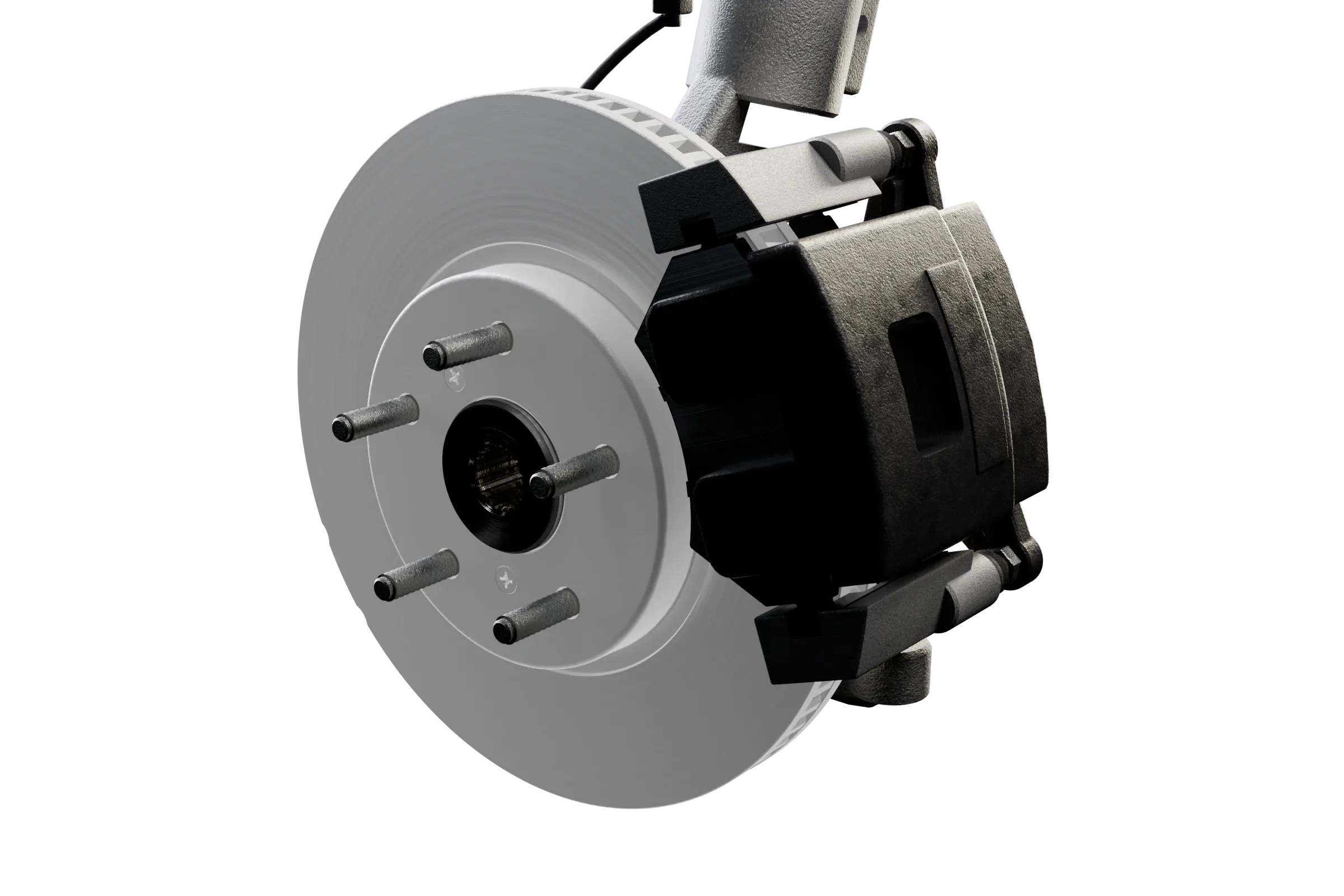
- Brake disc US: Brake rotor
The likely causes, most common first
-
Front discs worn unevenly
Most likelyHow it shows A shake in the wheel and a pulsing pedal when braking from speed, worst in long or hard stops.
Check Have the discs measured for uneven thickness and runout. They are replaced in pairs, with new pads.
Fix it soon
-
A sticking caliper
CommonHow it shows Shaking with a pull to one side, and a hot wheel or a burning smell after a drive.
Check After a short drive, hold a hand near each front wheel without touching it: a much hotter one has a brake that drags.
Have it checked soon
-
Worn control arm bushes
CommonHow it shows A shudder or shimmy as you brake, often with a clunk as the brakes come on or over bumps.
Check Look for cracked or split rubber in the bushes. A garage can watch the arm for movement while the brakes are applied.
Have it checked soon
-
Worn track rod ends or ball joints
Less likelyHow it shows A shimmy through the steering under braking, with vague steering or a knock over bumps.
Check With the wheel off the ground, rock it side to side and top to bottom: any play means a worn joint.
Have it checked soon
-
A worn wheel bearing
Less likelyHow it shows A shake under braking with a hum that rises with road speed.
Check With the wheel raised, rock it top to bottom. Play that goes when a helper presses the brake pedal is in the bearing.
Have it checked soon
-
Loose or unevenly tightened wheel nuts
Less likelyHow it shows A wobble or shake that started soon after the wheels were off, sometimes with a knock.
Check Stop and check the wheel nuts are tight. Nuts tightened unevenly can also distort a disc and start the judder.
Don't drive it
How to narrow it down
- Note when it shakes. Only under braking points to the brakes; at a certain speed with your foot off the brake points to wheel balance or a tyre.
- Feel where it comes through. The steering wheel points to the front; the pedal and the seat alone point more to the rear.
- If the wheels were off recently, check the wheel nuts are tight before anything else.
- Look through the wheels at the discs for blue patches, a deep lip or heavy rust, and at the tyres for bulges.
- A garage can measure the discs and check every steering and suspension joint for play on a lift.
Is it safe to drive if the steering wheel shakes when braking?
Have it checked before you drive far
Usually for a short while, carefully, but have it checked before you drive far. Uneven discs still stop the car, but less smoothly, and the shaking gets worse and wears the steering and suspension joints. If the shaking started soon after the wheels were off, stop and check the wheel nuts. If it comes with a pull to one side, grinding, a burning smell or loose-feeling steering, don't drive on until it is checked.
Do new discs stop the shaking for good?
Only if the cause goes with the old ones. A new disc fitted to a rusty hub face runs out of true from the start, wheel nuts tightened unevenly can distort it, and a caliper that sticks overheats the new disc just as it did the old one. Within a few thousand miles the judder is back. So a garage cleans the hub face, fits new pads with the discs, checks that the calipers slide freely and tightens the wheel nuts evenly, in a star pattern, to the maker’s figure.
Questions people ask
Can bad tyres make the steering wheel shake when braking?
They can add to it. A tyre out of balance, or with a bulge or a flat spot, shakes the wheel at speed whether you brake or not, and braking makes it more obvious. If the shake is there with your foot off the brake, have the wheels balanced and the tyres checked first.
Why does my car only shake when braking at high speed?
Because an uneven disc pulses once with every turn of the wheel, and at speed the pulses come faster and harder, close to the rate at which the steering and suspension shake most easily. At low speed they are slow and gentle enough to feel only in the pedal, if at all.
Will a wheel alignment fix a shaking steering wheel?
Not if it only shakes under braking. Alignment sets the wheel angles, which affect pulling and tyre wear, not brake judder. Worn joints found during the check can be part of the cause, though.
Related
The parts
- What do brake discs do? Brake discs (US: rotors) are the iron discs that turn with the wheels.
- What does a brake caliper do? A brake caliper is the clamp at each disc brake. When you brake, fluid pressure pushes its piston out and the caliper squeezes the two pads against the disc.
- What do control arm bushes do? Control arm bushes (US: bushings) are the rubber mountings where a control arm pivots on the subframe.
- What is a track rod end? A track rod end (US: tie rod end) is the ball joint at the outer end of each track rod, where the steering connects to the front wheel.
- What does a wheel bearing do? A wheel bearing lets the wheel spin freely while carrying the car's weight and the cornering and braking loads.
Similar symptoms
- Why does my car pull to one side when braking? A car that pulls to one side when braking usually has a brake that grips harder on one side than the other.
- What causes a grinding noise when braking? A grinding noise when you brake usually means the brake pads have worn through their friction material, so their steel backing plates are scraping the discs.
- What causes a knocking noise over bumps? A knocking or clunking noise over bumps usually comes from a worn joint in the front suspension.
- What causes a spongy brake pedal? A spongy or soft brake pedal usually means air in the brake fluid, which compresses where fluid does not.
