
Brakes · Floating disc caliper
What does a brake caliper do?
A brake caliper is the clamp at each disc brake. When you brake, fluid pressure pushes its piston out and the caliper squeezes the two pads against the disc. A seized caliper does not slide or release as it should, so the car pulls to one side under braking, or the brake drags and that wheel runs hot.
Also called brake calliper
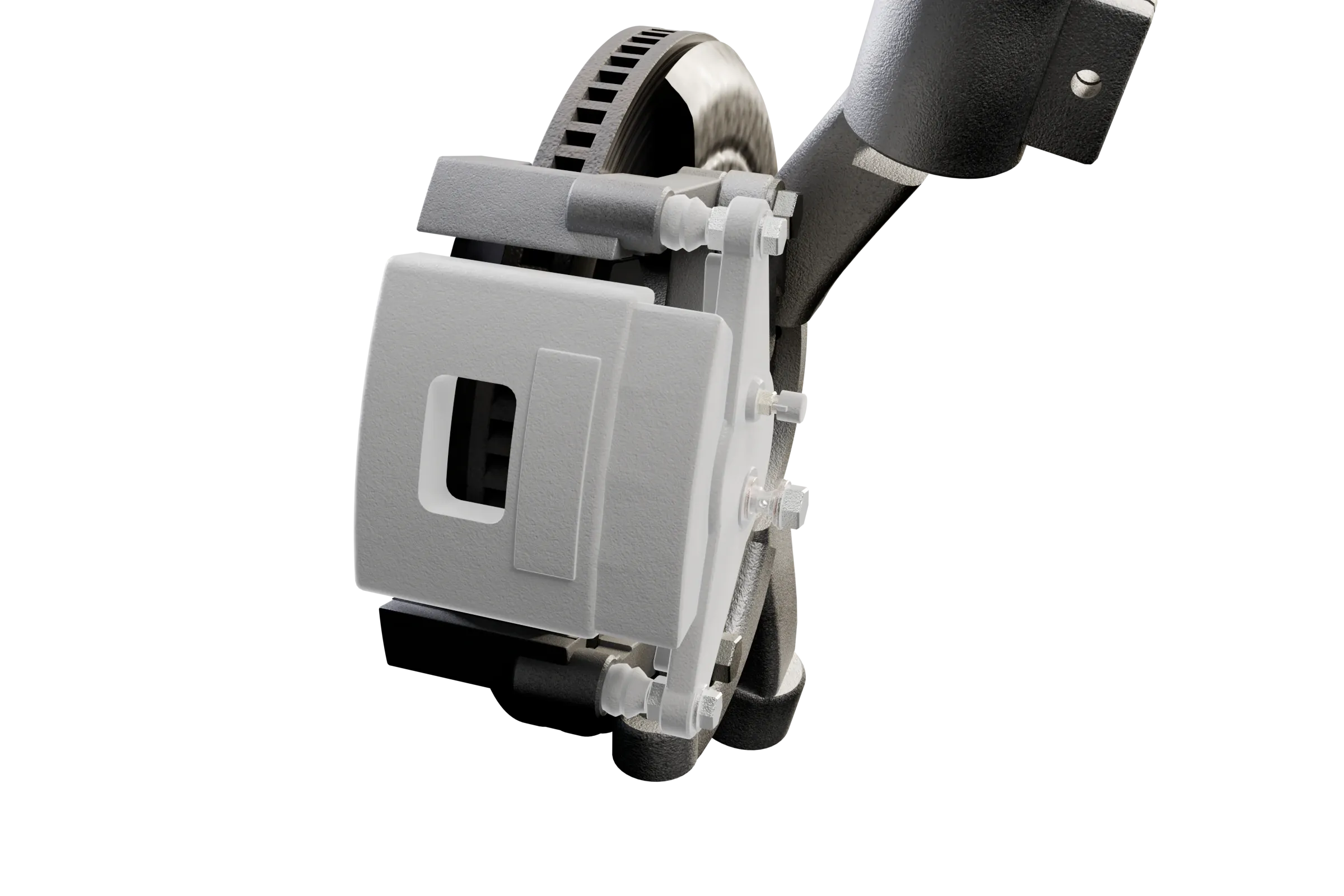
- Caliper housing US: Brake caliper
- Guide pin, upper US: Slide pin, upper
- Caliper bracket
- Brake disc US: Brake rotor
How does a brake caliper work?
Most cars use a floating caliper: a single piston on the inboard side of the disc, in a housing that slides on two greased guide pins so that it can pull the outer pad on as well. Fixed calipers, common on performance cars, have pistons on both sides of the disc and do not need to slide.
Letting go matters as much as clamping. The piston's square-section seal flexes as the piston moves out, and when the pressure drops it springs back and draws the piston in, by about 0.1 mm on the app's model. The housing then settles on its pins, and neither pad drags. A caliper seizes when the piston or the pins can no longer move freely, so it either cannot clamp fully or cannot let go.
What are the symptoms of a seized brake caliper?
- The car pulls to one side. A caliper that cannot clamp fully brakes less than the one opposite; one that will not let go keeps braking its wheel. Why does my car pull to one side when braking?
- One wheel much hotter than the others. After a short drive, hold a hand near each wheel without touching it. A dragging brake makes its wheel far hotter, often with a sharp burning smell.
- The car feels held back. It slows quickly when you lift off and may use more fuel. On level ground with the handbrake off, it may not roll freely.
- One pad worn much more than the other. Seized guide pins stop the housing floating, so one pad does most of the work, or wears to a wedge.
- Shaking under braking. The heat from a dragging brake can leave the disc unevenly worn, so the steering judders when you brake. Why does my steering wheel shake when braking?
- Brake fluid on the inside of the wheel. A leaking piston seal or bleed screw soaks the pads and can let the pedal go soft. Don't drive it.
Can you drive with a seized brake caliper?
Have it checked before you drive far
Only gently, and only as far as a garage. A caliper that sticks on keeps braking its wheel: the disc and pads overheat, braking fades, and the heat can boil the fluid in the caliper. One that sticks off leaves that wheel doing less, so the car pulls in a hard stop and takes longer to pull up. If a wheel is smoking, the smell is strong or the pedal goes soft, stop and have the car recovered.
Why do brake calipers seize?
Mostly from corrosion. Each guide pin slides in a greased bore under a rubber boot. Once the boot splits, water gets in, the grease washes out and the pin rusts in its bore, so the housing stops floating. The piston has a dust boot of its own, and if that tears, its chrome corrodes and it sticks in the bore. Old fluid that has absorbed water corrodes it from the inside as well.
Cars that stand for weeks, especially through a wet winter, are most at risk, and so are pins that are never cleaned and greased when the pads are changed. A brake can also drag with a healthy caliper: a flexible hose that has collapsed inside can hold pressure on it like a one-way valve.
Can a seized caliper be freed?
Seized guide pins often can. They are pulled out and cleaned, their bores are cleaned out, and they go back with fresh brake grease and new boots. A seized or pitted piston is a different matter: the caliper is usually replaced with a new or reconditioned one, or rebuilt with a new piston and seals if the bore is still smooth.
What does replacing a brake caliper involve?
- Raise the car safely onto an axle stand and take the wheel off.
- Undo the brake hose at the caliper, often a banjo bolt with a copper washer each side, and cap the hose's end so little fluid runs out. Keep the fluid off the paint.
- Take out the guide pin bolts and lift the caliper off the pads, then check the pads, the disc and the bracket while it is off.
- Fit the new caliper over the pads with its guide pin bolts, and reconnect the hose with new copper sealing washers.
- Bleed that caliper until the fluid runs clear with no bubbles, keeping the reservoir topped up above MIN.
- Refit the wheel, lower the car and pump the pedal until it is firm, then check for leaks before a careful test drive.
Tighten every nut and bolt to the figure in the maker's manual for your car.
Calipers do not have to be replaced in pairs, but many garages fit both on an axle so the brakes feel the same each side. Freeing and greasing seized guide pins, with new pads, is often enough on its own.
Questions people ask
How do you know if the caliper slide pins are seized?
With the caliper's bolts out, each guide pin, also called a slide pin, should slide in and out of its bore by hand, smoothly and with only light resistance. A pin that will not move, or moves only with pliers, is seized. A split pin boot and uneven pad wear usually point to it first.
What is the difference between a floating and a fixed caliper?
A floating caliper has its piston on the inboard side only and slides on guide pins to pull the outer pad on. A fixed caliper is bolted rigidly in place, with pistons on both sides of the disc. Fixed calipers clamp more evenly and suit big brakes; floating ones are more compact and simpler to make.
What does a sticking caliper smell like?
A sharp, acrid smell of hot brakes, a little like burning carpet, from one wheel after a drive. It is the pads and disc overheating. Some smell after a long, steep descent is normal; from one wheel after a level drive it is not.
Is it calliper or caliper?
Both are right. Calliper is the traditional British spelling and caliper the American one. For the brake part, caliper is the more common spelling in parts catalogues on both sides of the Atlantic.
Related
Symptoms
- Why does my car pull to one side when braking? A car that pulls to one side when braking usually has a brake that grips harder on one side than the other.
- Why does my steering wheel shake when braking? A steering wheel that shakes when you brake usually means the front brake discs have worn unevenly, which is often called warped.
Parts nearby
- What do brake pads do? Brake pads are the friction blocks the caliper squeezes against the brake disc, turning the car's movement into heat to slow it down.
- What do brake discs do? Brake discs (US: rotors) are the iron discs that turn with the wheels.
- What does brake fluid do? Brake fluid carries the push from the brake pedal to the calipers.
- What does a wheel bearing do? A wheel bearing lets the wheel spin freely while carrying the car's weight and the cornering and braking loads.
Explained
- Disc vs drum brakes: what's the difference? A disc brake squeezes pads against a disc that turns with the wheel; a drum brake pushes curved shoes outwards against the inside of a drum.
The whole system
- How do disc brakes and ABS work? The disc brakes and ABS, part by part, with an interactive diagram.
