
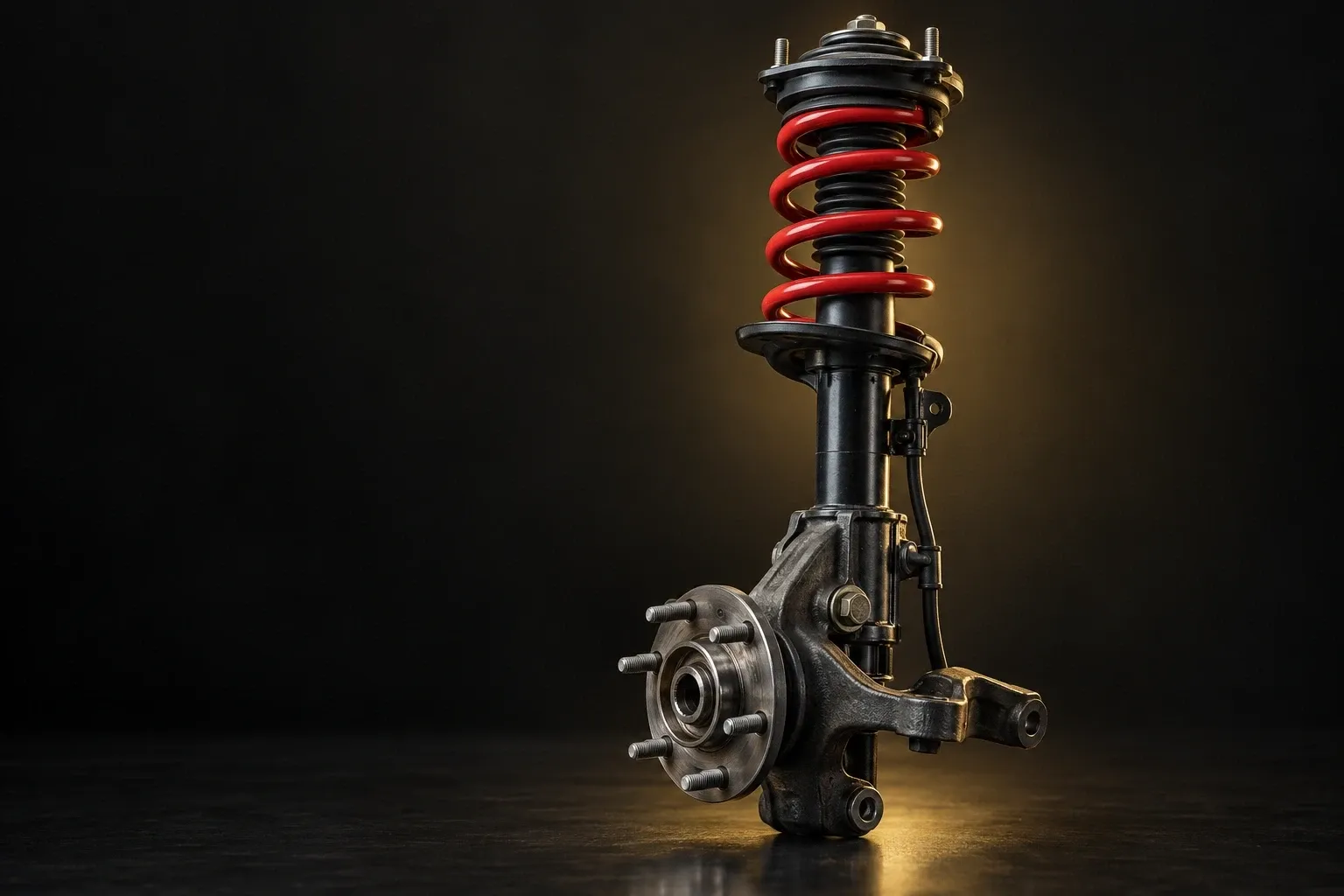
Suspension · MacPherson strut
How does a MacPherson strut work?
A MacPherson strut is a suspension design in which one unit, a coil spring wrapped around a damper, locates the top of the wheel and carries the car's weight. The bottom of the wheel is held by a single lower control arm on a ball joint. When you steer, the whole strut turns on a bearing in its top mount, so the strut is also the upper half of the steering axis.
In 3D Mechanic you can run the bump test on a complete strut corner, explode it into its parts and rebuild it in workshop order.
Run the bump test
InteractiveMacPherson strut (this model) Double wishbone, for comparison
- Wheel travel
- 0 mm
- Camber change
- 0.00°
- Strut compression
- 0 mm
- Strut top mount (fixed to the body)
- Coil spring
- Damper (strut tube)
- Steering knuckle
- Lower control arm
- Lower ball joint
What happens, step by step
-
The tyre meets a bump
The wheel is pushed upwards. The knuckle, the hub and the strut tube rise together, because the strut tube is clamped to the knuckle.
-
The lower arm swings
The lower control arm pivots on two bushes in the subframe, so the bottom of the knuckle follows an arc on its ball joint.
-
The spring compresses
The coil spring between the perch on the strut tube and the top mount shortens and stores the energy of the bump. It also carries the car's weight, so its length sets the ride height.
-
The damper controls it
Inside the tube a piston forces oil through small valves, turning the spring's movement into heat so the car settles after one movement instead of bouncing.
-
The wheel leans a little
The knuckle is guided by a pivot at the bottom and a slide at the top, so the wheel tilts slightly as it rises. In the app's model it gains −0.8° of camber at 80 mm of bump.
-
Steering turns the whole strut
The steering axis runs from the lower ball joint to the top mount. When you steer, the knuckle, the spring and the damper all turn together on the bearing at the top.
Where is the MacPherson strut on a car?
At the front of most small and medium cars. Earle S. MacPherson developed the design in the 1940s, and it reached production on the 1951 Ford Consul and Zephyr, built in Britain. It spread because it does a lot with very little: one strut and one lower arm per wheel, with nothing above the wheel but the strut itself. That leaves room in the engine bay for a sideways engine and the driveshafts, which suits front-wheel-drive cars perfectly.
What does the strut actually hold up?
The car. The coil spring sits on a perch welded to the strut tube and pushes up against the top mount, which is bolted into the reinforced strut tower in the body. So the weight of that corner of the car rests on the spring, and the spring’s length sets the ride height.
The strut does a second job that a plain shock absorber does not. The tube is clamped to the steering knuckle, so it locates the top of the wheel and takes the bending loads from the tyre in braking and cornering. That is why the piston rod in a strut is far thicker than the rod in a shock absorber, and why a worn strut is replaced as a unit.
Why does the wheel lean as it moves?
Because its top and bottom are guided differently. The bottom of the knuckle swings on an arc at the end of the lower arm, while the top slides along the strut’s own axis. As the wheel rises, the two don’t move in step, and the wheel tilts.
That tilt is camber change, and the chart in the diagram above plots it. In the app’s model the wheel gains −0.6° at 40 mm of bump and −0.8° at 80 mm, and leans out by +1.9° at 80 mm of droop. A small negative gain in bump helps a little in corners, where the outer wheel rises as the body rolls. A double wishbone can gain much more, which is the main reason performance cars use them.
Why does the whole strut turn when you steer?
Because it is the steering axis, or rather, the axis runs through it. The car steers about a line from the lower ball joint up through the centre of the top mount. In the app’s model that line leans in by 12.5° seen from the front, the steering axis inclination, and back by 4° seen from the side, the caster angle. Both help the steering return to the centre on its own.
When you turn the wheel, the knuckle, the spring and the damper all rotate together on a thrust bearing in the top mount. A dry or broken bearing is felt straight away as a crunch or a notch in the steering.
What does the anti-roll bar do?
It links the left and right wheels through a bar that works as a torsion spring. When both wheels rise together over a bump, the bar just rotates in its bushes and does nothing. In a corner, when the outer wheel rises and the inner one drops, the bar twists and resists, which reduces body roll without making the ride any harder in a straight line. Short drop links connect the bar to the struts, and their small ball joints are the usual source of a light knock over broken surfaces.
The parts that make it work
Strut and damper US: Strut
What it does
The tube holds the damper's oil and valves. It is also a structural link that locates the top of the knuckle, which is why a strut's piston rod is much thicker than a plain shock absorber's.
How it fails
Leaking oil, a car that keeps bouncing after bumps, nose-diving under braking and patchy, scalloped tyre wear.
Coil spring
What it does
Carries the corner's weight and sets the ride height. Its ends are ground flat to sit squarely, and its slight barrel shape cuts the side load on the damper.
How it fails
Springs corrode and can snap, usually near a bottom coil: a clunk, a corner that sits low and sometimes a damaged tyre.
Top mount and bearing US: Strut mount
What it does
The strut's upper pivot, bolted into the strut tower. Its rubber isolates road noise, and its bearing lets the whole strut turn when you steer.
How it fails
Perished rubber knocks over bumps; a dry bearing makes the steering crunch or stick slightly off centre.
Lower control arm US: Lower control arm (A-arm)
What it does
Holds the bottom of the wheel in place through two bushes: a stiff one for cornering loads and a softer one that lets the wheel move back slightly over sharp bumps, which helps the ride.
How it fails
Worn bushes cause clunks, vague steering and uneven tyre wear, and the car may pull under braking.
Lower ball joint
What it does
A sealed ball-and-socket joint that lets the knuckle steer and move up and down while carrying the wheel's load. It is the bottom end of the steering axis.
How it fails
A worn joint knocks and lets the car wander. A joint that fails can let the wheel collapse, so it is checked at every MOT and safety inspection.
Steering knuckle US: Knuckle (spindle)
What it does
The upright that carries the wheel bearing and the brake. It clamps to the strut, pivots on the ball joint and is turned by the tie rod.
How it fails
It rarely wears, but a hard kerb strike can bend it and throw out the alignment.
Anti-roll bar and drop links US: Sway bar and sway bar links
What it does
A torsion bar joining the left and right wheels. It does nothing when both rise together, but twists in corners to reduce body roll.
How it fails
Worn drop links are the usual source of a light knock over broken roads. The bar's rubber bushes can creak.
Bump stop and dust boot US: Jounce bumper and dust boot
What it does
The bump stop catches the last part of the travel in a big bump. The boot keeps grit off the chromed rod.
How it fails
A split boot lets dirt score the rod, which cuts the seal, and the damper starts to leak.
Tie rod end
What it does
The outer steering joint that pushes and pulls the knuckle. Screwing it along its thread is how front toe is set.
How it fails
Play in the joint makes the steering vague and wears the edges of the tyres.
The numbers
| Quantity | Value |
|---|---|
| Steering axis inclination | 12.5° |
| Caster angle | 4° |
| Camber change at 40 mm of bump | −0.6° |
| Camber change at 80 mm of bump | −0.8° |
| Camber change at 80 mm of droop | +1.9° |
| Strut compression at 80 mm of bump | 79 mm |
| Lower arm length, front view | 330 mm |
| Tyre | 225/45 R17, load index 94 (up to 670 kg per tyre) |
| Wheel | 17x7.5J ET45 |
From 3D Mechanic's MacPherson strut model: the front left corner of a compact front-wheel-drive car. The camber figures are worked out from the model's own pivot points.
Common problems and what they mean
| Symptom | Likely cause | What to check |
|---|---|---|
| A knock or clunk over bumps | Worn drop links, a worn top mount or a worn lower ball joint | Check the drop links first: they are the most common cause and the cheapest fix. |
| The car keeps bouncing after a bump | A worn damper | Push hard on the corner and let go: it should rise and settle, not bob. |
| Crunching or stiffness when turning the wheel slowly | A dry or broken bearing in the strut top mount | Have the top mounts inspected. |
| One corner sits lower than the others | A broken coil spring, often a snapped bottom coil | Look at the bottom of the spring. Springs are replaced in pairs. |
| Oil on the strut tube | A leaking damper seal, often after grit scored the rod | Replace the strut, and a split dust boot with it. |
| Uneven or feathered tyre wear | Worn bushes or ball joints, or alignment knocked out by a kerb | Check for play in the joints, then have the alignment checked. |
UK and US names
| UK | US |
|---|---|
| Anti-roll bar | Sway bar (stabilizer bar) |
| Drop link | Sway bar link (end link) |
| Track control arm | Lower control arm |
| Shock absorber | Shock |
| Tyre | Tire |
Questions people ask
What is the difference between a strut and a shock absorber?
A shock absorber only damps movement. A strut is a damper that is also part of the suspension's structure: it carries the spring, locates the top of the wheel and takes bending loads, and at the front of most cars it turns with the steering.
Why do so many cars use MacPherson struts?
They are compact, light and cheap, with few parts. One strut and one lower arm do the job of two arms plus a separate spring and damper, which leaves room for a sideways engine and the driveshafts.
What is the downside of a MacPherson strut?
Less control over camber. As the wheel rises the strut lets it lean in less than a double wishbone would, so in hard corners the tyre does not stay as flat on the road.
How do I know if my struts are worn?
Bouncing after bumps, nose-diving under braking, a knock from the top, oil on the strut tube or patchy tyre wear. Garages check them at every service.
What does the bump test in 3D Mechanic show?
It pushes the wheel up through its travel while the spring compresses and the damper strokes, so you can watch the lower arm swing and the camber change as the strut leans.
