
Drivetrain · CV axle and differential
What does a CV joint do?
A CV (constant velocity) joint lets a driveshaft turn a wheel through an angle without the speed pulsing. On a front-wheel-drive car each driveshaft has two: an outer joint at the wheel, which bends as you steer, and an inner joint at the gearbox, which also slides as the suspension moves. A worn outer joint clicks on full lock.
Also called constant velocity joint
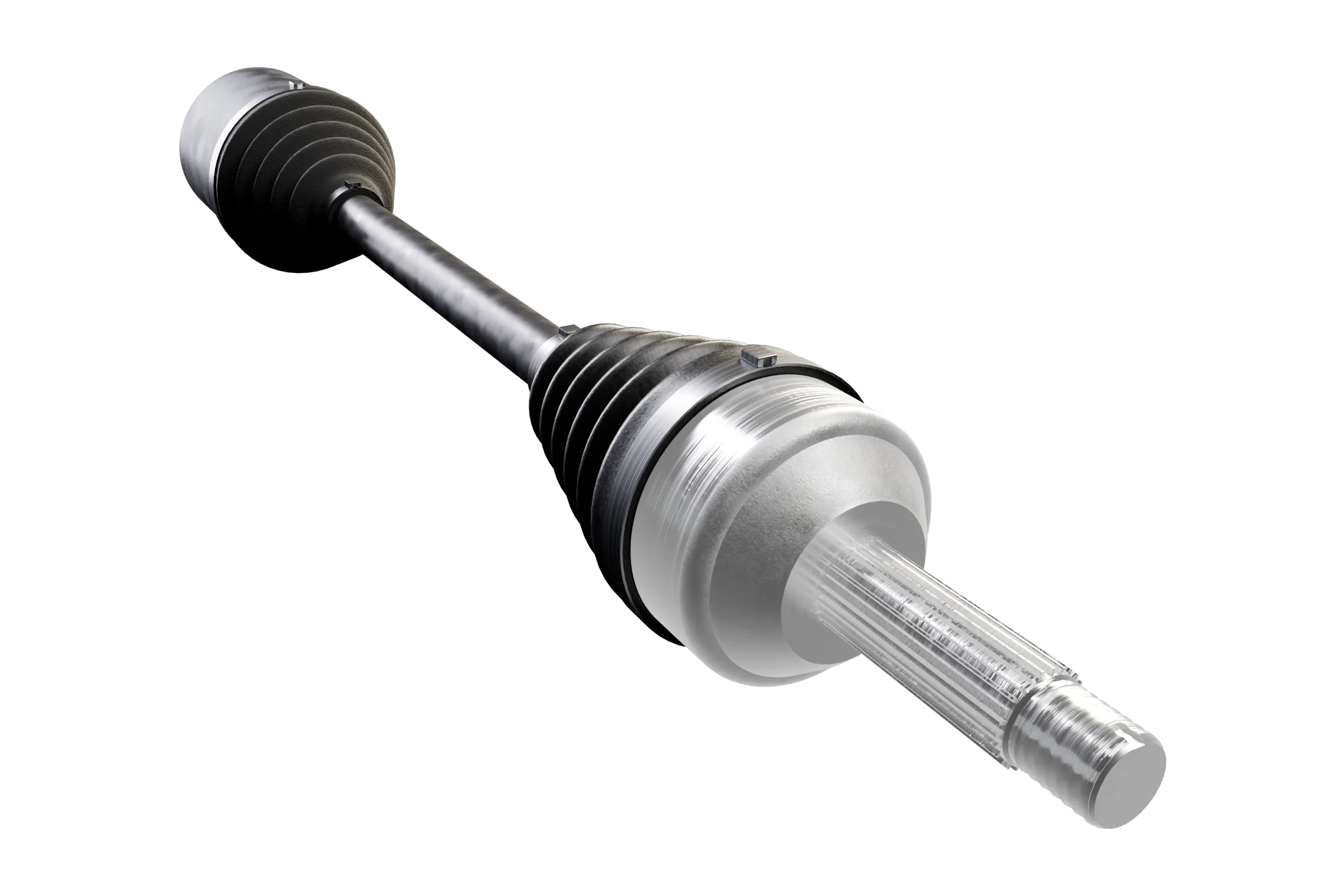
- Outer CV joint housing
- Outer CV boot
- Driveshaft US: Half-shaft
- Tripod housing
How does a CV joint work?
A front wheel steers through big angles and rides up and down, while the driveshaft that turns it comes from a gearbox fixed to the engine. A simple universal joint at those angles would speed the wheel up and slow it down twice every turn, so it would surge as you steered. A constant velocity joint turns the wheel at exactly the shaft's speed at any angle it is built for.
The outer joint in the app's model is a Rzeppa joint: six hardened balls run in curved tracks between a bell-shaped outer race and an inner race on the shaft, and a cage keeps them in one plane, so the joint can bend up to 46° for the steering. The inner joint is a tripod: three rollers on a spider run in three straight tracks, letting the shaft lengthen and shorten by up to 15 mm each way as the wheel rises and falls.
What are the symptoms of a bad CV joint?
- Clicking on full lock. A rapid click or crack from the front as you pull away or drive slowly with the steering turned hard, often louder in one direction. The outer joint is the usual cause. Why does my car click when turning?
- Grease on the inside of the wheel. Grease flung over the wheel's inner rim and the suspension means a boot has split, and the joint behind it is usually the next thing to wear.
- Shudder under hard acceleration. A vibration as you accelerate hard in a straight line, fading when you lift off, points to a worn inner tripod joint.
- A clunk as drive is taken up. A badly worn joint can clunk as you pull away or come off the throttle, though worn splines and engine mounts sound much the same.
Is it safe to drive with a bad CV joint?
Have it checked before you drive far
For a short distance, gently, but have it checked soon. A joint that has only just started to click can last a while, but the wear speeds up once it starts. If it breaks up, that wheel loses its drive, and with an open differential the other wheel then gets none either, so the car stops where it is. A click that has become a loud crack or a clunk, or a new vibration, means have it seen before you drive any further.
Inner or outer: which CV joint is worn?
The kind of noise tells you. A click that comes only with the steering turned is the outer joint, which takes the steering angle. A shudder under hard acceleration in a straight line, fading as you lift off, is the inner tripod joint: at an angle its centre orbits slightly, 1.2 mm at its full angle in the app’s model, three times every turn, and wear turns that into a vibration you can feel.
Outer joints wear out far more often. They work at much bigger angles, and their boots flex every time you steer, so those are the boots that split first. A split outer boot with grease round the wheel usually means a clicking joint before long, which is why the CV boot is worth replacing the moment you find it torn.
What does replacing a CV joint involve?
- With the car on its wheels, free the staked collar of the axle nut, break the nut loose and loosen the wheel nuts.
- Raise the car onto an axle stand, remove the wheel and the axle nut, split the lower ball joint and pull the hub off the joint's splines, supporting the driveshaft so it never hangs on its inner joint.
- For a new outer joint, cut off the boot clamps and knock the old joint off the shaft end, then fit the new boot, circlip and joint with the grease that comes with it.
- For a complete driveshaft, lever the inner joint out of the gearbox over a drip tray and fit a new oil seal before the new shaft clicks in.
- Refit the hub and the ball joint with a new axle nut, refit the wheel and lower the car.
- With the weight on the wheel, tighten and stake the axle nut, top up the gearbox oil if the inner joint came out, and test drive on full lock both ways.
Tighten every nut and bolt to the figure in the maker's manual for your car.
Many garages fit a complete new driveshaft rather than a single joint: it saves time and brings new boots and a new inner joint too.
Questions people ask
How long do CV joints last?
Often the life of the car, as long as their boots stay intact. Most joints that fail do so because a split boot let the grease out and the grit in, not because they wore out in clean grease.
Is a CV joint the same as a CV axle?
No. The CV axle, called a driveshaft in the UK, is the whole shaft with a joint at each end: on most front-wheel-drive cars a Rzeppa ball joint at the wheel and a tripod joint at the gearbox.
Do rear-wheel-drive cars have CV joints?
Many do. With independent rear suspension, a driveshaft runs from the differential to each rear wheel with a CV joint at each end, and some propshafts use one too. A rigid rear axle needs none at the wheels, and its propshaft usually has universal joints.
Is a worn CV joint an MOT failure?
It can be. A transmission joint that is excessively worn is a major defect, and so is a boot that is split or missing and no longer keeps out dirt. A boot that is only badly perished is a minor defect, which passes but is recorded.
Related
Symptoms
- Why does my car click when turning? A clicking noise when you turn, loudest on full lock as you pull away, is usually a worn outer CV joint on a front driveshaft, most often after its boot has split.
Parts nearby
- What does a CV boot do? A CV boot is the rubber or thermoplastic bellows over each CV joint on a driveshaft.
- What does a wheel bearing do? A wheel bearing lets the wheel spin freely while carrying the car's weight and the cornering and braking loads.
Explained
- Open vs limited-slip differential: what's the difference? An open differential always sends the same torque to both driven wheels, so if one wheel loses grip, the drive to both falls to what that wheel can take.
The whole system
- How do a CV axle and a differential work? The CV axle and differential, part by part, with an interactive diagram.
