
Drivetrain · CV axle and differential
Why does my car click when turning?
A clicking noise when you turn, loudest on full lock as you pull away, is usually a worn outer CV joint on a front driveshaft, most often after its boot has split. A worn strut top mount, a worn ball joint or track rod end, and a stone or loose part rubbing can also click.
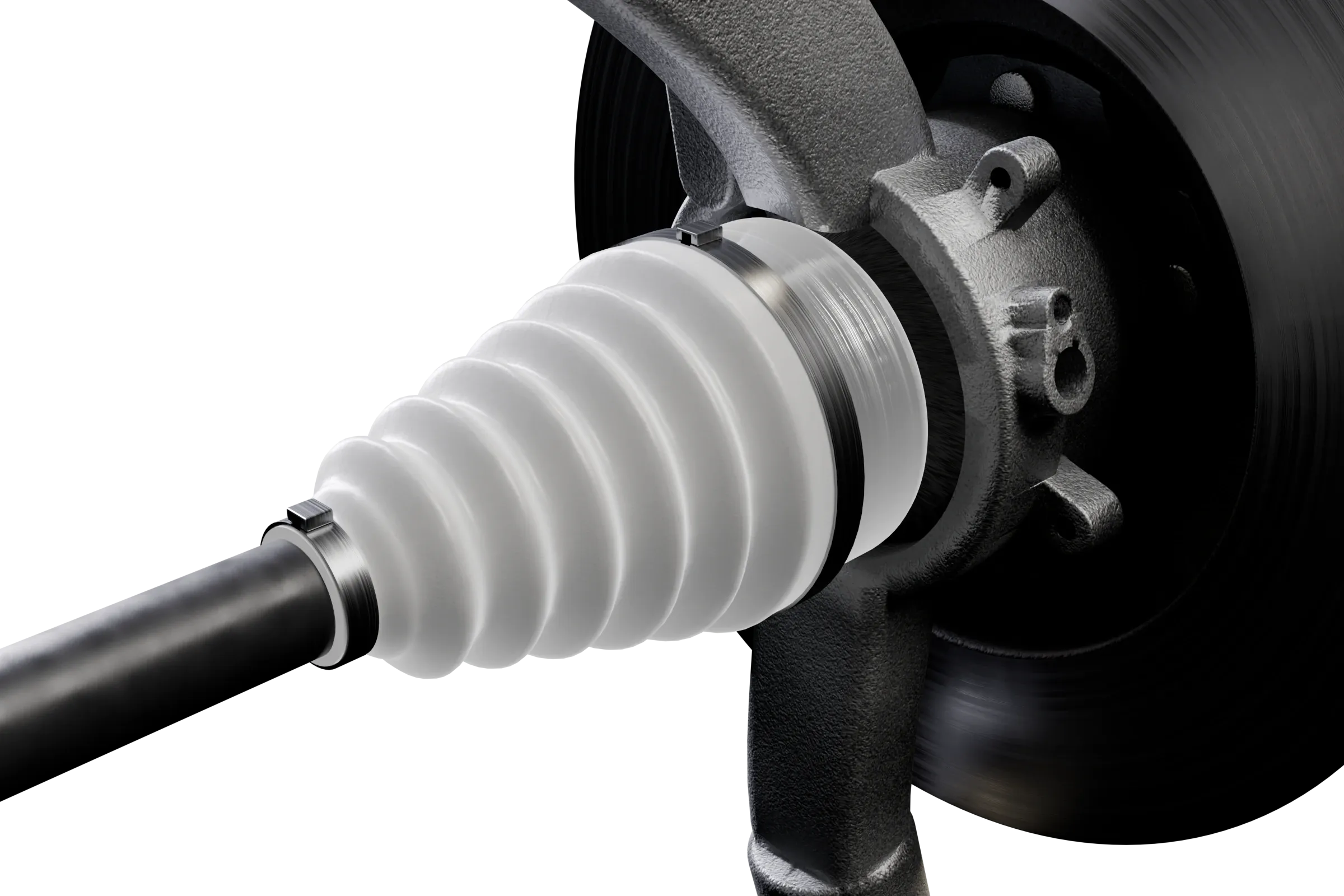
- Outer CV joint housing
- Outer CV boot
The likely causes, most common first
-
A worn outer CV joint
Most likelyHow it shows A rapid click or crack from the front as you pull away or drive slowly on full lock, quickening with speed and often louder in one direction.
Check Drive slow circles on full lock each way with the window down, then look for a split boot and grease flung round the inside of the wheel.
Have it checked soon
-
How it shows A click, creak or clunk from the top of the strut as you turn the steering, even when barely moving, often over bumps too.
Check With the car on its wheels, have a helper turn the steering from lock to lock while you feel and listen at the top of the strut.
Have it checked soon
-
Something rubbing or caught
CommonHow it shows A light, regular tick or scrape that may come and go: a stone behind the brake disc, a bent dust shield touching the disc, or a liner touching the tyre on full lock.
Check Look behind each front wheel at full lock for a stone, a bent shield or rubbing marks on the liner.
Fix it soon
-
A worn ball joint
Less likelyHow it shows A creak or click low down at the wheel when turning at low speed, sometimes with a knock over bumps and vague steering.
Check With the wheel off the ground, rock it top to bottom: movement at the ball joint means it is worn.
Have it checked soon
-
A worn track rod end
Less likelyHow it shows A knock or click through the steering when turning at low speed, with a little free play at the steering wheel.
Check With the wheel off the ground, rock it side to side: play at the track rod end means it is worn.
Have it checked soon
-
A loose wheel or axle nut
Less likelyHow it shows A click or clunk from one wheel, usually soon after the wheels or a driveshaft have been off.
Check Stop and check the wheel nuts before you drive any further, and have the axle nut checked.
Don't drive it
How to narrow it down
- Find an empty car park. With the window down, drive slow circles on full lock to the left, then to the right, pulling away firmly each time.
- A rapid click that keeps time with the wheels and quickens as you speed up is a CV joint. A single click, creak or clunk as you turn the steering, even when barely moving, points to a top mount or a ball joint.
- With the steering on full lock, look at the outer CV boots for splits and at the inside of the wheels for flung grease.
- Check the wheel nuts are tight, and look behind the wheels for a stone, a bent dust shield or a liner rubbing the tyre.
- With the car safely raised, a garage can check the driveshaft joints, ball joints and track rod ends for play in a few minutes.
Is it safe to drive with a clicking noise when turning?
Have it checked before you drive far
For a short while, if it is a CV joint that has only just started clicking, but have it checked soon: the wear speeds up, and a joint that breaks up leaves the car without drive. A click from a top mount needs checking too, and a ball joint or track rod end with play is a steering fault that needs fixing before you drive far. If the click started soon after the wheels were off, check the wheel nuts before you drive any further.
Why does a CV joint only click when turning?
Because that is when it works at an angle. Driving straight, the outer joint runs nearly straight and its balls hardly move in their tracks. On full lock it bends towards its limit, up to 46° in the app’s model, and each ball rolls to and fro along its track once every turn of the wheel. Where wear has opened up play in the tracks, the balls knock as the load comes onto them, so the clicks keep time with the wheel and are loudest when you pull away hard on full lock.
The usual start of it is a split CV boot. Grease flies out, water and grit get in, and the polished tracks are pitted within weeks. A boot found split before the clicking starts can be replaced on its own; once the joint clicks, it needs a new CV joint or a complete driveshaft.
Which side is the clicking joint on?
The direction of the turn does not reliably tell you, so test both ways and then look. A helper standing outside the car as you drive slow circles can usually place the click at once. Otherwise the boots usually show it: the split one marks the joint that is wearing. Both outer joints have done the same miles, so look closely at the other side while you are there.
Questions people ask
Can a CV joint click when driving straight?
Rarely, unless it is badly worn. A worn outer joint clicks at an angle. A clunk as you take up drive or lift off in a straight line is more often a worn inner joint, worn splines or worn engine mounts.
Why does my steering wheel click when I turn it?
If the click comes from inside the steering wheel, even with the car standing still, it is usually the clock spring: the coiled ribbon that carries the airbag and button wiring round as the wheel turns. A failing one often lights the airbag warning lamp, and it needs replacing.
Does a clicking noise when turning mean the CV axle needs replacing?
Usually the outer joint does, and many garages fit a complete driveshaft rather than a joint alone, because it saves time and brings new boots and an inner joint. A joint kit on the old shaft is the other way to do it.
Can low power steering fluid cause clicking when turning?
Not usually clicking. Low fluid in a hydraulic system makes the pump whine or groan, loudest on full lock, and electric power steering has no fluid at all. A click is almost always mechanical.
Related
The parts
- What does a CV joint do? A CV (constant velocity) joint lets a driveshaft turn a wheel through an angle without the speed pulsing.
- What is a strut top mount? A strut top mount (US: strut mount) is the rubber-bonded mounting that bolts the top of a MacPherson strut into the car's body and carries that corner's weight.
- What does a ball joint do? A ball joint is the ball-and-socket joint that connects a suspension arm to the wheel's steering knuckle.
- What is a track rod end? A track rod end (US: tie rod end) is the ball joint at the outer end of each track rod, where the steering connects to the front wheel.
Similar symptoms
- What causes a knocking noise over bumps? A knocking or clunking noise over bumps usually comes from a worn joint in the front suspension.
- Why is my car humming when I drive? A humming noise that rises with road speed is usually a worn wheel bearing, especially if it changes as you go round a bend.
- What causes a grinding noise when braking? A grinding noise when you brake usually means the brake pads have worn through their friction material, so their steel backing plates are scraping the discs.
- What causes uneven tyre wear? Uneven tyre wear usually means the wheel alignment is out, the tyre pressures are wrong or a suspension part is worn, and the pattern points to which.
