
Brakes · Floating disc caliper
Why is my car humming when I drive?
A humming noise that rises with road speed is usually a worn wheel bearing, especially if it changes as you go round a bend. Next most likely are the tyres: unevenly worn or feathered tyres, and some tread patterns, hum or drone. Less often it is a worn differential or gearbox bearing, and occasionally a worn CV joint.
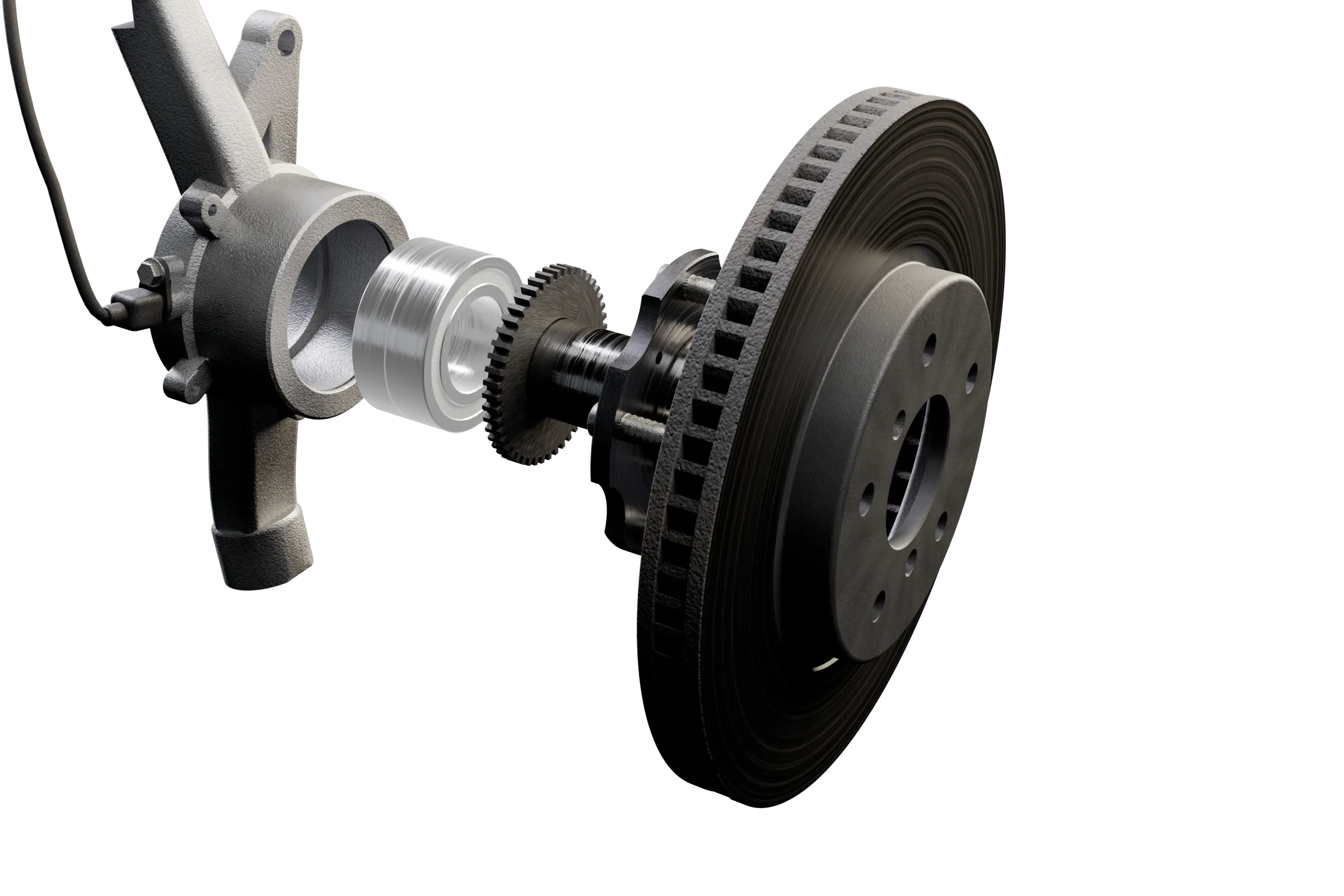
- Wheel bearing
The likely causes, most common first
-
A worn wheel bearing
Most likelyHow it shows A hum or growl that rises with road speed, not engine speed, and grows or fades as you steer or take a bend.
Check With the car safely raised, spin the wheel by hand and feel for roughness, then rock it top to bottom for play.
Have it checked soon
-
Tyre noise from uneven wear or the tread pattern
CommonHow it shows A hum or drone that changes with the road surface more than with steering, from tyres worn into feathered edges or cupped patches, or a new set with a chunkier pattern.
Check Run a flat hand across the tread both ways: a saw-tooth feel is feathering. Look round each tyre for scalloped patches.
Fix it soon
-
Worn differential bearings or final-drive gears
Less likelyHow it shows A hum, whine or rumble from between the driven wheels that rises with road speed and changes between accelerating and lifting off.
Check Have the gearbox oil checked: on most front-wheel-drive cars the differential shares it.
Have it checked soon
-
Worn gearbox (transmission) bearings
Less likelyHow it shows A whine that rises with road speed and may be louder in one gear. A worn input shaft bearing rumbles in neutral and goes quiet when you press the clutch.
Check Listen in each gear at the same road speed, then in neutral at idle with the clutch pedal up and then pressed.
Have it checked soon
-
A worn CV joint
Less likelyHow it shows More often a click on full lock or a shudder when accelerating hard than a hum, but a dry, worn joint can growl under load.
Check Look at the CV boots for splits and for grease flung round the inside of the wheel.
Fix it soon
How to narrow it down
- Work out what the hum follows. If it changes with road speed in every gear, it is in the wheels, tyres or drivetrain; if it rises when you rev the engine with the car standing still, look at the belt-driven accessories or the exhaust.
- Drive over smooth and coarse surfaces at the same speed. Tyre noise changes clearly with the surface; a bearing hum changes much less.
- Weave gently on a quiet, straight road. A hum that grows as you steer one way usually comes from a bearing on the other side, which takes the extra load.
- Accelerate gently, then lift off. A note that changes between the two points to the differential or the gearbox rather than the wheels.
- A garage can road test the car with microphones clipped near each wheel, then check the bearings with the wheels off the ground.
Is it safe to drive with a humming noise?
Have it checked before you drive far
Usually for a short while, but find the cause soon. Tyre noise is rarely a danger in itself, though the wear behind it needs fixing. A wheel bearing is different: it gets louder as it wears, and a badly worn one develops play, runs hot and can, at worst, collapse. If the hum turns into a grinding, the steering feels loose or the ABS warning light comes on, have it checked before you drive far.
Why does a worn wheel bearing hum?
On most modern cars each front hub turns in a sealed double-row ball bearing, either pressed into the steering knuckle, as in the app’s brake model, or built into a hub unit bolted to it. It carries the weight of that corner and every cornering load on two rows of balls running in hardened races. Once water gets past a seal, or a pothole dents a race, the surfaces start to pit, and each ball rolling over the damage makes a small pulse. At road speed the pulses run together into a hum that rises in pitch with speed, and in a bend, as the car’s weight moves onto the outer wheels, the note changes.
On many cars the ABS sensor reads a toothed ring on the hub, or a magnetic one in the bearing’s seal. In the app’s model it sits just 0.8 mm from a 48-tooth ring, so a bearing with play can upset the signal and light the ABS warning. What a wheel bearing does covers the bearing itself.
Questions people ask
Can a wheel bearing hum before it has any play?
Yes, and it usually does. The hum starts when the balls and races begin to roughen, often long before there is play you can feel by rocking the wheel, which is why a humming bearing can pass a quick check by hand.
Will a humming wheel bearing fail an MOT?
It can. The noise itself is not tested, but the tester checks each wheel bearing, and one that is excessively rough or has excessive play fails.
Can new tyres make a humming noise?
Yes. Tread patterns differ, and chunky all-terrain and some winter patterns hum more than ordinary road patterns. A hum that started the day new tyres went on is probably the tyres; one that starts later and keeps growing is more likely a bearing or uneven wear.
Related
The parts
- What does a wheel bearing do? A wheel bearing lets the wheel spin freely while carrying the car's weight and the cornering and braking loads.
- What does a CV joint do? A CV (constant velocity) joint lets a driveshaft turn a wheel through an angle without the speed pulsing.
Similar symptoms
- Why does my car click when turning? A clicking noise when you turn, loudest on full lock as you pull away, is usually a worn outer CV joint on a front driveshaft, most often after its boot has split.
- What causes uneven tyre wear? Uneven tyre wear usually means the wheel alignment is out, the tyre pressures are wrong or a suspension part is worn, and the pattern points to which.
- What causes a grinding noise when braking? A grinding noise when you brake usually means the brake pads have worn through their friction material, so their steel backing plates are scraping the discs.
- What causes a knocking noise over bumps? A knocking or clunking noise over bumps usually comes from a worn joint in the front suspension.
Explained
- Toe in vs toe out: what's the difference? Toe is the angle of a pair of wheels seen from above. With toe in, their fronts point slightly towards each other; with toe out, slightly apart.
- Open vs limited-slip differential: what's the difference? An open differential always sends the same torque to both driven wheels, so if one wheel loses grip, the drive to both falls to what that wheel can take.
