
Brakes · Floating disc caliper
What causes a grinding noise when braking?
A grinding noise when you brake usually means the brake pads have worn through their friction material, so their steel backing plates are scraping the discs. Stop driving and have the brakes checked: the discs are probably damaged too. A stone caught behind the disc, heavy rust and a sticking caliper can grind as well.
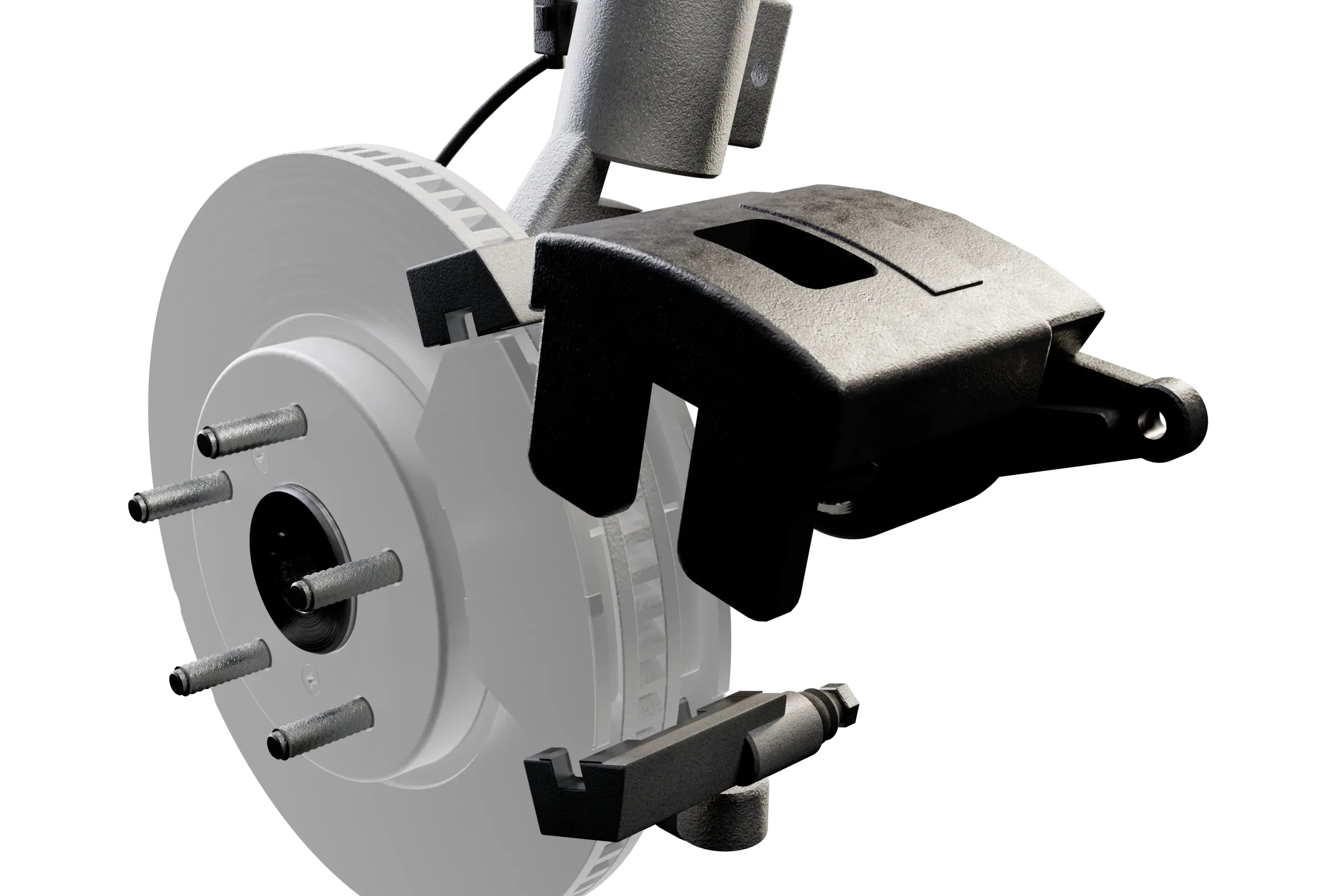
- Brake pad, inner
- Brake pad, outer
- Brake disc US: Brake rotor
The likely causes, most common first
-
Pads worn down to their backing plates
Most likelyHow it shows A harsh, metallic grind every time you brake, often with a vibration and a longer stop.
Check Look at the outer pad through the wheel: no friction material left, or bright, deep grooves in the disc, confirm it.
Don't drive it
-
A stone or grit trapped behind the disc
CommonHow it shows A loud scraping that starts suddenly, often after a gravel road, and may carry on with your foot off the brake.
Check Have the wheel taken off and the stone removed from between the disc and its dust shield before it scores the disc.
Have it checked soon
-
Heavy rust after the car has stood
CommonHow it shows A rough grind on the first stops after days or weeks parked, which may fade as the rust wears off.
Check Light surface rust clears in a few gentle stops. A grind that stays, or a rusty band across the disc face, needs the discs and pads checked.
Fix it soon
-
How it shows A grinding or rumble through the pedal, worst when new pads ride on an old, scored disc.
Check Look for a ridge at the disc's edge and deep rings in its face, and have it measured against the minimum stamped on it.
Fix it soon
-
A dust shield bent onto the disc
Less likelyHow it shows A thin, tinny scrape that comes and goes as the wheel turns, often after brake work or a knock.
Check Look behind the disc for the thin steel splash shield touching it. It can be bent back carefully, clear of the disc.
Fix it soon
-
A sticking caliper
Less likelyHow it shows Grinding or scraping from one wheel, with heat, a burning smell or a pull to one side.
Check After a short drive, a wheel much hotter than the others has a brake that drags.
Have it checked soon
-
A worn wheel bearing
Less likelyHow it shows A growl or grind that rises with road speed and changes as you steer, whether you brake or not.
Check With the wheel off the ground, spin it and rock it: roughness or play points to the bearing.
Have it checked soon
How to narrow it down
- Note when it grinds. Only when braking points to the pads, the discs or rust; all the time points to a stone, the dust shield, a dragging brake or a bearing.
- If it grinds only on the first stops after rain or a few days parked, and then fades, it was surface rust.
- Find the corner: somewhere quiet, with the windows down, drive slowly and brake gently, listening for the side.
- Look at the outer pad through each front wheel. No friction material left, or a disc with bright, deep grooves, means stop driving.
- If in doubt, have it checked where the car is, or recovered. With the wheels off, a garage can see the cause in minutes.
Is it safe to drive with grinding brakes?
Don't drive it
No. Until you know otherwise, treat grinding as pads worn down to metal. Steel is then rubbing on iron: the car takes longer to stop, every stop cuts deeper into the discs, and braking on that wheel gets worse quickly. Have it checked where it is, or recovered. A grind that started suddenly after a gravel road and carries on with your foot off the pedal is more likely a trapped stone, but have that looked at before you drive on as well.
Why does grinding mean new discs as well as pads?
Because by the time a pad grinds, its steel backing plate has been cutting into the disc. A few stops are enough to score deep rings in the iron and take it towards its minimum thickness. New pads on a scored disc touch only on the ridges, so they grip poorly and wear quickly, and the noise can carry on. That is why discs and pads are replaced together, on both wheels of the axle. Caught earlier, while the wear indicator is still squealing, the pads can usually be changed on their own.
Questions people ask
Why do my brakes grind when I brake hard?
In a hard or emergency stop, a grinding buzz with a pulsing pedal is usually ABS at work, releasing and reapplying the brake at a wheel that had started to lock. That is normal. A grind in ordinary, gentle stops is not.
Can rear brakes grind?
Yes. Rear pads and drum brake shoes wear too, usually more slowly, and rear discs rust more because they do less work. A grind from the back is checked the same way, though it can be harder to place by ear.
Why do my brakes grind after new pads?
Most often the discs were left with a deep lip or grooves that the new pads now ride on, or a pad clip or shim is out of place. A light scrape for the first few miles while new pads bed in is normal; a grind is not, and the brakes should go back to whoever fitted them.
Related
The parts
- What do brake pads do? Brake pads are the friction blocks the caliper squeezes against the brake disc, turning the car's movement into heat to slow it down.
- What do brake discs do? Brake discs (US: rotors) are the iron discs that turn with the wheels.
- What does a brake caliper do? A brake caliper is the clamp at each disc brake. When you brake, fluid pressure pushes its piston out and the caliper squeezes the two pads against the disc.
- What does a wheel bearing do? A wheel bearing lets the wheel spin freely while carrying the car's weight and the cornering and braking loads.
Similar symptoms
- Why are my brakes squeaking? Brakes squeak when the pads and disc vibrate at a high pitch as they rub.
- Why does my steering wheel shake when braking? A steering wheel that shakes when you brake usually means the front brake discs have worn unevenly, which is often called warped.
- Why is my car humming when I drive? A humming noise that rises with road speed is usually a worn wheel bearing, especially if it changes as you go round a bend.
- What causes a knocking noise over bumps? A knocking or clunking noise over bumps usually comes from a worn joint in the front suspension.
Explained
- Disc vs drum brakes: what's the difference? A disc brake squeezes pads against a disc that turns with the wheel; a drum brake pushes curved shoes outwards against the inside of a drum.
