
Brakes · Floating disc caliper
What do brake pads do?
Brake pads are the friction blocks the caliper squeezes against the brake disc, turning the car's movement into heat to slow it down. They wear with every stop, so there is no fixed life: front pads often last 20,000 to 40,000 miles, less with a lot of town driving, and rear pads usually last longer.
Also called disc pads
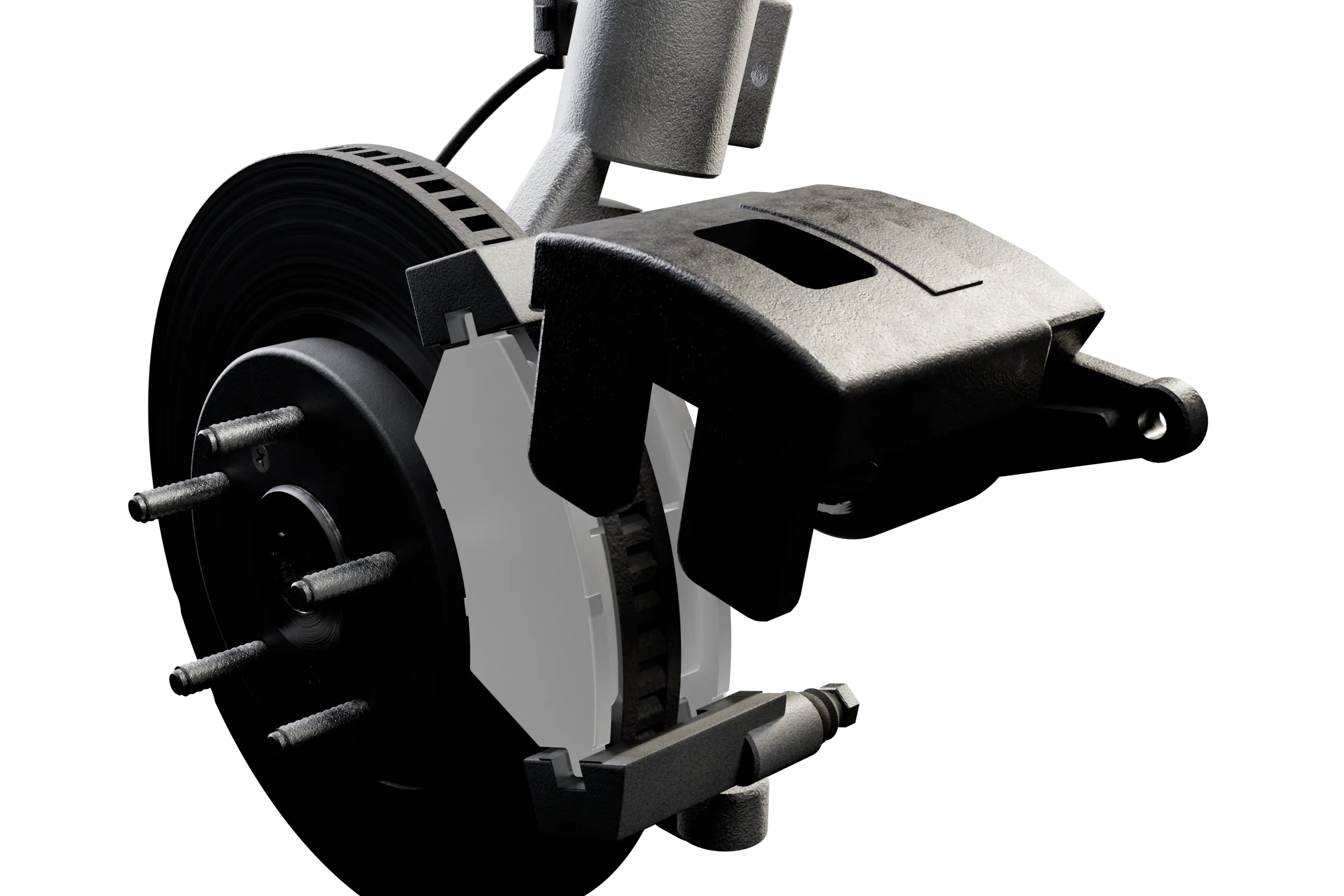
- Brake pad, inner
- Brake pad, outer
- Caliper housing US: Brake caliper
- Brake disc US: Brake rotor
- Caliper bracket
How do brake pads stop the car?
Each pad is a layer of friction material bonded to a steel backing plate, and a floating caliper holds two, one each side of the disc. The piston pushes the inner pad on, and as the caliper slides back on its guide pins, its fingers pull the outer pad on just as hard. The pads sit in a bracket bolted to the steering knuckle, which takes the drag of the disc on them: up to about 10 kN per pad on the app's model.
The friction turns the car's movement into heat, and on a long descent the pads can run at several hundred degrees. Their material is made to grip in much the same way hot or cold and to wear slowly, and a thin stainless shim behind each pad damps the vibration that makes brakes squeal.
What are the signs of bad brake pads?
- A high squeal that stops when you brake harder. The wear indicator, a spring-steel tab on the inner pad, has reached the disc. On the app's model it touches with about 2.5 mm of friction material left, so the pads are due but still working. Why are my brakes squeaking?
- Grinding, metal on metal. The friction material has gone and the steel backing plate is cutting into the disc. Stop driving: the discs will need replacing too. What causes a grinding noise when braking?
- Thin friction material. Look through the wheel spokes at the outer pad. The model's pads start with 11 mm and are replaced at 2 mm; many garages advise new pads at about 3 mm.
- A pad warning light. Some cars have an electrical sensor clipped into one pad that lights a dashboard warning when the pad wears down to it. It is usually replaced with the pads.
- The brake fluid level slowly falling. As the pads wear, the pistons move out and fluid fills the space behind them, so the reservoir level drops a little. A quick drop means a leak.
- One pad much thinner than the other. Uneven wear across one wheel, or a pad worn to a wedge, points to a sticking guide pin or piston in the caliper.
Can you drive with worn brake pads?
Fix it soon
For a short while, once the wear indicator starts to squeal: it reaches the disc while some friction material is left, so the brakes still work. Book new pads within days, not weeks. Once the pads grind, stop driving. The backing plates are then cutting into the discs, the car takes longer to stop and every stop does more damage. Pads worn down to the wear indicator also fail an MOT.
How long do brake pads last?
There is no fixed mileage. Pads are replaced at their minimum thickness, and how soon that comes depends on the car, the roads and the driving. As a rough guide, front pads last somewhere between 20,000 and 40,000 miles: less in town traffic, more on long motorway runs. Rear pads usually last longer, because the car’s weight shifts forwards under braking and the front brakes do most of the work, though on some newer cars the rear pads wear out first.
What shortens their life is braking itself: short trips with many stops, hills, heavy loads and towing, and braking late and hard. Reading the road ahead and lifting off early, so the car slows on the engine, saves them.
What does changing brake pads involve?
- Time
- About 45 minutes
- Difficulty
- Moderate
- Parts
-
- A set of front pads (with new shims)
- Brake grease
- Brake cleaner
- Chock the wheels and loosen the wheel nuts with the car on the ground, then raise it onto an axle stand and take the wheel off.
- Hold the lower guide pin by its flats, take out its bolt and swing the caliper up on the upper pin. Never let it hang on the hose, and leave the brake pedal alone while the pads are out.
- Lift out both pads, clean the rust and dust from their seats, check the guide pin slides freely and measure the disc in the middle of the pad track.
- Draw a little fluid off if the reservoir is near MAX, then push the piston slowly and squarely back into its bore to make room for the new pads.
- Fit the new pads with a smear of brake grease on their ears, never on the friction face, then swing the caliper down and refit its bolt.
- Do the other front wheel the same way, refit the wheels, lower the car and tighten the wheel nuts in a star pattern.
- Pump the pedal until it is firm before you move the car, top up the fluid if it needs it and bed the new pads in with a few firm stops.
Tools
- Wheel chocks
- Breaker bar
- Socket and ratchet
- Trolley jack (US: Floor jack)
- Axle stand (US: Jack stand)
- Open-ended spanner (US: Open-end wrench)
- Wire brush
- Brake cleaner (US: Brake parts cleaner)
- Vernier caliper
- Caliper piston tool
- Brake grease
- Torque wrench
Work safely
- Work on firm, level ground with the handbrake on and the other wheels chocked.
- Never work under a car held only by a jack: set it on an axle stand.
- Brake fluid strips paint and harms skin and eyes: wear gloves and glasses, wipe up spills at once.
- Brake dust is harmful: clean it with brake cleaner, never with an air line.
Tighten every nut and bolt to the figure in the maker's manual for your car.
Pads are always changed on both wheels of an axle, so the brakes grip evenly. Discs near their minimum or deeply scored are replaced at the same time.
Questions people ask
How do you bed in new brake pads?
Make several firm stops from moderate speed without coming to a halt, then drive gently for a few miles to let the brakes cool. Avoid very hard braking for the first hundred or so miles, and do not sit with the pedal held hard on hot new pads, which can print pad material onto the disc.
Will worn brake pads fail an MOT?
Yes, when the tester can see them. A pad worn down to its wear indicator is a major fault, and one worn below 1.5 mm is a dangerous fault. A pad warning light on the dashboard is not a reason for failure on its own.
Can you replace brake pads without replacing the discs?
Yes, if the discs are above their minimum thickness, run true and have no deep grooves or lip. They are measured at every pad change, and many cars get through two sets of pads for each set of discs.
Can you change just the front brake pads?
Yes. Front and rear pads wear at different rates and are changed separately, as long as both wheels on that axle get new pads at the same time.
Related
Symptoms
- Why are my brakes squeaking? Brakes squeak when the pads and disc vibrate at a high pitch as they rub.
- What causes a grinding noise when braking? A grinding noise when you brake usually means the brake pads have worn through their friction material, so their steel backing plates are scraping the discs.
- Why does my car pull to one side when braking? A car that pulls to one side when braking usually has a brake that grips harder on one side than the other.
Parts nearby
- What do brake discs do? Brake discs (US: rotors) are the iron discs that turn with the wheels.
- What does a brake caliper do? A brake caliper is the clamp at each disc brake. When you brake, fluid pressure pushes its piston out and the caliper squeezes the two pads against the disc.
- What does brake fluid do? Brake fluid carries the push from the brake pedal to the calipers.
- What does a wheel bearing do? A wheel bearing lets the wheel spin freely while carrying the car's weight and the cornering and braking loads.
Explained
- Disc vs drum brakes: what's the difference? A disc brake squeezes pads against a disc that turns with the wheel; a drum brake pushes curved shoes outwards against the inside of a drum.
The whole system
- How do disc brakes and ABS work? The disc brakes and ABS, part by part, with an interactive diagram.
