
Brakes · Floating disc caliper
What does a wheel bearing do?
A wheel bearing lets the wheel spin freely while carrying the car's weight and the cornering and braking loads. Each wheel has one, in the hub or the steering knuckle. A worn one makes a hum or growl that rises with road speed and changes as you steer, and in time the wheel develops play.
Also called hub bearing
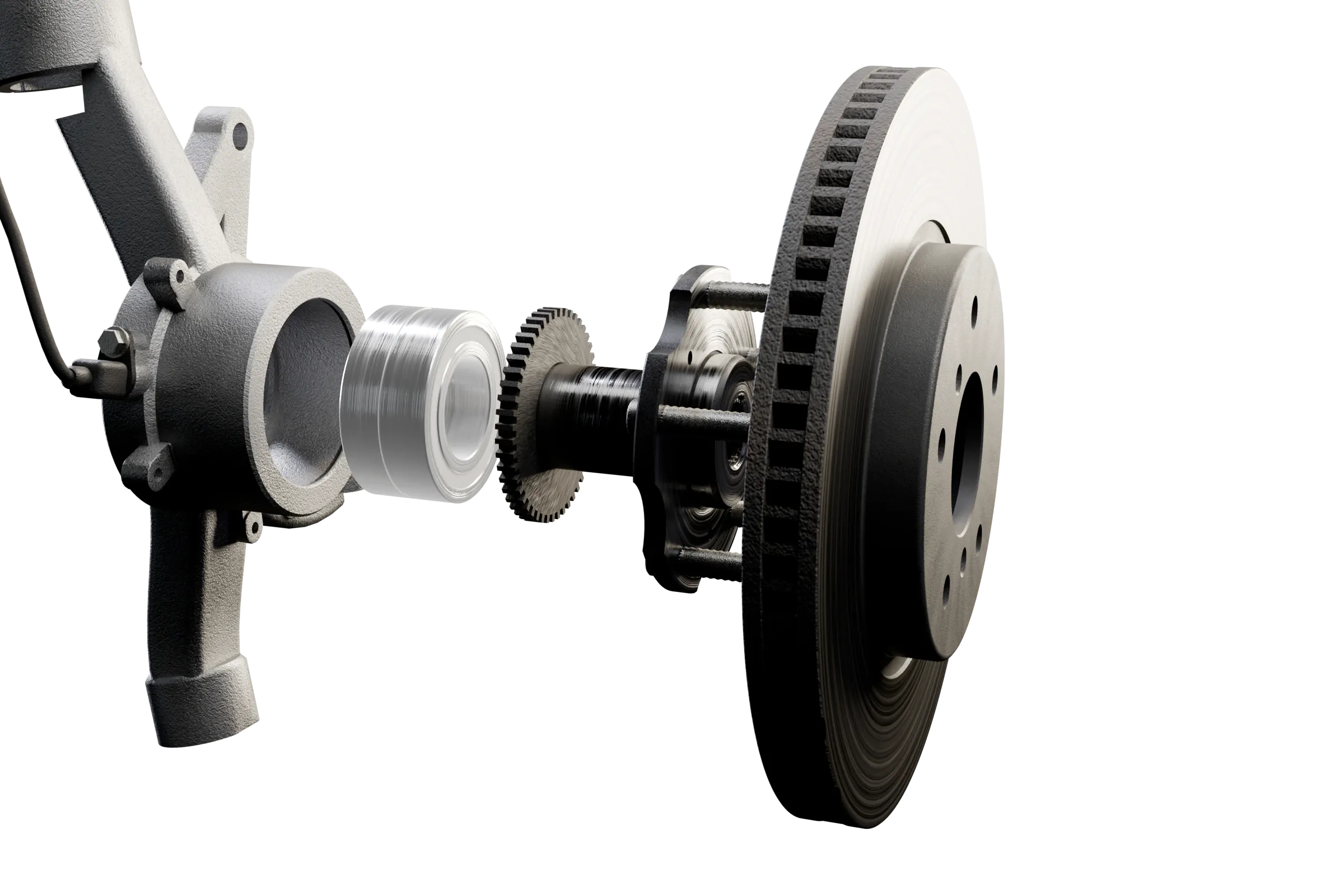
- Wheel bearing
- Wheel hub
- Steering knuckle
- Brake disc US: Brake rotor
How does a wheel bearing work?
The wheel and the brake disc are clamped to the hub, and the hub turns in the bearing. The bearing carries the car's weight, the sideways load in every corner and the forces of braking and driving, at close to a thousand turns a minute at motorway speed, and it is expected to do that quietly for many years.
Most cars now use a sealed, double-row ball bearing like the one in the app's model, greased for life and never adjusted. Its two rows of balls run at an angle to each other, so between them they take loads from the side as well as from above. On a driven wheel the driveshaft turns the hub through splines in its centre.
What are the symptoms of a bad wheel bearing?
- A hum or growl that rises with road speed. It follows road speed, not engine speed: it stays the same in any gear and does not stop when you coast. Why is my car humming when I drive?
- The noise changes as you steer. A bend loads the bearings on its outside. A hum that grows in a gentle right-hand bend usually points to the left side, and the other way round.
- Play when you rock the wheel. With the wheel raised, rock it top to bottom. If the play goes when a helper presses the brake pedal, it is the bearing; if it stays, look at the ball joints.
- Roughness when you spin it. Spun by hand with the wheel off the ground, a worn bearing rumbles or feels gritty.
- The ABS warning light. Play in the bearing changes the ABS sensor's gap, and where the sensor reads a magnetic ring in the bearing's seal, a failing bearing can take the signal with it.
Is it safe to drive with a bad wheel bearing?
Have it checked before you drive far
For a short while, while it only hums, but have it checked before you drive far. A worn bearing only gets worse, and near the end it runs hot, its play grows and the wheel can wobble. In the worst case it can seize or break up. Stop driving if the hum turns into grinding, the steering feels loose or the wheel wobbles. A rough bearing, or one with too much play, fails an MOT.
How do you tell which wheel bearing is bad?
Start on a smooth, quiet road at the speed where the hum is loudest, and weave gently. A bend to the right loads the left-hand bearings, so a hum that grows to the right points to the left side, and one that grows to the left points to the right. Front or rear is harder to tell by ear, because the noise carries through the whole car.
Then, with the car safely raised, rock and spin each wheel by hand: the bad bearing usually has play, roughness or both. A garage can listen at each hub with microphones clipped to the suspension on a road test.
Rule out the tyres first. Tread that has worn unevenly, in a saw-tooth or cupped pattern, hums just like a bearing. Run a hand round each tread and look at all four before blaming a bearing.
What wears out a wheel bearing?
Water, mostly. Once a seal lets water past, the grease washes out and the balls and races rust and pit. Hard knocks do damage too: a deep pothole or a kerb strike can dent the races, and the bearing starts to hum some thousands of miles later. A new bearing can also be ruined as it is fitted, if it is pressed in through the wrong race or the hub nut is not tightened properly.
What does replacing a wheel bearing involve?
- Raise the car safely, take the wheel off and remove the caliper with its bracket, tied up clear and never hanging on its hose, then the disc.
- Take out the ABS sensor so it is not damaged, and on a driven wheel undo the large hub nut and free the driveshaft from the hub.
- Where the bearing comes in a bolt-on hub unit, unbolt the unit from the knuckle and fit the new one.
- Where it is pressed in, as on the app's model, take the knuckle off the car, press the hub out, remove the circlip and press the old bearing out of its bore.
- Press the new bearing in by its outer race only, fit a new circlip, then press the hub back in while supporting the bearing's inner race.
- Refit the knuckle, driveshaft, disc, caliper and ABS sensor, and have the wheel alignment checked if the knuckle came off.
Tighten every nut and bolt to the figure in the maker's manual for your car.
Usually work for a garage, because a pressed-in bearing needs a hydraulic press. Bearings are replaced one at a time unless both sides are worn, and a bearing that has been pressed out is never refitted.
Questions people ask
What does a bad wheel bearing sound like?
Usually a steady hum or drone, like tyre roar on a coarse road, that rises with road speed. As it wears it turns into a growl or rumble, and near the end a grinding or knocking. It changes as you steer, which tyre noise mostly does not.
How long do wheel bearings last?
There is no service interval. A sealed bearing often lasts 100,000 miles or more, and many last the life of the car. Water past a seal, potholes and kerb strikes are what end them early.
Should wheel bearings be replaced in pairs?
Not usually. A new bearing does not change how the car handles, the way new dampers or brakes on one side would, so only the worn one is replaced. The other side has done the same miles, though, and is worth checking for noise and play.
Is a wheel bearing part of the hub?
On many cars, yes: the bearing is built into a hub unit that bolts to the knuckle and is replaced as one part. On others, like the app's model, the bearing is pressed into the knuckle and the hub is pressed into the bearing.
Related
Symptoms
- Why is my car humming when I drive? A humming noise that rises with road speed is usually a worn wheel bearing, especially if it changes as you go round a bend.
- What causes uneven tyre wear? Uneven tyre wear usually means the wheel alignment is out, the tyre pressures are wrong or a suspension part is worn, and the pattern points to which.
Parts nearby
- What does an ABS sensor do? An ABS sensor (US: wheel speed sensor) measures how fast its wheel is turning by reading a toothed or magnetic ring that turns with the hub.
- What does a CV joint do? A CV (constant velocity) joint lets a driveshaft turn a wheel through an angle without the speed pulsing.
- What does a ball joint do? A ball joint is the ball-and-socket joint that connects a suspension arm to the wheel's steering knuckle.
- What do brake discs do? Brake discs (US: rotors) are the iron discs that turn with the wheels.
The whole system
- How do disc brakes and ABS work? The disc brakes and ABS, part by part, with an interactive diagram.
