
What does a ball joint do?
A ball joint is the ball-and-socket joint that connects a suspension arm to the wheel's steering knuckle. It lets the wheel move up and down and steer at the same time, while holding it in place. A worn ball joint knocks over bumps and makes the car wander, and one that fails can let the wheel collapse.
Also called suspension ball joint, lower ball joint
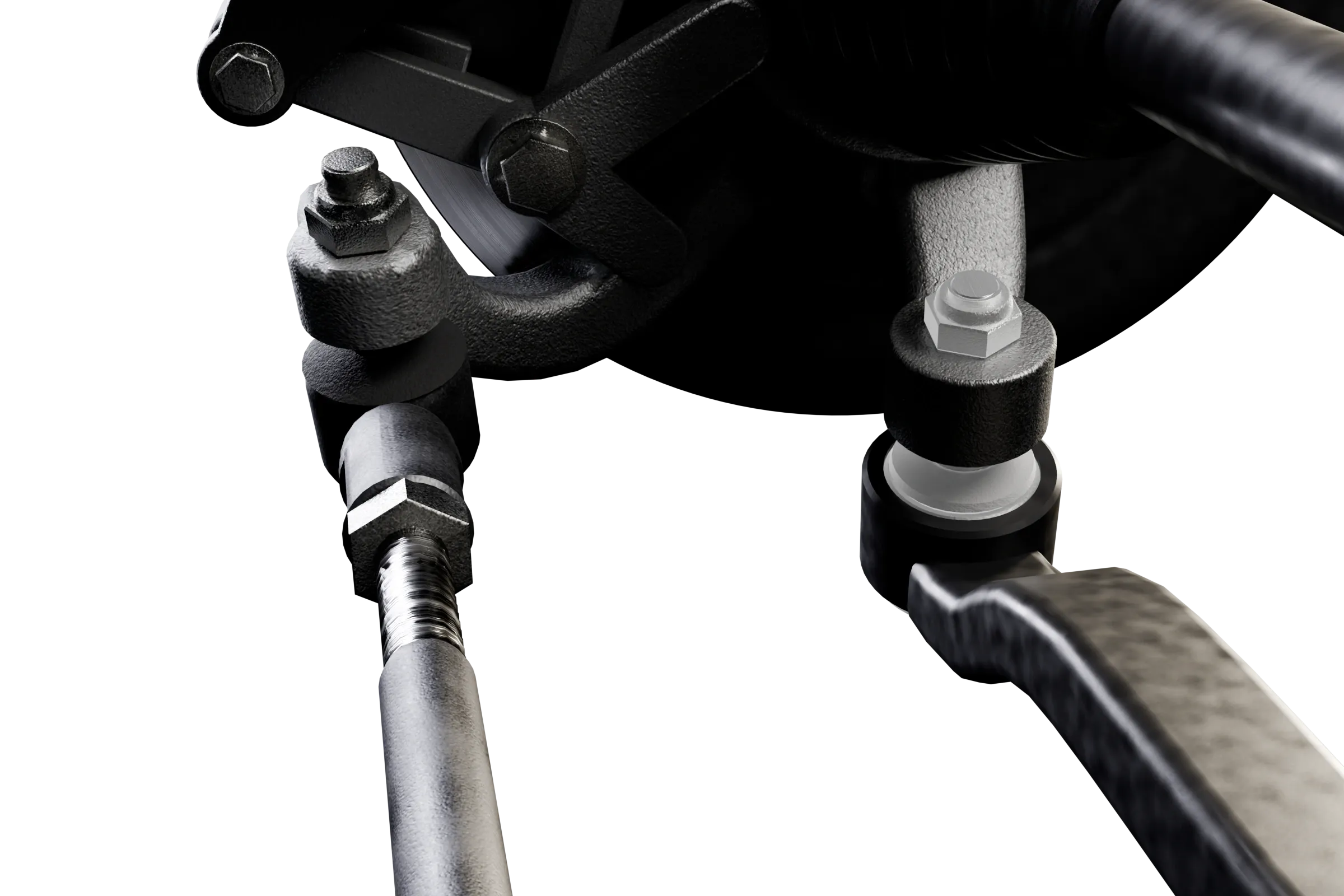
- Lower ball joint
- Track control arm US: Lower control arm
- Steering knuckle
- Track rod end US: Outer tie rod end
How does a ball joint work?
It is a ball on the end of a stud, held in a greased socket at the end of a suspension arm, with a rubber boot sealing the gap around the stud. The stud locks into the steering knuckle, usually on a taper, on some cars in a clamp. The ball can swivel and tilt in its socket without any free play, so the knuckle can rise and fall with the arm and turn for steering at the same time.
A MacPherson strut has one at each front wheel, at the outer end of the lower control arm, and the car steers about a line from that joint up through the top mount. On the app's strut that line leans in by 16°. A double wishbone has two at each wheel, one on each arm, and the wheel steers about the line between them. Either way the joints carry the wheel's loads in braking and cornering, so a worn one is felt most when you brake hard or turn.
What are the signs of a bad ball joint?
- A knock from low down at the front. Over potholes and speed bumps, and often as you brake. What causes a knocking noise over bumps?
- Wandering or vague steering. The wheel can shift on the loose joint, so the car follows ruts and needs constant small corrections.
- Uneven tyre wear. Play lets the camber and toe change under load, and one edge of the tyre wears faster than the other. What causes uneven tyre wear?
- Movement at the joint. With the wheel safely off the ground, rock it top to bottom while someone watches the joint, or lever the wheel up gently with a bar under the tyre. Any movement between the arm and the knuckle at the joint means it is worn.
- A torn or missing boot. Once the boot is torn, road dirt reaches the ball and the joint wears out far sooner. The MOT fails a boot that no longer seals.
Can you drive with a broken ball joint?
Have it checked before you drive far
No, not if it has broken, and only gently to a garage if it is worn. A worn joint still holds the knuckle, but once it starts to knock the wear speeds up. If the ball pulls out of its socket, that end of the knuckle is free: the wheel collapses under the car, and the car can no longer be steered or stopped in a straight line. A joint that knocks loudly, or lets you see the wheel move, should not be driven on at all. Excessive play in a ball joint fails the MOT.
What does a bad ball joint sound like?
Usually a dull knock or clunk from low down at the front, loudest over potholes and speed bumps at low speed, as the worn ball moves in its socket. It often knocks as you brake too, when the braking force pushes the wheel back and takes up the play. A joint that has lost its grease makes a different noise: a creak or a groan as the suspension moves, most noticeable at parking speed or rolling over a speed bump.
The knock is easy to confuse with a worn drop link, which makes a lighter rattle over broken surfaces and leaves the steering feeling normal. A worn ball joint usually brings other signs with it, such as vague steering or a tyre wearing on one edge, and its knock grows steadily louder as the wear increases. A knock that appears suddenly, or gets much worse within days, needs checking straight away, because the joint may be close to coming apart.
What does replacing a ball joint involve?
- Raise the car onto axle stands on firm ground and take the wheel off.
- Undo the nut on the ball stud, or the pinch bolt on cars where the stud is clamped in the knuckle, and free the stud, with a splitter where it sits in a taper.
- Take the joint out: unbolt it from the arm, press it out of the arm or the knuckle with a ball joint press, or remove the whole arm where the joint is part of it.
- Fit the new joint, or the new arm, and secure its stud in the knuckle with new fixings.
- Refit the wheel and lower the car.
- Have the alignment checked, because the camber and toe can move a little.
Tighten every nut and bolt to the figure in the maker's manual for your car.
Usually a garage repair. On many cars the joint only comes as part of a new control arm, and a pressed-in joint needs a press tool and some care to fit squarely.
Questions people ask
Is a ball joint part of the control arm?
On many cars, yes: the joint is built into the arm, and the two are replaced together. On others it is bolted or pressed into the arm, or pressed into the knuckle, and it can be changed on its own.
How many ball joints does a car have?
It depends on the suspension. A car with MacPherson struts has one at the bottom of each front wheel, plus the smaller ball joints in the track rod ends and drop links. A double wishbone has an upper and a lower joint at each wheel.
Do ball joints need greasing?
Most modern ones are sealed for life and need nothing. Some, mainly on older cars, pickups and heavy vehicles, have a grease nipple and are greased at each service.
How long do ball joints last?
There is no service interval: they are replaced when they wear, which on many cars takes a very high mileage. A torn boot shortens their life the most, because water and grit get into the socket, and potholes and kerb strikes add to the wear.
Related
Symptoms
- What causes a knocking noise over bumps? A knocking or clunking noise over bumps usually comes from a worn joint in the front suspension.
- What causes uneven tyre wear? Uneven tyre wear usually means the wheel alignment is out, the tyre pressures are wrong or a suspension part is worn, and the pattern points to which.
Parts nearby
- What is a control arm? A control arm is a hinged suspension link between the car's subframe or body and the wheel.
- What is a track rod end? A track rod end (US: tie rod end) is the ball joint at the outer end of each track rod, where the steering connects to the front wheel.
- What do control arm bushes do? Control arm bushes (US: bushings) are the rubber mountings where a control arm pivots on the subframe.
- What does a coil spring do? A coil spring holds the car up. Each corner rests on one, and when the wheel hits a bump the spring compresses, stores the energy and pushes the wheel back down, while its length sets the ride height.
Explained
- What is camber? Camber is the lean of a wheel seen from the front of the car.
The whole system
- How does a MacPherson strut work? The MacPherson strut, part by part, with an interactive diagram.
