
What is camber?
Camber is the lean of a wheel seen from the front of the car. When the top of the wheel leans in towards the car, the camber is negative; when it leans out, it is positive. Most cars run a little negative camber, usually less than two degrees, and the angle changes as the suspension moves.
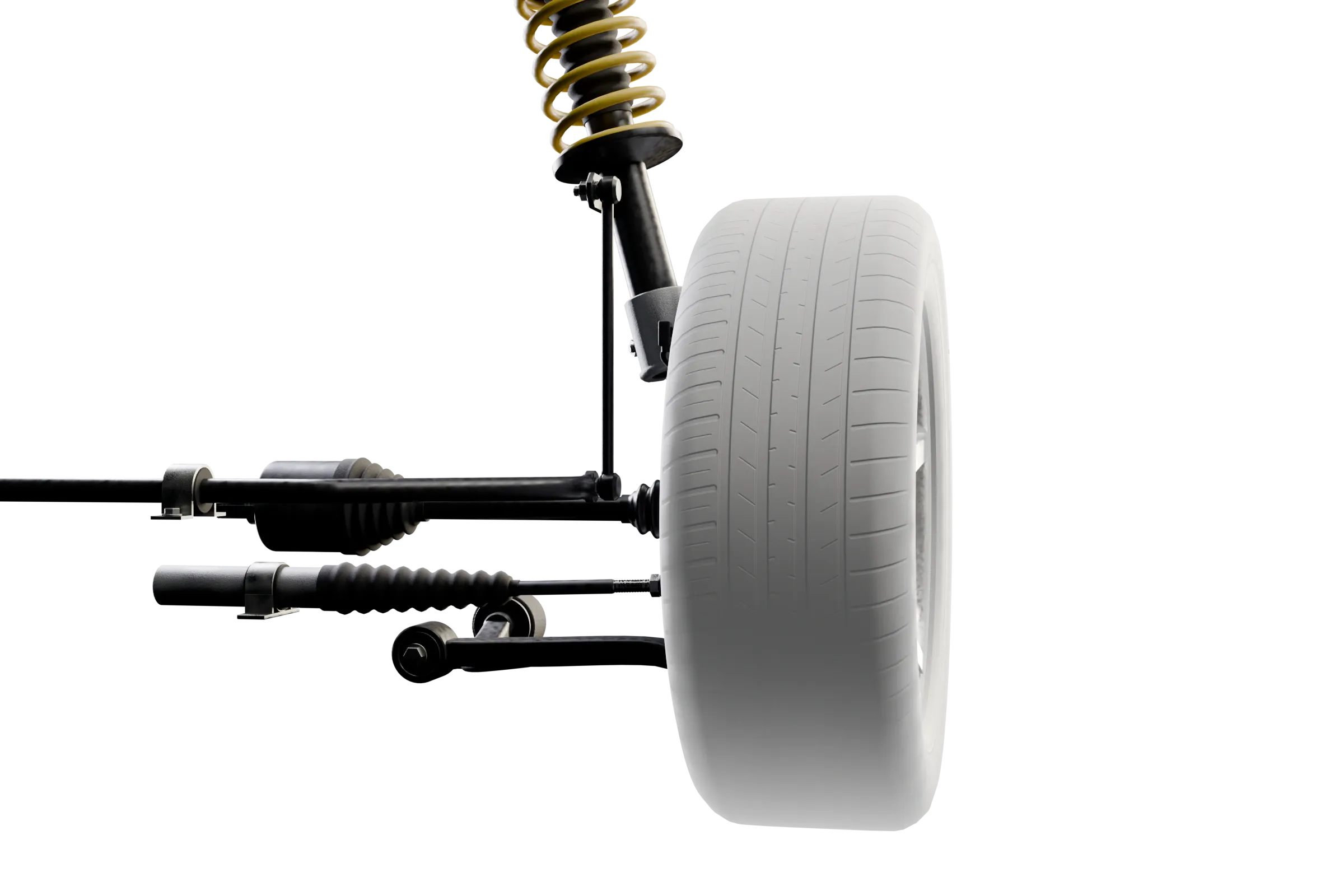
- Tyre 225/45 R17 US: Tire 225/45 R17
- Alloy wheel 17 x 7.5J
Run the bump test
InteractiveMacPherson strut (this model) Double wishbone, for comparison
- Wheel travel
- 0 mm
- Camber change
- 0.00°
- Strut compression
- 0 mm
- Strut top mount (fixed to the body)
- Coil spring
- Damper (strut tube)
- Steering knuckle
- Lower control arm
- Lower ball joint
What do negative and positive camber mean?
Look at the car from the front. A wheel standing exactly upright has zero camber. If its top leans in towards the middle of the car, the camber is negative; if it leans out, positive. The angle is small, on most road cars between zero and about one and a half degrees negative, too little to see by eye.
The two sides of an axle should match closely, because a leaning tyre pushes gently towards the side it leans to. With equal camber the pushes cancel; with more positive camber on one side, the car drifts that way.
Why do most cars run a little negative camber?
For the corners. When a car turns, the body rolls towards the outside of the bend, and the outer wheel, which carries most of the load, is tipped with it onto the outer edge of its tread. Starting with the top of the wheel leaning in slightly means that tyre ends up closer to upright, with more of its tread on the road.
It is a compromise. Too much negative camber leaves the tyres on their inner edges in a straight line and under braking, where they grip less and wear faster. Older cars often ran a little positive camber, partly to lighten the steering; modern radial tyres work best close to upright.
How much does camber change over a bump?
On most independent suspension the wheel leans in as it rises and out as it drops. Run the bump test in the diagram above: the chart plots camber against wheel travel for the app’s MacPherson strut and for a double wishbone with typical proportions. The strut’s wheel gains −0.6° at 40 mm of bump and −0.9° at 80 mm, and leans out by +1.9° at 80 mm of droop; the double wishbone gains −1.1° and −2.7°.
The gain matters in a corner, where the outer wheel rises towards the body and the camber it gains cancels some of the body’s lean. Why each design behaves as it does is in how a MacPherson strut works and how double wishbone suspension works.
How does camber show in tyre wear?
As smooth, even wear along one edge: the inner edge with too much negative camber, the outer with too much positive. It lacks the saw-tooth feel of a toe problem, and it comes on more slowly than toe wear, which scrubs the tread sideways on every turn of the wheel.
Watch the inner edge, which is out of sight: turn the steering to full lock to see it on the front tyres. Camber also moves with ride height, so a corner sitting low on a tired spring, or a car that always carries a heavy load, runs more negative camber than it was set up with. What causes uneven tyre wear covers the other patterns.
Can camber be adjusted?
On some cars, within limits. Many MacPherson strut cars have no camber adjustment at the front, so a reading out of range means something is bent, worn or sagging. Some have an eccentric bolt or slotted holes where the strut meets the knuckle, and camber bolts and adjustable top mounts are made for many others. Double wishbone and multi-link suspension is more often adjustable, through eccentric bolts or shims at the arm pivots.
How is camber different from caster?
Camber is the lean of the wheel, seen from the front. Caster is the lean of the steering axis, seen from the side: on the app’s strut model the axis tilts back by 4.5°, which helps the steering return to the centre. Camber decides how the tyre meets the road; caster mostly decides how the steering feels.
They meet when you steer. A wheel turning about an axis that tilts back also leans as it turns, and with positive caster the outer wheel in a bend gains negative camber, which helps it grip.
Questions people ask
Why do lowered cars have so much negative camber?
Because lowering puts the suspension further into its bump travel, and on most strut and wishbone designs the wheel leans in more as it rises. Unless it is corrected with adjustable parts, a lowered car runs more negative camber than it was designed for and wears its inner edges.
What camber should my car have?
The figure the maker gives for that model, which an alignment printout shows next to each reading. It is usually a small negative angle with a tolerance of around half a degree, and the two sides of an axle should be close to each other, or the car can pull.
Is camber the same at the front and the rear?
Not usually. Many cars run a little more negative camber at the rear, which helps the back of the car grip in corners. On a twist-beam rear axle the camber is built into the beam and cannot be adjusted.
Related
The parts
- What is a control arm? A control arm is a hinged suspension link between the car's subframe or body and the wheel.
- What does a ball joint do? A ball joint is the ball-and-socket joint that connects a suspension arm to the wheel's steering knuckle.
- What do control arm bushes do? Control arm bushes (US: bushings) are the rubber mountings where a control arm pivots on the subframe.
- What does a coil spring do? A coil spring holds the car up. Each corner rests on one, and when the wheel hits a bump the spring compresses, stores the energy and pushes the wheel back down, while its length sets the ride height.
More explained
- Toe in vs toe out: what's the difference? Toe is the angle of a pair of wheels seen from above. With toe in, their fronts point slightly towards each other; with toe out, slightly apart.
- Struts vs shocks: what's the difference? A shock absorber only damps movement: it stops the car bouncing after a bump.
