
What is a control arm?
A control arm is a hinged suspension link between the car's subframe or body and the wheel. It pivots on bushes at its inner end and carries a ball joint at its outer end, so the wheel can rise and fall while staying in place. In the UK it is often called a track control arm or wishbone.
US control arm or A-arm Also called track control arm, wishbone, lower arm
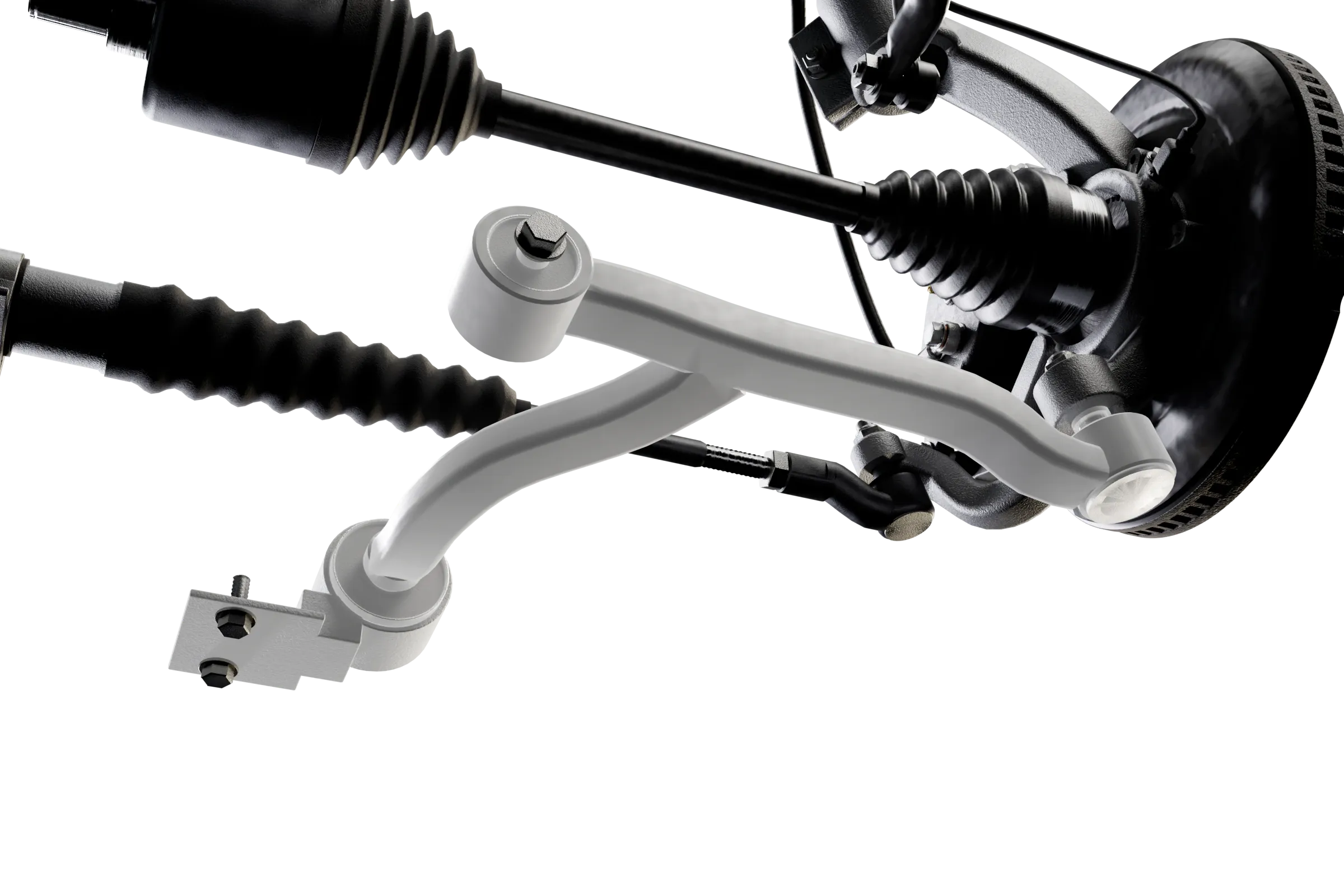
- Track control arm US: Lower control arm
- Track control arm bush, front US: Lower control arm bushing, front
- Track control arm bush, rear US: Lower control arm bushing, rear
- Lower ball joint
What does a control arm do?
It holds the bottom of the wheel where it should be. The arm's inner end usually pivots on two bushes on the subframe and its outer end carries the ball joint the knuckle sits on, so the wheel can follow the bumps but cannot move forwards, backwards or sideways. The arm also carries the braking and cornering forces into the car.
A car with MacPherson struts has one lower arm at each front wheel, and the strut holds the top; a double wishbone has an upper and a lower arm. Either way, the arm's length and pivot points decide how the wheel leans as it moves, which is why a bent arm throws the wheel angles out.
What are the symptoms of a bad control arm?
- A clunk over bumps or when braking. Worn bushes let the arm shift on its pivots, and a worn ball joint knocks in its socket. What causes a knocking noise over bumps?
- Pulling or a shake under braking. Hard braking puts some of the largest loads through the arm, so a worn one often shows up first as a pull to one side, or a shimmy in the steering, in a firm stop. Why does my car pull to one side when braking?
- Uneven tyre wear. Play in the arm, or an arm bent by a kerb, puts the camber and toe out, and one edge of the tyre wears faster. What causes uneven tyre wear?
- Damage you can see. Split bushes, an arm bent after a kerb strike, or heavy rust on a pressed-steel arm. Corrosion that weakens an arm fails the MOT.
Can you drive with a broken control arm?
Have it checked before you drive far
Not if the arm has cracked, snapped or come loose. It holds the bottom of the wheel, and if it lets go the wheel can fold under the car and the steering on that side is lost. A worn arm, with tired bushes or a ball joint with play, still holds the wheel, but it moves under braking, so the car can pull or wander in an emergency stop. Have it checked before you drive far. An arm that is badly corroded or damaged fails the MOT.
What happens if a control arm is bent?
The wheel no longer sits where it should. A hard kerb strike or a deep pothole can bend an arm without any other warning, and the first signs are a steering wheel that sits off centre, a car that pulls to one side and a tyre wearing on one edge. Sometimes the wheel also looks further forward or back in its arch than the one on the other side.
An alignment check usually finds it: the camber or caster on that side reads outside the maker’s figures, and on many small cars neither can be adjusted. A bent arm is replaced, never straightened, because bending it back weakens the steel. Have the knuckle and the track rod checked at the same time, since a blow hard enough to bend the arm can bend them too.
What does replacing a control arm involve?
- Time
- About 1 hour 30 minutes
- Difficulty
- Demanding
- Parts
-
- A new lower wishbone with its bushes and ball joint
- A new nyloc nut for the ball joint
- Chock the wheels and loosen the wheel nuts, raise the car onto an axle stand and take the wheel off.
- Set a jack under the arm and raise it to about ride height, so the knuckle stays supported once the arm is free.
- Disconnect whatever is fixed to the arm: the drop link on many cars, and on a double wishbone the bottom of the spring and damper.
- Undo the ball joint's nut and the pivot bolts, split the ball joint from the knuckle and lower the old arm out.
- Offer up the new arm, push its ball stud into the knuckle with a new nyloc nut and fit the pivot bolts finger tight.
- Refit the drop link and the damper's mounting, then jack the arm to ride height before you tighten the pivot bolts.
- Refit the wheel, lower the car, tighten the wheel nuts in a star pattern and have the alignment checked.
Tools
- Wheel chocks
- Breaker bar
- Socket and ratchet
- Trolley jack (US: Floor jack)
- Axle stand (US: Jack stand)
- Flat screwdriver (US: Flat-blade screwdriver)
- Pry bar
- Ring spanner (US: Box-end wrench)
- Hex key (US: Allen key)
- Ball-joint splitter (US: Ball joint separator)
- Hammer
- Torque wrench
- Crow's-foot spanner (US: Crowfoot wrench)
Work safely
- Work on firm, level ground with the handbrake on and the other wheels chocked.
- Never work under a car held only by a jack: set it on an axle stand.
- Hold the knuckle up while a wishbone is off, so it cannot hang on the brake hose or the driveshaft.
- Tighten the wishbones' pivot bolts only with the suspension at ride height, or the bushes twist and wear out early.
Tighten every nut and bolt to the figure in the maker's manual for your car.
The time and difficulty shown are for the lower wishbone on the app's double wishbone; a strut car's arm carries no spring or damper, so there is less to free. A new arm normally comes with its bushes and ball joint fitted.
Questions people ask
What is a track control arm?
The UK name for the lower control arm on a car with MacPherson struts, often shortened to TCA. It is the same part as the US lower control arm, and many people in the UK call it the wishbone, whatever its shape.
What is the difference between an upper and a lower control arm?
Only cars with double wishbone or multi-link suspension have both. The lower arm is longer and stronger and carries most of the load, often with the spring on it; the shorter upper arm mainly controls how the wheel leans. A strut car has lower arms only, because the strut does the upper arm's work.
Do you need an alignment after replacing a control arm?
Yes. A new arm, with new bushes and a new ball joint, never sits in exactly the same place as the worn one, so the camber and toe move a little. An alignment check afterwards stops the tyres wearing unevenly.
Do control arms need replacing in pairs?
Not always. A worn arm can be replaced on its own, but the arm on the other side has done the same miles and its bushes are often close behind, so many garages fit both to keep the car even.
Related
Symptoms
- What causes a knocking noise over bumps? A knocking or clunking noise over bumps usually comes from a worn joint in the front suspension.
- Why does my car pull to one side when braking? A car that pulls to one side when braking usually has a brake that grips harder on one side than the other.
- Why does my steering wheel shake when braking? A steering wheel that shakes when you brake usually means the front brake discs have worn unevenly, which is often called warped.
- What causes uneven tyre wear? Uneven tyre wear usually means the wheel alignment is out, the tyre pressures are wrong or a suspension part is worn, and the pattern points to which.
Parts nearby
- What does a ball joint do? A ball joint is the ball-and-socket joint that connects a suspension arm to the wheel's steering knuckle.
- What do control arm bushes do? Control arm bushes (US: bushings) are the rubber mountings where a control arm pivots on the subframe.
- What is a drop link? A drop link (US: sway bar link) is a short rod with a ball joint at each end that connects the anti-roll bar to the suspension, so the bar can resist body roll in corners.
- What does a coil spring do? A coil spring holds the car up. Each corner rests on one, and when the wheel hits a bump the spring compresses, stores the energy and pushes the wheel back down, while its length sets the ride height.
Explained
- What is camber? Camber is the lean of a wheel seen from the front of the car.
The whole system
- How does a MacPherson strut work? The MacPherson strut, part by part, with an interactive diagram.
