
Steering · Rack and pinion
How does rack and pinion steering work?
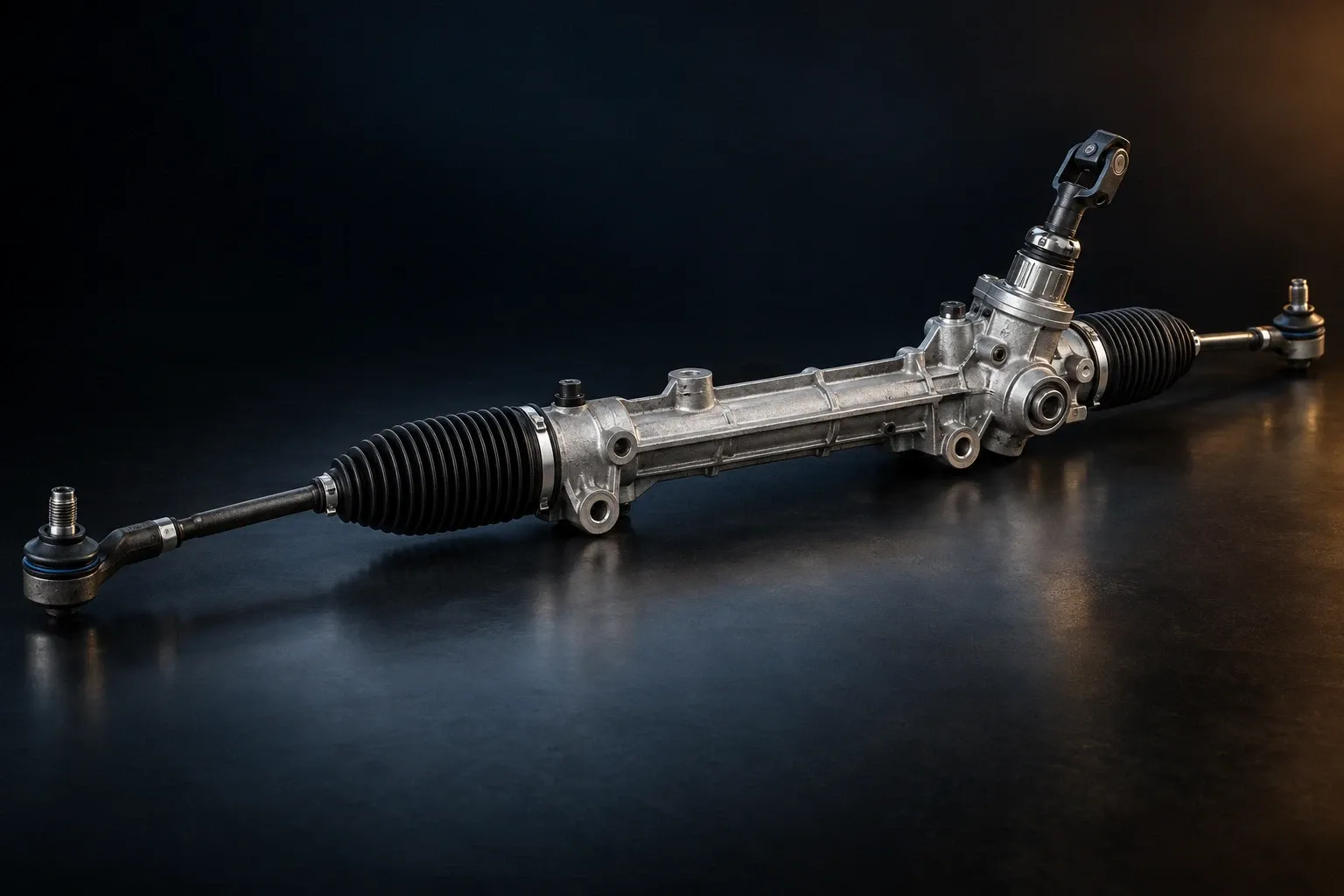
In rack and pinion steering, the steering column turns a small gear, the pinion, which meshes with a toothed bar, the rack. Turning the steering wheel slides the rack sideways, and tie rods at each end push and pull the steering arms on the front wheels' knuckles, so the wheels turn. Most modern cars add electric or hydraulic power assistance to the same mechanism.
In 3D Mechanic you run the steering sweep and watch the pinion, the rack, the tie rods and the knuckles move from lock to lock.
Turn the steering wheel
Interactive- Rack travel
- 0 mm
- Inner wheel
- 0°
- Outer wheel
- 0°
- Turning circle
- Straight
- Steering wheel and column
- Pinion
- Rack (in its housing)
- Tie rod
- Steering arm on the knuckle
- Front wheel
What happens, step by step
-
You turn the steering wheel
The column carries your turn down to the pinion, usually through one or two universal joints to get round the engine bay.
-
The pinion slides the rack
The pinion's teeth mesh with teeth along the rack, so turning it moves the rack sideways. In the typical setup shown, one turn of the steering wheel moves the rack about 48 mm.
-
Tie rods push the steering arms
Ball-jointed tie rods at each end of the rack push one steering arm and pull the other, turning both knuckles about their steering axes.
-
The inner wheel turns further
The steering arms are angled towards the rear axle, so the inner wheel turns more than the outer: 38.9° against 29.8° at full lock in this example. That is Ackermann geometry.
-
Power assistance adds force
An electric motor on the column or the rack, or a hydraulic piston on the rack, adds force in the direction you are steering, so parking takes little effort.
-
The wheels return to the centre
Caster and the lean of the steering axis give the front tyres a self-centring effect, so the steering returns towards straight ahead when you relax your grip.
What is the steering ratio?
It is the number of degrees you turn the steering wheel for each degree the front wheels turn. The pinion is small, so a full turn of the steering wheel only slides the rack a few centimetres, about 48 mm in the example shown, and the steering arms turn that into a modest change of wheel angle. Near the centre the example works out at 17.6:1, inside the usual range for road cars.
The ratio is a compromise. A quick, low ratio means less arm-twirling when parking but a twitchy car at speed; a slow one is calm on the motorway but hard work in a car park. In the example it takes 1.5 turns of the steering wheel to go from the centre to full lock.
What is Ackermann steering geometry?
When a car turns, its inner front wheel follows a tighter circle than the outer one, so it has to turn to a sharper angle or the tyres would scrub sideways. Ackermann geometry does this with nothing more than the angle of the steering arms: they point back towards the middle of the rear axle, so as the rack moves, the inner wheel’s arm swings through a larger angle than the outer one.
Turn the steering wheel in the diagram above and the two dashed axle lines swing round to point at roughly the same spot, the centre of the turn. At full lock the inner wheel turns 38.9° and the outer 29.8°, giving a turning circle of about 10.5 m.
How does power steering work?
Most new cars use electric power steering. A torque sensor in the steering column measures how hard you are turning, and an electric motor, on the column, the pinion or the rack itself, adds force to match. The assistance can change with speed, heavy at motorway speeds and light when parking, and because the motor only uses power while you steer, it saves fuel compared with a hydraulic pump.
Hydraulic systems, still common on older cars, use a pump driven by the engine. A valve around the pinion senses which way you are turning and sends pressurised fluid to one side of a piston on the rack, which pushes the rack the same way.
What do the tie rods do besides steering?
They set the toe, the small inward or outward angle of the front wheels when the car runs straight. Each outer tie rod end screws along a thread, so lengthening or shortening the rod turns that wheel slightly. Toe that is only a little out wears the edges of the tyres quickly.
Their geometry matters too. A tie rod has to swing on an arc that matches the suspension’s, or the wheel steers itself as it moves up and down, an effect called bump steer.
Why does the steering wheel return to the centre?
Because the steering axis is tilted. In the app’s MacPherson strut corner it leans back by 4°, the caster angle, so the tyre’s contact patch trails behind the axis like a shopping trolley wheel and tends to straighten up. It also leans in by 12.5° seen from the front, the steering axis inclination, which lifts the front of the car slightly as you steer, so the car’s weight helps push the wheels back to the centre.
The parts that make it work
Steering wheel and column
What it does
Carries your input to the pinion, often through one or two universal joints. The column is designed to collapse in a crash.
How it fails
Worn universal joints give a notchy or clunky feel and free play at the centre.
Pinion
What it does
A small helical gear at the bottom of the column that meshes with the rack.
How it fails
Wear leaves play around the straight-ahead position, so the car wanders and needs constant correction.
Rack
What it does
A toothed steel bar in a sealed housing across the car. Sliding it sideways steers both front wheels.
How it fails
A worn rack or worn rack bushes knock over bumps; leaks in a hydraulic rack drip fluid.
Rack gaiters US: Rack boots
What it does
Rubber bellows over each end of the rack that keep the grease in and road dirt out.
How it fails
A split gaiter lets grit and water wear the rack and its inner joints; it is a common MOT advisory.
Tie rods and tie rod ends US: Tie rods and outer tie rod ends
What it does
Ball-jointed rods from the rack to the steering arms. The outer ends screw along a thread, which is how the toe of the front wheels is set.
How it fails
Play in the joints gives vague steering, a knock over bumps and wear on the tyre edges.
Steering arms and knuckles
What it does
Arms on the knuckles that the tie rods push and pull, turning each wheel about its steering axis.
How it fails
A hard kerb strike can bend an arm and throw the alignment out.
Power assistance US: Power steering
What it does
Electric systems use a torque sensor in the column and a motor that adds force; hydraulic systems use a pump, a valve at the pinion and a piston on the rack.
How it fails
An electric fault makes the steering heavy and lights a warning; a hydraulic system whines when its fluid is low or the pump is worn.
The numbers
| Quantity | Value |
|---|---|
| Steering ratio near the centre | 17.6:1 |
| Steering wheel turns, centre to full lock | 1.5 (3 turns lock to lock) |
| Rack travel each way | 72 mm |
| Rack travel per turn of the steering wheel | 48 mm |
| Inner wheel at full lock | 38.9° |
| Outer wheel at full lock | 29.8° |
| Turning circle | 10.5 m |
| Wheelbase and track used | 2,600 mm and 1,500 mm |
| Caster and steering axis inclination | 4° and 12.5° (from the app's MacPherson strut corner) |
Typical values for a small car, not from the app's model, except the caster and steering axis inclination, which come from 3D Mechanic's MacPherson strut corner.
Common problems and what they mean
| Symptom | Likely cause | What to check |
|---|---|---|
| The steering feels heavy | A fault in the electric assistance, low power steering fluid or a failing pump | Look for a warning light and check the fluid level on hydraulic systems; have the system scanned. |
| A whine when turning, loudest at full lock | Low hydraulic fluid or a worn power steering pump | Top up with the right fluid and look for leaks at the rack and hoses. |
| A knock through the steering over bumps | Worn tie rod ends, inner rack joints or rack mounting bushes | Have the joints checked for play with the wheels off the ground. |
| The car wanders and needs constant correction | Play in the steering joints or the rack, or the alignment out | Have the steering inspected, then the alignment set. |
| The steering wheel is off centre when driving straight | Toe out of adjustment, often after hitting a kerb or after steering work | Have the wheel alignment checked and adjusted. |
UK and US names
| UK | US |
|---|---|
| Track rod | Tie rod |
| Track rod end | Outer tie rod end |
| Steering rack gaiter | Rack boot (bellows) |
| Power assisted steering (PAS) | Power steering |
| Tyre | Tire |
Questions people ask
What is the difference between rack and pinion and recirculating ball steering?
Rack and pinion uses a gear sliding a toothed bar, which is light, direct and compact, and almost every modern car uses it. Recirculating ball steering uses a worm gear with balls running in its threads to swing a lever; it survives on some heavy trucks and older off-roaders.
What is a steering ratio?
The number of degrees you turn the steering wheel for each degree the front wheels turn. Most cars sit between about 14:1 and 18:1; a lower number feels quicker. The example shown works out at 17.6:1 near the centre.
Why is my steering wheel off centre?
Usually because the toe of the front wheels has been knocked out of adjustment, by a kerb strike or by work on the steering or suspension. A wheel alignment corrects it by adjusting the tie rod ends.
How does electric power steering work?
A torque sensor in the column measures how hard you are turning, and an electric motor on the column, the pinion or the rack adds force to match. It only uses power while you steer, and it lets the car add features such as lane keeping and park assist.
