
What does a steering rack do?
A steering rack is a toothed steel bar that slides sideways in a housing across the front of the car. A small gear on the steering shaft, the pinion, meshes with it, so turning the steering wheel moves the rack, and tie rods at each end push and pull the front wheels to steer them. A bad rack knocks, leaks or feels loose.
Also called rack and pinion, steering rack and pinion, steering gear
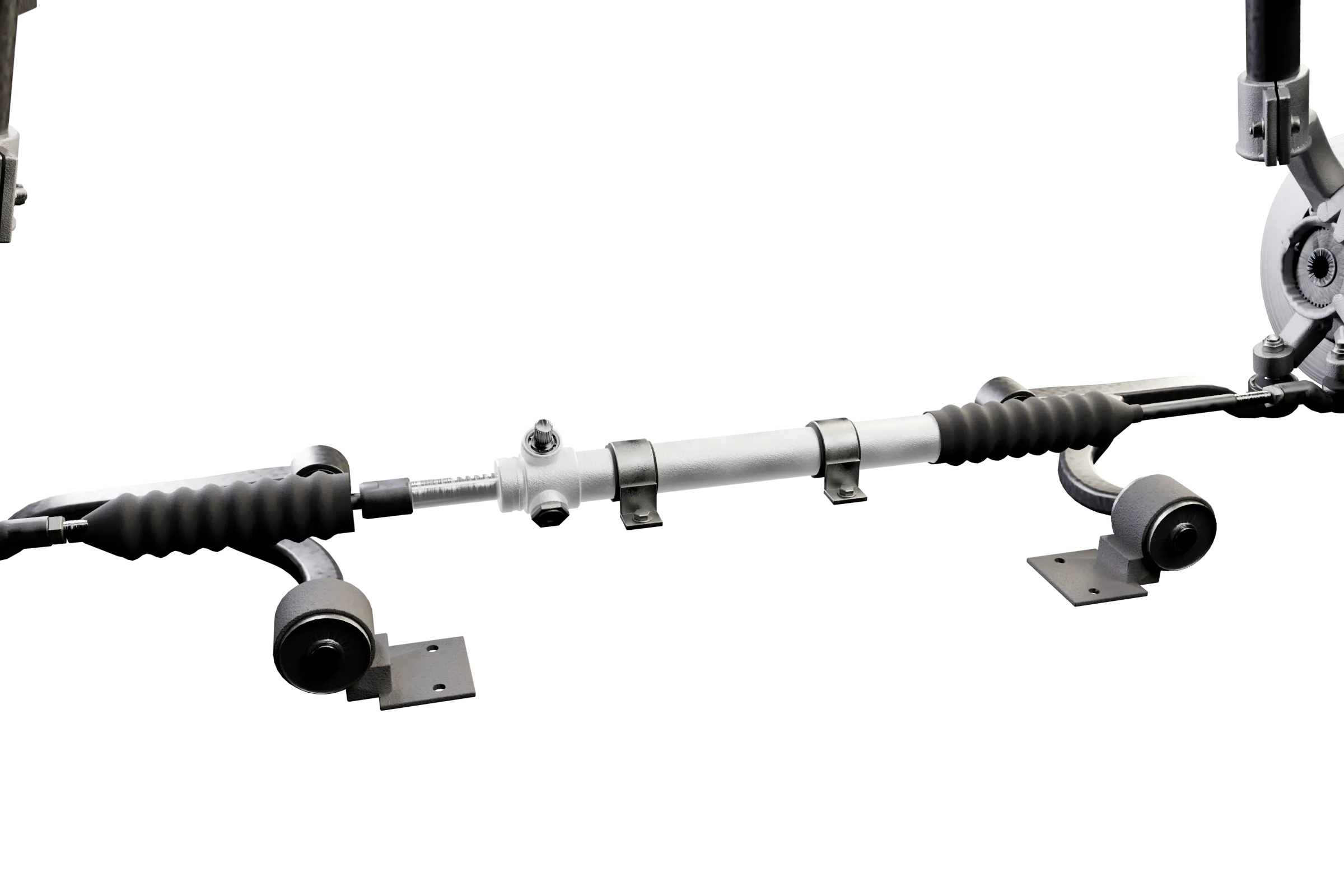
- Rack bar UK: Steering rack
- Rack-and-pinion housing UK: Steering rack housing
- Steering pinion UK: Pinion
- Rack support yoke UK: Rack yoke
- Rack boot UK: Steering rack gaiter
- Inner tie rod UK: Track rod
What does a steering rack do?
It turns rotation into a sideways push. The pinion on the end of the steering shaft meshes with teeth cut along the rack, so each turn of the steering wheel slides the rack a set distance across the car: in the app's model, 54 mm per turn and 75 mm each way to full lock. An inner tie rod screwed onto each end carries that movement out to the steering arms on the front knuckles.
The rack slides in an aluminum housing clamped across the subframe on rubber bushings. A spring-loaded yoke presses the rack into the pinion from behind so the teeth mesh with no free play, a bushing at the far end supports the bar, and rubber boots seal both ends. On cars with hydraulic power steering the rack also has a piston and seals inside the housing; most new cars put an electric motor on the column or the rack instead.
What are the symptoms of a bad steering rack?
- A knock from the front as you steer or hit bumps. A dull knock felt through the steering wheel, worst on rough roads and at low speed, often from a worn rack yoke, worn mounting bushings or worn inner joints. Why does my car clunk when I turn the steering wheel?
- Loose or vague steering. Free play around the straight-ahead position, so the car wanders and needs small corrections to hold a straight line.
- Heavy steering or a tight spot. The wheel is harder to turn at one point or all the time. On a hydraulic rack this can be failing seals; on any car it can also be the assist, so that is checked before the rack is blamed. Why is my steering wheel hard to turn?
- Fluid on the rack boots. On hydraulic power steering, red or clear fluid wetting the boots or dripping under the front of the car means the rack's seals are leaking.
- Grinding or notchiness. A rough feel through the wheel as you turn it, from worn teeth or grit that got in through a torn boot.
Can you drive with a bad steering rack?
Have it checked before you drive far
Only carefully, and not far. A worn rack still steers the car, but play makes it wander and the knock usually grows. A rack that binds, catches or leaks heavily can make the steering suddenly heavy or slow to respond, which is dangerous in traffic. Have it inspected before you drive far, and stop driving at once if the steering sticks, jumps or fails to return. In states with safety inspections, too much free play in the steering fails.
How do you tell a bad rack from a bad tie rod?
By watching where the play is. With the car on its wheels and the engine off, have a helper rock the steering wheel a little each way while you look under the front. If the tie rod moves before the wheel does, the joint you are watching is worn: an outer tie rod end at the knuckle, or an inner tie rod under the boot. If the whole rack housing shifts in its clamps, the mounting bushings are worn. If the shaft turns but the rack lags, the play is inside the rack, at the pinion or the yoke.
A knock that comes only on rough roads, with no play you can see, often points to the yoke. Some racks have an adjuster plug for it that a technician can set; others are replaced as a unit.
What does replacing a steering rack involve?
- Center the steering wheel and lock it so the airbag clock spring cannot be wound, then raise the front of the car onto jack stands and remove both front wheels.
- Separate both tie rod ends from the steering arms, and mark the intermediate shaft's joint on the pinion before unbolting it.
- On hydraulic power steering, drain the system and disconnect the pressure and return lines; on an electric rack, unplug its connectors.
- Unbolt the rack's mounting brackets and lift the rack out, often with the subframe lowered a little for room.
- Transfer the tie rod ends at the same thread position, install the new rack with new bushings and refit everything in reverse.
- Bleed a hydraulic system, then have the wheel alignment set: a new rack always moves the toe.
Tighten every nut and bolt to the torque spec in the manufacturer's service manual for your car.
A rack is usually replaced as a complete unit, often a remanufactured one, by a shop. The alignment must be set afterward, and on many new cars the steering angle sensor needs calibrating too.
Questions people ask
Is a steering rack the same as rack and pinion?
Yes, in everyday use. Rack and pinion is the type of steering, and the steering rack is the assembly: the toothed bar, the pinion, the housing and the parts inside it. Some shops call it the steering gear.
How long does a steering rack last?
On many cars it lasts the life of the car, often well over 100,000 miles (160,000 km). Torn boots, hard impacts and, on hydraulic racks, old fluid are what shorten it.
Can a steering rack be repaired instead of replaced?
Some parts can: boots, inner tie rods, the yoke adjustment and the mounting bushings are all replaced or set on the car. Worn teeth or leaking internal seals usually mean a new or remanufactured rack.
Can a bad steering rack cause vibration?
It can add to it. Play in the rack or its bushings lets the wheels shimmy over ridges, but a vibration is more often a wheel out of balance or a warped brake rotor, so those are checked first.
Related
Symptoms
- Why does my car clunk when I turn the steering wheel? A clunk when you turn the steering wheel usually means something in the steering or front suspension has worn loose: a tie rod end or inner tie rod, the steering rack's mounting bushings, a U-joint on the intermediate shaft or a strut mount bearing.
- Why is my steering wheel hard to turn? A steering wheel that is hard to turn usually means the power steering assist has failed or been cut back.
- What causes a knocking noise over bumps? A knocking or clunking noise over bumps usually comes from a worn joint in the front suspension.
Parts nearby
- What does a steering rack boot do? A steering rack boot is the rubber bellows over each end of the steering rack.
- What is an inner tie rod? An inner tie rod is the rod that screws onto each end of the steering rack, with a ball joint at its inner end, under the rack boot.
- What do steering rack bushings do? Steering rack bushings are the rubber or polyurethane mounts that clamp the steering rack's housing to the subframe.
- What is a tie rod end? A tie rod end is the ball joint at the outer end of each tie rod, where the steering connects to the front wheel.
The whole system
- How does rack and pinion steering work? The rack and pinion steering, part by part, with an interactive diagram.
