
What does a steering rack boot do?
A steering rack boot is the rubber bellows over each end of the steering rack. It keeps grease in and water and grit out of the rack and the inner tie rod joint while they move. A torn boot is quick to replace, but left alone it lets dirt in to wear the rack and the joint inside it.
UK steering rack gaiter Also called rack and pinion boot, rack boot, tie rod boot
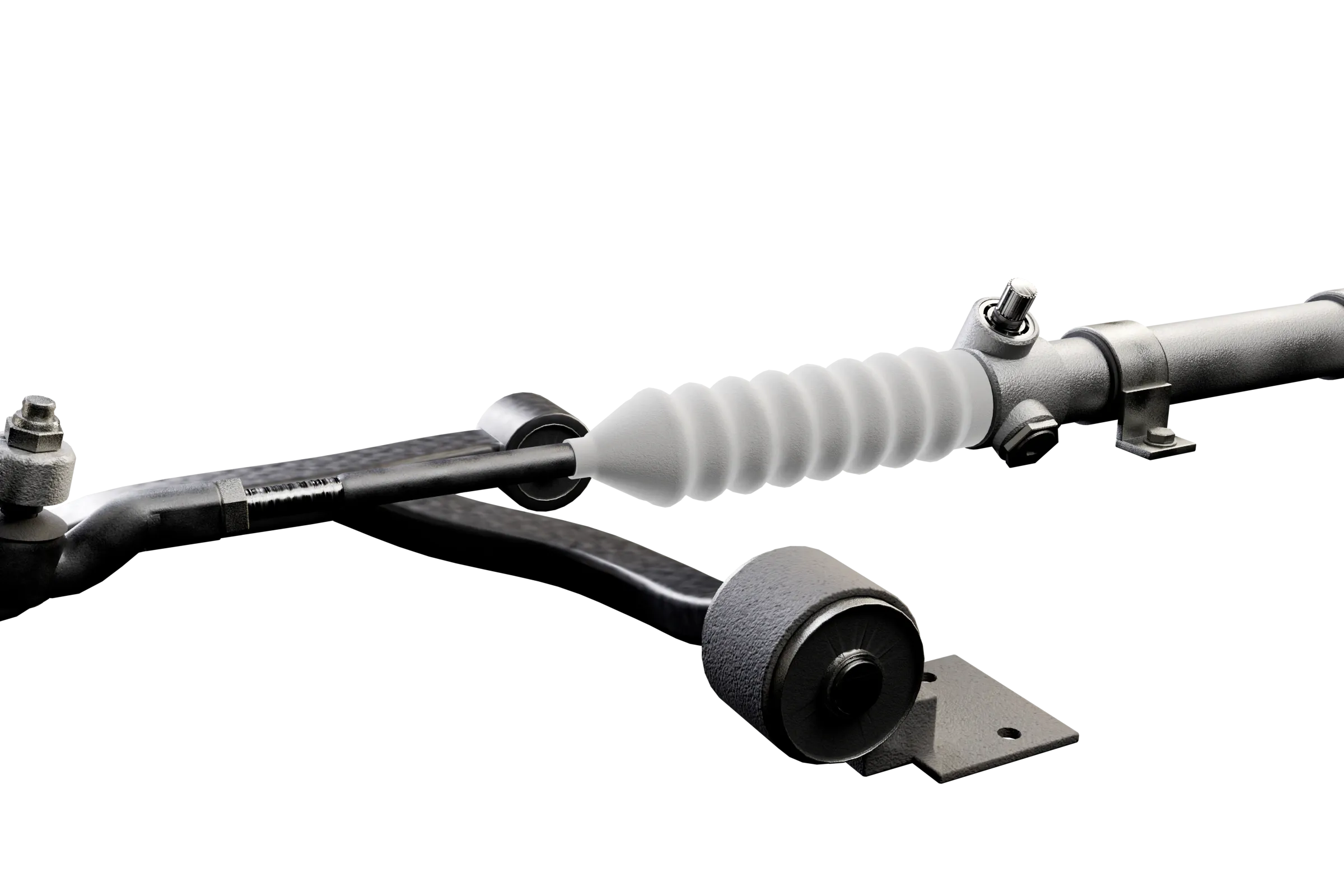
- Rack boot UK: Steering rack gaiter
- Inner tie rod UK: Track rod
- Rack-and-pinion housing UK: Steering rack housing
- Outer tie rod end UK: Track rod end
- Steering knuckle
What does a steering rack boot do?
It seals the moving end of the rack. Each boot is clamped to the rack housing at one end and to the inner tie rod at the other, covering the inner joint where the rod screws onto the rack. As you steer, the rack slides in and out and the boot's folds stretch on one side and squash on the other, so the seal holds through the whole travel.
Inside, the inner joint and the rack's teeth run in grease. The boot keeps it there and keeps road water, salt and grit out. On racks with hydraulic power steering, the boots also show a leak early: fluid from the rack's seals collects in them.
How do you know if a rack boot is torn?
- A split or a hole you can see. Turn the steering to full lock so the boot on the outside of the turn stretches, then look at each fold from behind the front wheel. Cracks usually open in the deepest folds.
- Grease flung around the boot. Dark grease on the boot's outside, the tie rod or the subframe near it, often thrown out as the boot flexes.
- A boot that has come off its clamp. The small end slides along the tie rod, often after the outer end was replaced and the clip was not refitted.
- Fluid inside the boot. On hydraulic racks, a boot that bulges with fluid means the rack's seals are leaking and the rack itself needs attention.
- A knock or vague steering, later on. Once dirt has got in, the inner joint wears, and the knock and play of a worn inner tie rod follow. Why does my car clunk when I turn the steering wheel?
Can you drive with a torn rack boot?
Fix it soon
Yes, for now. A torn boot does not change how the car steers today, so there is no immediate danger. But every wet or salty mile lets more grit into the inner joint and the rack, and those cost far more to put right than the boot. Have it replaced soon, and have the inner joint checked for play at the same time: if it already knocks, the inner tie rod is replaced together with the boot.
How often should you check the rack boots?
Every time the car is up for an oil change or new tires is a good habit, and any time a tie rod end is replaced. Rubber hardens and cracks with age and heat, and the boot nearest the exhaust usually goes first.
A quick check needs no tools. With the car parked on level ground, turn the steering wheel to full lock one way and look behind the front wheel on the outside of the turn, where the boot is stretched and its folds are open. Then turn to the other lock and look at the other side. On front-wheel-drive cars a CV boot sits close by, so it is worth looking at both while you are there.
What does replacing a rack boot involve?
- Time
- About 1 hour 15 minutes
- Difficulty
- Moderate
- Parts
-
- A rack boot kit: boot and two clips
- A new nylon lock nut for the tie-rod end
- Chock the wheels, loosen the lug nuts, raise that side onto a jack stand and take the wheel off.
- Mark the outer tie rod end's jam nut on the rod with paint, loosen it, then free the end's taper from the steering arm and unscrew the end, counting the turns.
- Cut the old boot's clips and slide the boot off over the tie rod.
- Clean the inner joint, check it for play and add grease if the boot kit comes with it.
- Slide the new boot on, seat both ends in their grooves and fit the new clips with clamp pliers.
- Screw the tie rod end back on by the same number of turns to your mark, fit it to the steering arm with a new nut and tighten the jam nut.
- Reinstall the wheel, lower the car and have the alignment checked.
Tools
- Wheel chocks
- Breaker bar
- Socket and ratchet
- Floor jack (UK: trolley jack)
- Jack stand (UK: axle stand)
- Paint marker (UK: paint pen)
- Open-end wrench (UK: open-ended spanner)
- Box-end wrench (UK: ring spanner)
- Ball joint separator (UK: ball-joint splitter)
- Diagonal cutters (UK: side cutters)
- CV boot clamp pliers (UK: boot clamp pliers)
- Torque wrench
- Crowfoot wrench (UK: crow's-foot spanner)
Work safely
- Work on firm, level ground with the parking brake on and the other wheels chocked.
- Never work under a car held only by a jack: set it on a jack stand.
- Have the alignment checked after any track-rod work: a small error wears the tires fast.
Tighten every nut and bolt to the torque spec in the manufacturer's service manual for your car.
It is one of the simpler steering repairs, and a boot kit includes the boot and its clips. Taking the tie rod end off moves the toe a little, so an alignment check afterward is worth it.
Questions people ask
What is the difference between a rack boot and a CV boot?
Both are rubber bellows over a moving joint. The rack boot covers the end of the steering rack and the inner tie rod; a CV boot covers a joint on the axle shaft that drives the wheel. They sit close together on front-wheel-drive cars but are not interchangeable.
Can a rack boot be replaced without removing the tie rod end?
Usually not, unless you use a split boot designed to be glued or clipped around the rod. Most kits are a solid boot that slides on over the rod once the outer end is off.
Why does my rack boot have fluid in it?
On a car with hydraulic power steering, fluid in the boot comes from a leaking seal inside the rack. A new boot will not stop it: the rack's seals need repair or the rack needs replacing. Electric racks have no fluid, so they never show this.
Related
Symptoms
- Why does my car clunk when I turn the steering wheel? A clunk when you turn the steering wheel usually means something in the steering or front suspension has worn loose: a tie rod end or inner tie rod, the steering rack's mounting bushings, a U-joint on the intermediate shaft or a strut mount bearing.
Parts nearby
- What is an inner tie rod? An inner tie rod is the rod that screws onto each end of the steering rack, with a ball joint at its inner end, under the rack boot.
- What does a steering rack do? A steering rack is a toothed steel bar that slides sideways in a housing across the front of the car.
- What is a tie rod end? A tie rod end is the ball joint at the outer end of each tie rod, where the steering connects to the front wheel.
- What does a CV boot do? A CV boot is the rubber or thermoplastic bellows over each joint on a CV axle.
The whole system
- How does rack and pinion steering work? The rack and pinion steering, part by part, with an interactive diagram.
