
Why does my car clunk when I turn the steering wheel?
A clunk when you turn the steering wheel usually means something in the steering or front suspension has worn loose: a tie rod end or inner tie rod, the steering rack's mounting bushings, a U-joint on the intermediate shaft or a strut mount bearing. Where you feel it, and whether the car is moving, narrows it down. Have it checked soon, because worn steering joints get worse.
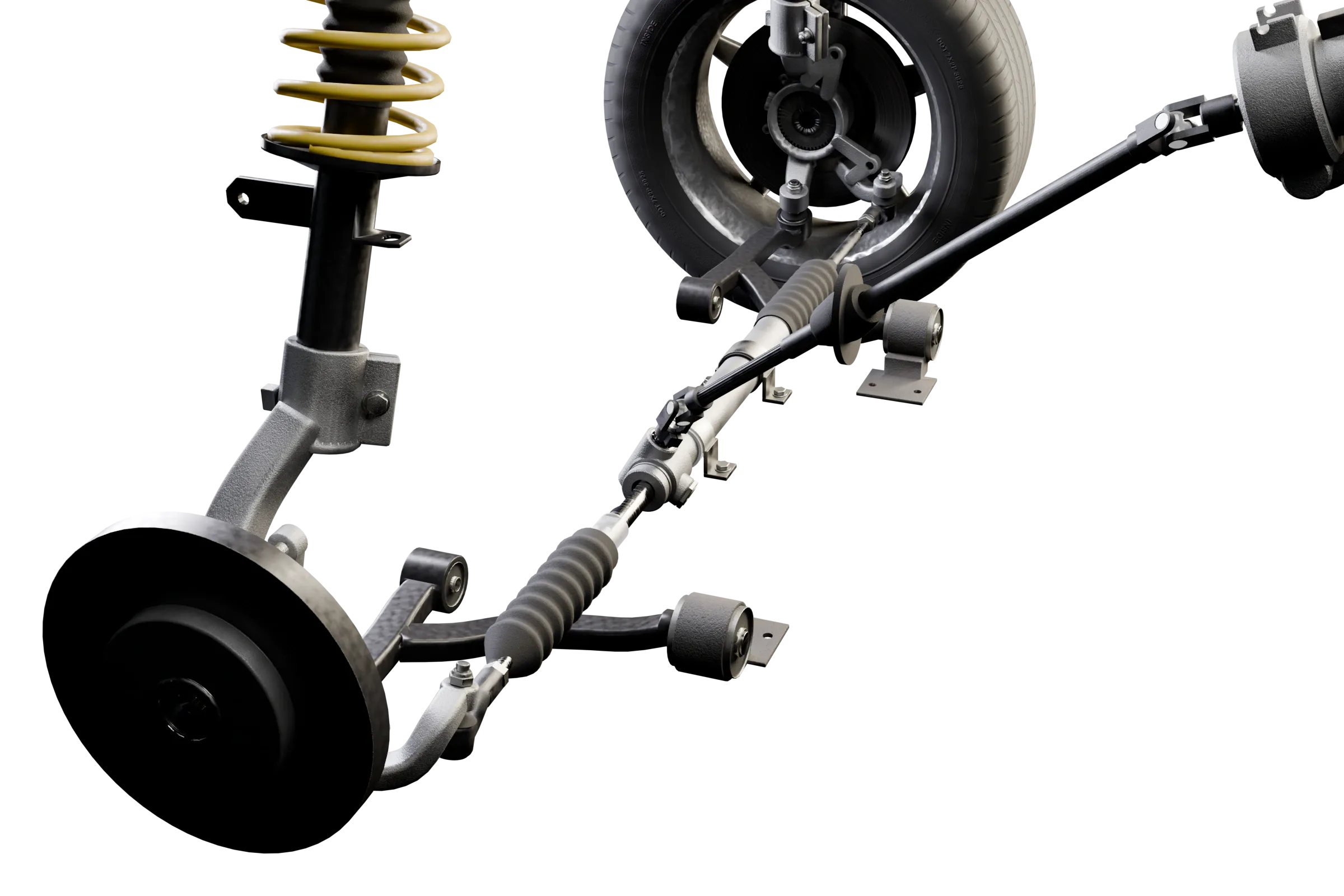
- Intermediate steering shaft UK: Intermediate shaft
- Lower u-joint cross UK: Lower universal joint spider
- Rack mount bushing UK: Rack mounting bush
- Inner tie rod socket UK: Inner track rod joint
- Outer tie rod end UK: Track rod end
The likely causes, most common first
-
Worn tie rod ends or inner tie rods
Most likelyHow it shows A knock from the front wheels as you turn and over bumps, with vague steering around straight ahead.
Check With the wheel off the ground, have a helper rock the tire at nine and three o'clock while you watch each joint for play.
Have it checked soon
-
A worn strut mount bearing
CommonHow it shows A clunk or creak from the top of the strut as you turn the wheel, often while parked, sometimes felt as a notch.
Check Put a hand on the top of the spring inside the engine bay while a helper turns the wheel: a clunk or jump you can feel there is the mount.
Have it checked soon
-
Worn steering rack bushings
CommonHow it shows A clunk as you start each turn and change direction, with a slight delay before the car responds.
Check With the engine off, have a helper rock the wheel while you watch whether the rack housing shifts in its clamps.
Have it checked soon
-
How it shows A clunk or click you feel in the steering wheel itself, from under the dashboard or by the firewall, often while parked.
Check Hold each U-joint on the shaft while a helper turns the wheel back and forth through center; feel for a click or play.
Have it checked soon
-
A loose rack yoke or worn rack
Less likelyHow it shows A knock through the steering on rough roads and as you turn at low speed, with no play in the joints.
Check A shop can check the rack for internal play and adjust the yoke on racks that allow it.
Have it checked soon
-
A worn ball joint or control arm bushing
Less likelyHow it shows A clunk from a front corner over bumps and when turning, sometimes with a pull under braking.
Check With the wheel off the ground, rock the tire at twelve and six o'clock: play there points to a ball joint.
Have it checked soon
-
A worn power steering worm gear
Less likelyHow it shows On column-mounted electric power steering, a knock from inside the column as you turn or over bumps.
Check With the engine off, feel at the column under the dashboard while a helper turns the wheel; a shop can confirm it.
Have it checked soon
How to narrow it down
- Note when it clunks. Only while parked or at walking pace points to the strut mounts, the shaft or the rack mounts; over bumps as well points to the joints and bushings.
- Note where you feel it. In the steering wheel itself points to the column or intermediate shaft; from a front wheel points to the joints and strut.
- Look at the rack boots and tie rod ends for tears or grease, and at the tires for edge wear.
- With the engine off and the wheels on the ground, have a helper rock the steering wheel a little each way while you watch and listen under the front.
- Have a shop check every joint for play on a lift: with the car on its wheels and with them off the ground.
Is it safe to drive with a clunk when turning?
Have it checked before you drive far
Usually for a short distance, but have it checked before you drive far. A clunk means something has worn loose, and in the steering that play grows: a tie rod or shaft joint that separates leaves a wheel no longer controlled by the steering wheel. Stop driving at once if the steering feels loose, binds, jumps or the car pulls suddenly.
Where is the clunk coming from?
Feel and listen in three places. In the steering wheel itself, a click you feel in your hands as you rock the wheel back and forth points to the intermediate shaft or, on column-mounted electric power steering, the worm gear inside the column. At the top of the strut, a hand on the spring or the strut mount in the engine bay picks up a worn mount bearing. Under the front, watching each joint while a helper rocks the wheel shows a worn inner tie rod, tie rod end or rack mount.
If the clunk only happens while driving through a corner, and it is a rhythmic click rather than a single knock, read why a car clicks when turning: that is usually an axle joint, not the steering.
Questions people ask
Why does my car clunk when turning the steering wheel while parked?
With the car stopped, the steering is under the most load and nothing masks the noise, so worn strut mount bearings, rack bushings and intermediate shaft joints show up there first. A clunk only at speed over bumps points more to tie rods, ball joints and bushings.
Is a clunk the same as a clicking noise when turning?
No. A rhythmic clicking that speeds up with the car, loudest on full lock while driving, is usually a worn outer CV joint on the axle. A single clunk as you turn the wheel points to the steering or the strut mount.
Can low power steering fluid cause a clunk?
Not usually a clunk. Low fluid on hydraulic systems gives a whine or groan and heavy steering. A clunk points to play in a joint, a mount or the rack.
Related
The parts
- What is an inner tie rod? An inner tie rod is the rod that screws onto each end of the steering rack, with a ball joint at its inner end, under the rack boot.
- What do steering rack bushings do? Steering rack bushings are the rubber or polyurethane mounts that clamp the steering rack's housing to the subframe.
- What does an intermediate steering shaft do? The intermediate steering shaft is the short shaft that runs from the bottom of the steering column, through the firewall, to the pinion on the steering rack.
- What does a steering rack do? A steering rack is a toothed steel bar that slides sideways in a housing across the front of the car.
- What does a ball joint do? A ball joint is the ball-and-socket joint that connects a suspension arm to the wheel's steering knuckle.
- What does a power steering motor do? A power steering motor is the electric motor that helps you turn the steering wheel on cars with electric power steering.
Similar symptoms
- Why is my steering wheel hard to turn? A steering wheel that is hard to turn usually means the power steering assist has failed or been cut back.
- What causes a knocking noise over bumps? A knocking or clunking noise over bumps usually comes from a worn joint in the front suspension.
- Why does my car click when turning? A clicking noise when you turn, loudest at full lock as you start moving, is usually a worn outer CV joint on a front CV axle, most often after its boot has torn.
- What causes a grinding noise when braking? A grinding noise when you brake usually means the brake pads have worn through their friction material, so their steel backing plates are scraping the brake rotors.
