
What is an inner tie rod?
An inner tie rod is the rod that screws onto each end of the steering rack, with a ball joint at its inner end, under the rack boot. It carries the rack's push and pull out to the outer tie rod end at the wheel. A worn one knocks, makes the steering vague and lets the toe wander, much like a worn outer end.
UK track rod Also called inner tie rod end, inner track rod joint, rack end
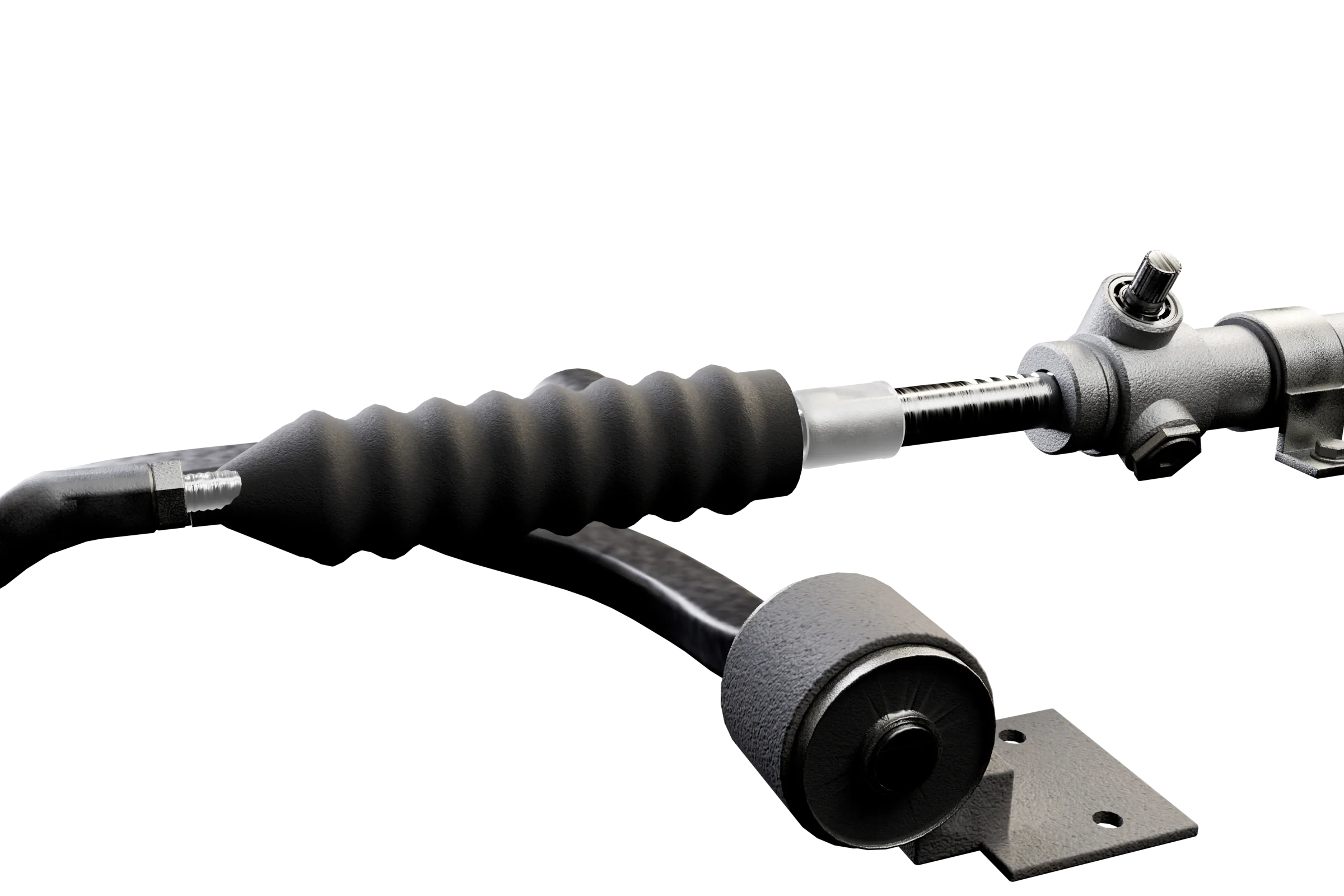
- Inner tie rod UK: Track rod
- Inner tie rod socket UK: Inner track rod joint
- Rack boot UK: Steering rack gaiter
- Outer tie rod end UK: Track rod end
- Rack bar UK: Steering rack
What does an inner tie rod do?
It links the rack to the wheel. The inner tie rod has a ball joint at its inner end, an axial joint that screws onto the end of the rack, and a threaded outer end that the outer tie rod end screws onto. As the rack slides across the car, the rod pushes one steering arm and pulls the other, and its ball swings in the socket as the wheel steers and moves up and down over bumps.
Its length, with the outer end's position on the thread, sets the toe. In the app's model the rod is 340 mm between its ball centers, and one turn of the rod in its end changes the toe by 0.57°, so even small changes show up in the alignment. The inner joint sits under the rack boot, which keeps its grease in and grit out.
What are the symptoms of a bad inner tie rod?
- A knock from the front when steering or over bumps. A dull knock or clunk near the front wheels, often felt through the steering wheel at low speed and on rough roads. Why does my car clunk when I turn the steering wheel?
- Vague or wandering steering. Free play around the straight-ahead position, so the car drifts and needs constant small corrections.
- Tires wearing on one edge. Play in the joint lets the toe change as you drive, which scrubs the inner or outer shoulder of the front tires. What causes uneven tire wear?
- The steering wheel off center. A worn or bent rod lets the toe shift, so the steering wheel sits crooked when the car goes straight. Why is my steering wheel off center?
- Play you can feel through the boot. With the front wheel off the ground, squeeze the rack boot around the inner joint while a helper rocks the tire side to side: a clunk or movement at the joint means it is worn.
Can you drive with a bad inner tie rod?
Have it checked before you drive far
Not far. A worn inner tie rod still steers the wheel, but the play grows and the car wanders more as it does. If the joint separates, that wheel is no longer held by the steering: it can turn on its own and the car can swerve without warning. Have a worn one replaced before you drive far, and stop driving if the steering suddenly feels loose or the car pulls hard.
How do you know whether it is the inner or the outer tie rod?
By watching each joint while the wheel is rocked. Raise the front of the car safely so the wheel is clear of the ground, and have a helper push and pull the tire at the sides, at nine and three o’clock, as if steering. Look first at the outer tie rod end: if the rod moves but the steering arm lags, or the stud knocks in its socket, the outer end is worn.
If the outer end is tight, feel the rack boot around the inner joint with your hand while the tire is rocked. A clunk or a sideways shift you can feel through the rubber is the inner joint. A worn inner joint often goes with a torn rack boot, so look at the boot while you are there.
What does replacing an inner tie rod involve?
- Time
- About 2 hours
- Difficulty
- Demanding
- Parts
-
- A new inner tie rod (inner joint and rod)
- A rack boot kit: boot and two clips
- A new nylon lock nut for the tie-rod end
- Chock the wheels, loosen the lug nuts, raise that side onto a jack stand and take the wheel off.
- Mark the outer tie rod end's jam nut on the rod with paint, then free the end's taper from the steering arm and unscrew the end, counting the turns.
- Cut the rack boot's clips and slide the boot off to reach the inner joint.
- Unscrew the inner tie rod from the end of the rack with an inner tie rod tool, holding the rack still.
- Screw the new inner tie rod onto the rack, then fit a new boot with new clips.
- Screw the outer end onto the new rod by the same number of turns, fit it to the steering arm with a new nut and tighten the jam nut.
- Reinstall the wheel, lower the car and have the alignment set.
Tools
- Wheel chocks
- Breaker bar
- Socket and ratchet
- Floor jack (UK: trolley jack)
- Jack stand (UK: axle stand)
- Paint marker (UK: paint pen)
- Open-end wrench (UK: open-ended spanner)
- Box-end wrench (UK: ring spanner)
- Ball joint separator (UK: ball-joint splitter)
- Diagonal cutters (UK: side cutters)
- Inner tie rod tool (UK: inner track-rod tool)
- Torque wrench
- CV boot clamp pliers (UK: boot clamp pliers)
- Crowfoot wrench (UK: crow's-foot spanner)
Work safely
- Work on firm, level ground with the parking brake on and the other wheels chocked.
- Never work under a car held only by a jack: set it on a jack stand.
- Have the alignment checked after any track-rod work: a small error wears the tires fast.
Tighten every nut and bolt to the torque spec in the manufacturer's service manual for your car.
The inner tie rod is often replaced together with the outer end and the boot, since all three are already off. An alignment afterward is not optional: a new rod is never exactly the old one's length.
Questions people ask
What is the difference between an inner and an outer tie rod?
The outer one is the tie rod end at the wheel, a ball joint with a tapered stud in the steering arm. The inner one is the rod itself, with a ball joint at its inner end screwed onto the rack under the boot. Both wear and give a knock and vague steering, so a shop checks both.
Do you need a special tool for an inner tie rod?
Usually yes. The inner joint has flats or a round body that an ordinary wrench cannot grip in the space under the boot, so an inner tie rod tool, a socket on a long shaft, is used to unscrew it from the rack.
Should you replace both inner tie rods at once?
Only if both are worn. They wear at similar rates, so the other side is worth checking while the car is up, but a good joint can stay.
Related
Symptoms
- Why does my car clunk when I turn the steering wheel? A clunk when you turn the steering wheel usually means something in the steering or front suspension has worn loose: a tie rod end or inner tie rod, the steering rack's mounting bushings, a U-joint on the intermediate shaft or a strut mount bearing.
- What causes uneven tire wear? Uneven tire wear usually means the wheel alignment is off, the tire pressures are wrong or a suspension part is worn, and the pattern points to which.
- Why is my steering wheel off center? A steering wheel that sits off center while the car drives straight usually means the front toe is out of adjustment, or the tie rods were set unevenly at the last alignment.
Parts nearby
- What is a tie rod end? A tie rod end is the ball joint at the outer end of each tie rod, where the steering connects to the front wheel.
- What does a steering rack boot do? A steering rack boot is the rubber bellows over each end of the steering rack.
- What does a steering rack do? A steering rack is a toothed steel bar that slides sideways in a housing across the front of the car.
- What do steering rack bushings do? Steering rack bushings are the rubber or polyurethane mounts that clamp the steering rack's housing to the subframe.
Explained
- Toe in vs toe out: what's the difference? Toe is the angle of a pair of wheels seen from above. With toe in, their fronts point slightly toward each other; with toe out, slightly apart.
The whole system
- How does rack and pinion steering work? The rack and pinion steering, part by part, with an interactive diagram.
