
Why is my steering wheel off center?
A steering wheel that sits off center while the car drives straight usually means the front toe is out of adjustment, or the tie rods were set unevenly at the last alignment. A curb strike that bends a tie rod or knuckle, worn steering joints and a road that slopes to one side can do it too. An alignment check finds which.
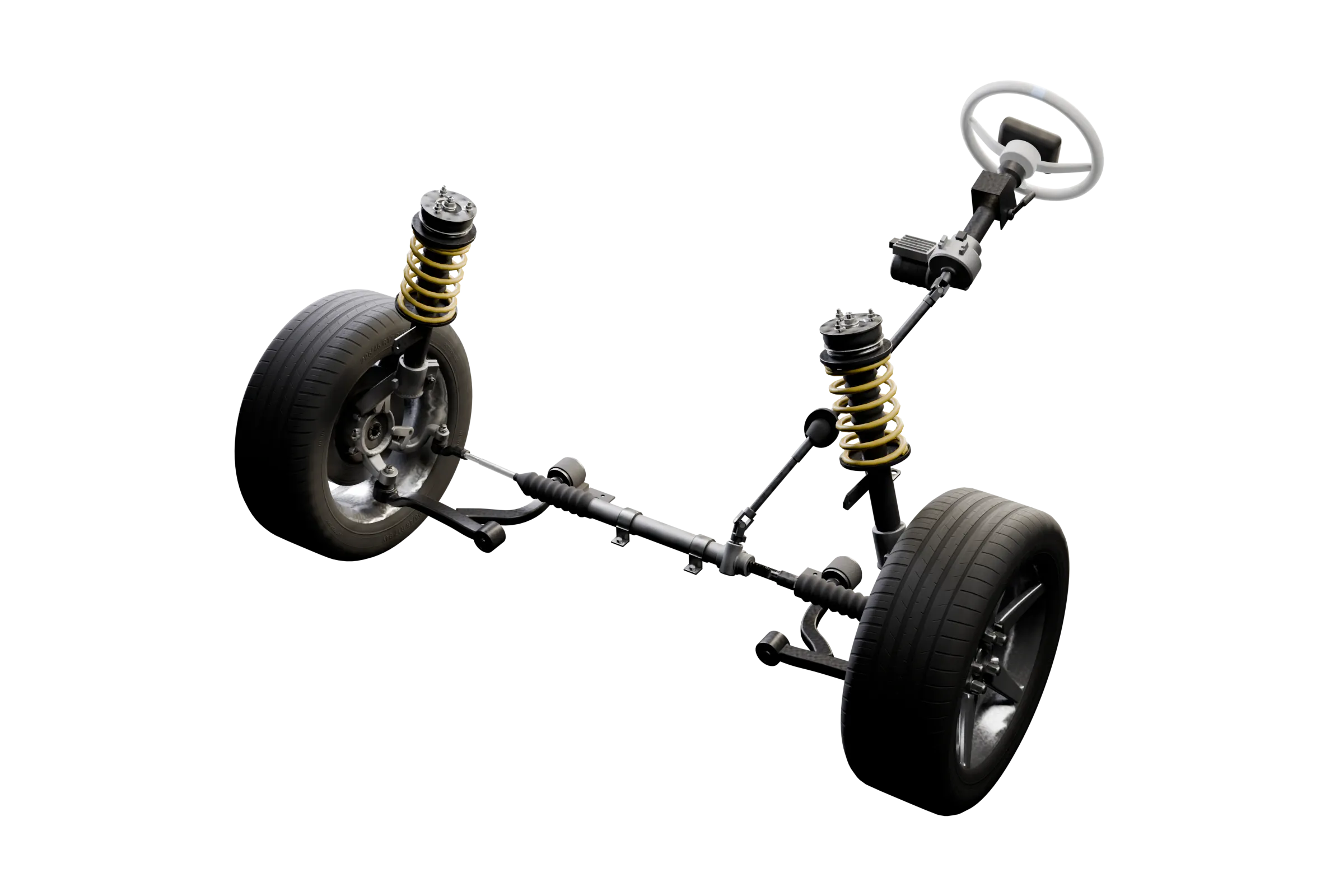
- Steering wheel
- Inner tie rod UK: Track rod
- Inner tie rod UK: Track rod
- Rack bar UK: Steering rack
- Wheel and tire UK: Road wheel and tyre
The likely causes, most common first
-
Toe out of adjustment
Most likelyHow it shows The car tracks straight, but the steering wheel sits turned a few degrees one way.
Check Have the alignment checked: both front toe settings and whether the steering wheel was centered when they were set.
Fix it soon
-
A recent alignment or steering repair set unevenly
CommonHow it shows The wheel has been crooked since an alignment, new tie rods or a new rack.
Check Take it back to the shop that did the work: the tie rods need adjusting evenly with the wheel held straight.
Fix it soon
-
How it shows Off center suddenly after hitting a curb or a pothole, sometimes with a new pull or vibration.
Check Have the tie rods and the steering arm checked for bends before the alignment is reset.
Have it checked soon
-
A bent steering knuckle or control arm
Less likelyHow it shows Off center after a hard impact, with alignment that cannot be brought back into range.
Check A shop compares the angles side to side and measures the suspension parts.
Have it checked soon
-
Worn tie rod ends or inner joints
Less likelyHow it shows The wheel sits differently from day to day, with vague steering and a knock over bumps.
Check Have the steering joints checked for play before an alignment, since a worn joint will not hold the setting.
Have it checked soon
-
A road that slopes to one side
Less likelyHow it shows The wheel sits slightly turned on most roads, which are crowned to drain, but centered on a flat one.
Check Drive on a flat, level road or a parking lot: if the wheel centers there, the car is fine.
Fix it soon
How to narrow it down
- Note when it started: since an alignment or steering repair, after a curb strike, or slowly over time.
- Drive straight on a flat, level road at a steady speed and see how far the wheel sits from center, and whether the car also pulls.
- Look at the front tires for wear on one edge, which shows the toe is off.
- Have the steering joints checked for play, then the wheel alignment set with the steering wheel held centered.
Is it safe to drive with the steering wheel off center?
Have it checked before you drive far
Usually yes, for now, if the car drives straight and the steering feels normal. The crooked wheel itself is not a danger, but the toe error behind it wears the front tires and can affect how the car behaves under hard braking. If it started after an impact, or comes with a pull, a vibration or a knock, have it checked before you drive far: a bent tie rod or knuckle is a safety issue.
How does an alignment center the steering wheel?
By adjusting the toe on each side evenly. The shop holds the steering wheel straight, often with a clamp, then turns each inner tie rod in its end until that wheel’s toe is right. Because each tie rod is adjusted separately, the two sides can each be correct while the steering wheel ends up straight: in the app’s steering model, one turn of a tie rod changes the toe by 0.57°, so small turns make a visible difference.
If one tie rod is turned and not the other, the wheels still point straight but the steering wheel shifts off center. That is the commonest reason a wheel is crooked after an alignment, and it is fixed the same way, with both tie rods adjusted together. A wheel that will not stay centered from week to week points instead to worn joints that need replacing first.
Questions people ask
Why is my steering wheel off center but the car drives straight?
Because the steering wheel's position and the direction the wheels point are set separately. If one tie rod is longer than the other, the wheels can be straight while the steering wheel is turned. Adjusting both tie rods evenly with the wheel held centered fixes it.
Why is my steering wheel off center after an alignment?
Usually because the steering wheel was not held centered while the toe was set, or the tie rods were adjusted on one side only. It is a quick correction for the shop that did the alignment.
Can you fix an off-center steering wheel by moving it on the spline?
Not properly. Moving the wheel on the column's spline hides the problem but leaves the tie rods uneven, which can upset the steering angle sensor that stability control relies on. The toe is adjusted instead.
Related
The parts
- What is an inner tie rod? An inner tie rod is the rod that screws onto each end of the steering rack, with a ball joint at its inner end, under the rack boot.
- What is a steering knuckle? A steering knuckle is the cast part at each front wheel that carries the wheel bearing and hub.
- What is a tie rod end? A tie rod end is the ball joint at the outer end of each tie rod, where the steering connects to the front wheel.
Similar symptoms
- What causes uneven tire wear? Uneven tire wear usually means the wheel alignment is off, the tire pressures are wrong or a suspension part is worn, and the pattern points to which.
- Why does my car clunk when I turn the steering wheel? A clunk when you turn the steering wheel usually means something in the steering or front suspension has worn loose: a tie rod end or inner tie rod, the steering rack's mounting bushings, a U-joint on the intermediate shaft or a strut mount bearing.
- Why is my steering wheel hard to turn? A steering wheel that is hard to turn usually means the power steering assist has failed or been cut back.
- What causes a knocking noise over bumps? A knocking or clunking noise over bumps usually comes from a worn joint in the front suspension.
Explained
- Toe in vs toe out: what's the difference? Toe is the angle of a pair of wheels seen from above. With toe in, their fronts point slightly toward each other; with toe out, slightly apart.
