
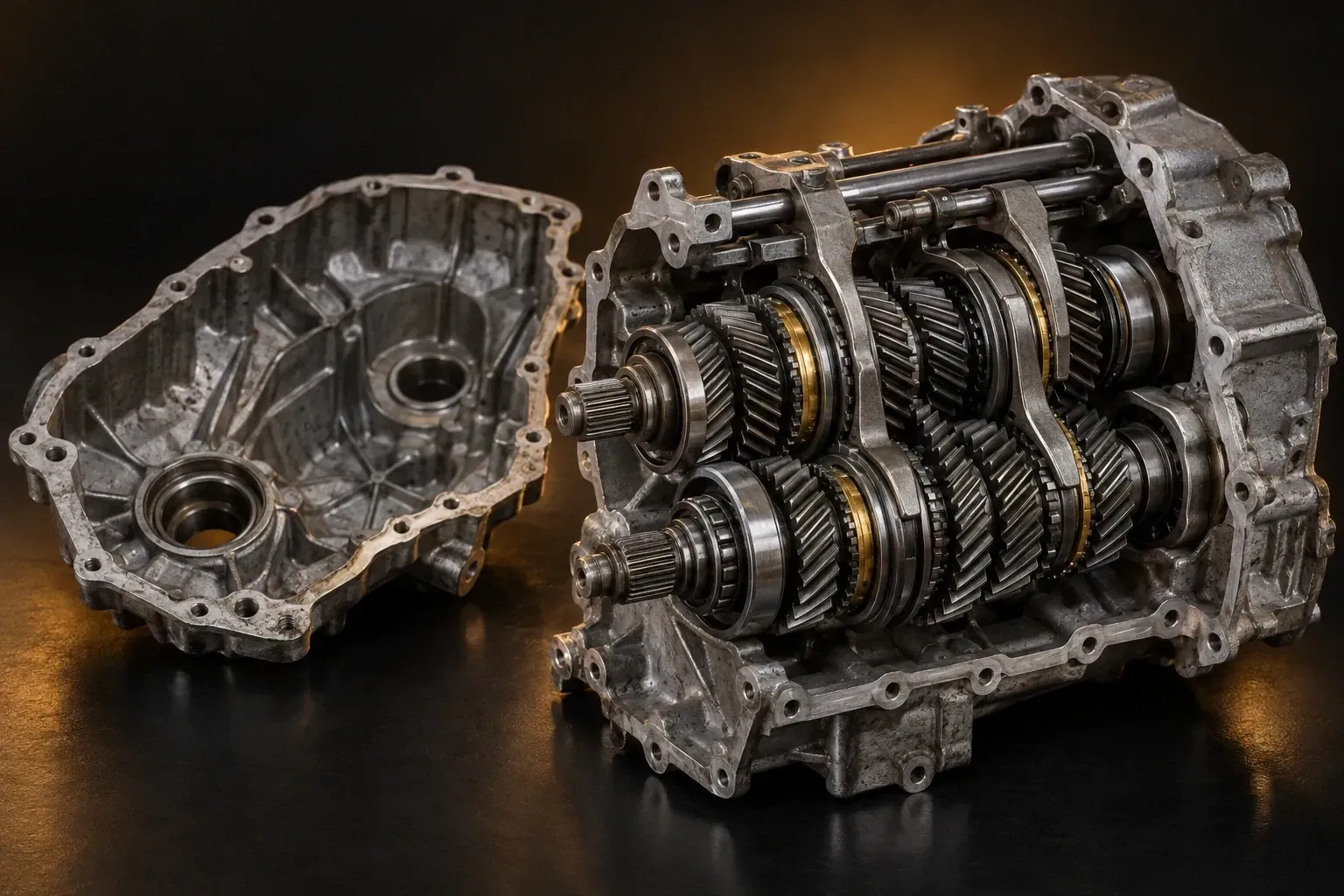
Gearbox · Five-speed manual
How does a manual gearbox work?
A manual gearbox (US: manual transmission) lets the engine run at a useful speed whatever the car's speed. Its gears sit in pairs on two shafts, always in mesh. The gear you select is locked to the output shaft by a sliding synchro sleeve, so the drive passes through that one pair: first multiplies the engine's turning force most, fifth least.
The gearbox joined 3D Mechanic in October 2026 as its eighth system: 77 parts from the clutch to the differential. Start the engine, change through all five gears and reverse, watch the synchros match the speeds, then strip it down stage by stage and build it back up.
Change gear
InteractiveIn 3rd: the sleeve locks the 34-tooth gear to the output shaft.
- Gear
- 3rd
- Teeth
- 26 drive 34
- Gearbox ratio
- 1.31:1
- With final drive
- 5.5:1
- Road speed
- 32 km/h (20 mph)
- Input shaft, from the clutch
- Drive gears, fixed to it
- Driven gears, free on the output shaft
- Synchro sleeves
- Output shaft
- Reverse idler
- Final-drive pinion, to the differential
What happens, step by step
-
You press the clutch
The clutch disconnects the engine, so the input shaft and every gear on it are free to change speed while the wheels keep the output shaft turning.
-
The lever picks a rail
Moving the lever across the gate turns the selector to one of three rails: first and second, third and fourth, or fifth and reverse.
-
The fork pushes a sleeve
Moving the lever forwards or back slides that rail, and its fork pushes a synchro sleeve towards the gear you want.
-
The synchro matches the speeds
The sleeve presses a blocker ring onto a cone on the gear. Friction brings the gear to the output shaft's speed, and until the speeds match, the ring's teeth block the sleeve.
-
The dog teeth lock the gear
With the speeds equal, the sleeve slides over the gear's dog teeth and locks it to the output shaft. The drive now passes through that one pair of gears.
-
The final drive takes it on
A pinion on the output shaft turns the differential's ring gear, multiplying the turning force again by 4.24:1 before it reaches the driveshafts.
Why does a car need a gearbox?
Because the engine and the wheels want different things. An engine only works well within a band of speeds, from a little above idle to its rev limit, and it makes little turning force at the bottom of that band. The wheels need a lot of force to pull away and a high speed on the motorway. The gearbox sits between the clutch and the wheels and changes the ratio between them.
Counting the final drive, the overall ratio in first is 14.6:1, and in fifth only 3.5:1. So the same 1,000 rpm gives 8.2 km/h in first and 34.6 km/h in fifth: first trades speed for the force to pull away, fifth trades force for speed.
What does each gear do?
Each gear is a pair of helical gears, one on the input shaft and one on the output shaft, and the ratio is simply their teeth. In first, a gear with 11 teeth drives one with 38: a ratio of 3.45:1. The output shaft turns that much slower than the engine and with that much more turning force, less a little lost to friction.
Second is 1.94:1, third 1.31:1 and fourth 0.97:1, almost one to one. Fifth is 0.82:1, an overdrive, where the output shaft turns faster than the engine. That is why fifth is quiet and economical at a cruise, about 3,250 rpm at 70 mph, but has little pull for overtaking.
Why are all the gears always turning?
Because they are always in mesh. The driven gears on the output shaft are not fixed to it: each turns on its own needle bearing, so with the engine running all of them spin, each at its own speed, whether it is in use or not. Selecting a gear does not move any gears. It locks one of them to the output shaft.
Between each pair of driven gears sits a synchro hub, splined to the shaft, with a sleeve that slides along it: towards first or second, third or fourth, fifth or reverse. Keeping the gears in mesh is also what allows helical teeth, which run more quietly than straight-cut teeth but could never slide into mesh.
How does a synchro stop the gears crunching?
With the clutch down, the gear you want is still turning at a different speed from the output shaft, which the wheels keep turning. If the sleeve went straight onto its dog teeth, they would clash: the crunch of a gear change without a synchro.
So the sleeve first pushes a blocker ring onto a cone on the side of the gear. The cone is shallow, 6.5° each side of its axis in the app’s model, so it grips hard, and its friction brings the gear, the input shaft and the clutch disc to the output shaft’s speed. While the speeds differ, the drag turns the ring half a tooth, so its teeth block the sleeve. Once they match, the sleeve’s chamfers turn the ring back and the sleeve slides on over the gear’s dog teeth, 9.5 mm in all, and the gear is locked.
It is also why the engine speed has already dropped when the clutch comes up on a change up: the synchro has slowed the input shaft to suit the next gear. Press Play in the diagram above to watch it happen.
How does reverse work?
Every forward gear turns the output shaft the opposite way to the input shaft, because two gears in mesh turn in opposite directions. Reverse adds a third gear, the idler, on its own short shaft. A gear with 13 teeth on the input shaft drives the 22-tooth idler, which drives a 43-tooth gear on the output shaft, so the output now turns the same way as the input and the car goes backwards.
The idler’s teeth do not change the ratio, 3.31:1, close to first. Many gearboxes have no synchro on reverse, which is why it crunches if you select it before the car has stopped. The app’s model synchronises reverse with the same sleeve as fifth.
Why does the gear lever move in an H?
Because each gear needs two movements. Moving the lever across the gate turns the selector to one of three rails, for first and second, third and fourth, or fifth and reverse. Moving it forwards or back then slides that rail, its fork and its sleeve. An interlock lets only the chosen rail move, so two gears can never be engaged at once, which would lock the gearbox solid.
Spring-loaded detents hold each rail in neutral or in gear. A worn detent or fork is one reason a gearbox jumps out of gear. The drive then leaves through the final drive and the differential, in the same case in a front-wheel-drive car.
The parts that make it work
Input shaft
What it does
Turns with the clutch disc. The drive gears for first, second and reverse are cut into it, and the gears for third, fourth and fifth are fixed to it, so all of them always turn at engine speed with the clutch up.
How it fails
Its bearings wear and rumble, loudest in neutral with the clutch up. The noise stops when you press the pedal, because the shaft stops too.
Output shaft
What it does
Carries the driven gears on needle bearings, so they can spin freely, and the three synchro hubs, which are splined to it. Its own pinion drives the final drive.
How it fails
Worn bearings whine in every gear, and the note rises with road speed.
Gear pairs
What it does
Helical gears in constant mesh, one pair for each gear. The teeth set the ratio: in first, 11 teeth drive 38.
How it fails
Chipped or worn teeth whine or grumble in one gear only, usually under load or on the overrun.
Synchro hub, sleeve and blocker rings US: Synchronizer
What it does
The sleeve slides on the hub towards a gear. It first presses a blocker ring onto the gear's cone, whose friction brings the gear to the shaft's speed, then slides over the gear's dog teeth and locks it.
How it fails
Worn blocker rings can no longer match the speeds in time, so that gear crunches as it goes in, worst on a quick change.
Shift forks and rails
What it does
Each fork sits in the groove of one sleeve and moves with its own rail. Spring-loaded detents hold each rail in neutral or in gear.
How it fails
A worn fork or a weak detent lets a gear jump out, usually on the overrun or over bumps.
Selector and gear lever US: Shifter
What it does
Moving the lever across the gate turns the selector to a rail; moving it along slides that rail. An interlock lets only one rail move, so two gears can never be engaged at once.
How it fails
Worn bushes in the linkage make the lever sloppy and the gears hard to find.
Reverse idler gear
What it does
A third gear on its own short shaft between the input and output gears, which turns the output shaft the other way. In the app's model reverse has a synchro too, shared with fifth.
How it fails
On gearboxes without a reverse synchro, reverse crunches if it is selected before the car has stopped.
Final drive and differential US: Ring and pinion and differential
What it does
The output shaft's 17-tooth pinion turns the differential's 72-tooth ring gear, which splits the drive between the two driveshafts.
How it fails
Worn or badly set final-drive gears whine, and the note changes between accelerating and coasting.
The numbers
| Quantity | Value |
|---|---|
| First gear | 3.45:1 (11 teeth drive 38) |
| Second gear | 1.94:1 (18 teeth drive 35) |
| Third gear | 1.31:1 (26 teeth drive 34) |
| Fourth gear | 0.97:1 (31 teeth drive 30) |
| Fifth gear | 0.82:1 (38 teeth drive 31, an overdrive) |
| Reverse | 3.31:1 (13 teeth drive 43 through a 22-tooth idler) |
| Final drive | 4.24:1 (17 teeth drive 72) |
| Road speed per 1,000 rpm in first | 8.2 km/h (5.1 mph) |
| Road speed per 1,000 rpm in fifth | 34.6 km/h (21.5 mph) |
| Engine speed at 70 mph in fifth | 3,250 rpm (3,860 rpm in fourth) |
| Synchro cone angle | 6.5° (each side of the cone's axis) |
| Synchro sleeve travel | 9.5 mm |
| Distance between the shafts | 75 mm |
From 3D Mechanic's gearbox model: a five-speed manual transaxle for a front-wheel-drive car, with the differential in the same case. Road speeds use the model's 225/45 R17 tyre.
Common problems and what they mean
| Symptom | Likely cause | What to check |
|---|---|---|
| Grinding or crunching as a gear goes in | The clutch not releasing fully, or worn synchro blocker rings | If every gear crunches, suspect the clutch; if only one does, its synchro. |
| The gearbox jumps out of gear | Worn dog teeth, a worn shift fork or weak detent, or worn engine and gearbox mounts | Note which gear and when: under load, on the overrun or over bumps. |
| A whine that rises with road speed | Worn bearings or low gearbox oil | Check the oil level first. A whine in one gear only points to that pair of gears. |
| A rumble in neutral that stops when you press the clutch | A worn input shaft bearing | Pressing the pedal stops the input shaft, which is why the noise goes. |
| Stiff or hard to get into gear | Clutch drag, a stiff or worn linkage, or cold, thick oil | If it is only hard with the engine running, the clutch is not releasing fully. |
UK and US names
| UK | US |
|---|---|
| Gearbox | Transmission (a transaxle when it holds the differential) |
| Gear lever | Shifter |
| Synchro | Synchronizer |
| Bellhousing | Bell housing |
| Change gear | Shift gears |
Questions people ask
What does a synchro do in a gearbox?
It matches the speed of the gear you are selecting to the speed of the output shaft before the gear is locked. A blocker ring rubs on a cone on the gear until both turn together, and only then lets the sleeve slide over the gear's dog teeth. Without it, the teeth would clash and crunch.
Is fifth gear an overdrive?
In the app's model, yes. In fifth, 38 teeth drive 31, so the output shaft turns faster than the engine: at 70 mph the engine turns at about 3,250 rpm, which keeps it quiet and economical on the motorway.
Can you skip gears in a manual car?
Yes. Changing from second to fourth, or from fifth to third, is fine as long as the road speed suits the gear, because the synchro matches the speeds either way. Skipping gears on the way down asks more of the synchro, so give it a moment.
What is the difference between a manual and an automatic gearbox?
A manual uses pairs of gears that you select with a clutch pedal and a lever. A conventional automatic uses planetary gear sets and a torque converter and changes gear by itself, and dual-clutch and CVT gearboxes work differently again. 3D Mechanic's gearbox is a manual.
Why does a manual gearbox need a clutch?
To disconnect the engine while the gear changes. With the clutch down, the input shaft and its gears are free to change speed, so the synchro can match them to the output shaft. The clutch also lets the car pull away smoothly from a standstill.
More on the manual gearbox
Parts
- What does a clutch plate do? A clutch plate (US: clutch disc) is the friction disc clamped between the engine's flywheel and the pressure plate.
- What is a clutch release bearing? A clutch release bearing (US: throw-out bearing) presses the clutch's diaphragm spring when you push the pedal.
Symptoms
- Why does my car jump out of gear? A manual gearbox jumps out of gear when the sleeve locking the gear to its shaft is pushed back to neutral.
- Why does my car make a noise when I press the clutch? A whirr, squeal or chirp that starts when you press the clutch pedal is usually a worn release bearing (US: throw-out bearing), which works only while the pedal is down.
- Why does my gearbox grind when I change gear? A gearbox grinds when the gear you select is still turning at a different speed from the shaft it is being locked to.
