
What is a clutch release bearing?
A clutch release bearing (US: throw-out bearing) presses the clutch's diaphragm spring when you push the pedal. It slides on a tube around the gearbox input shaft and lets the release fork, which does not turn, push on spring fingers that spin with the engine. A worn one whirs or chirps as you press the pedal.
US throw-out bearing Also called release bearing, clutch thrust bearing
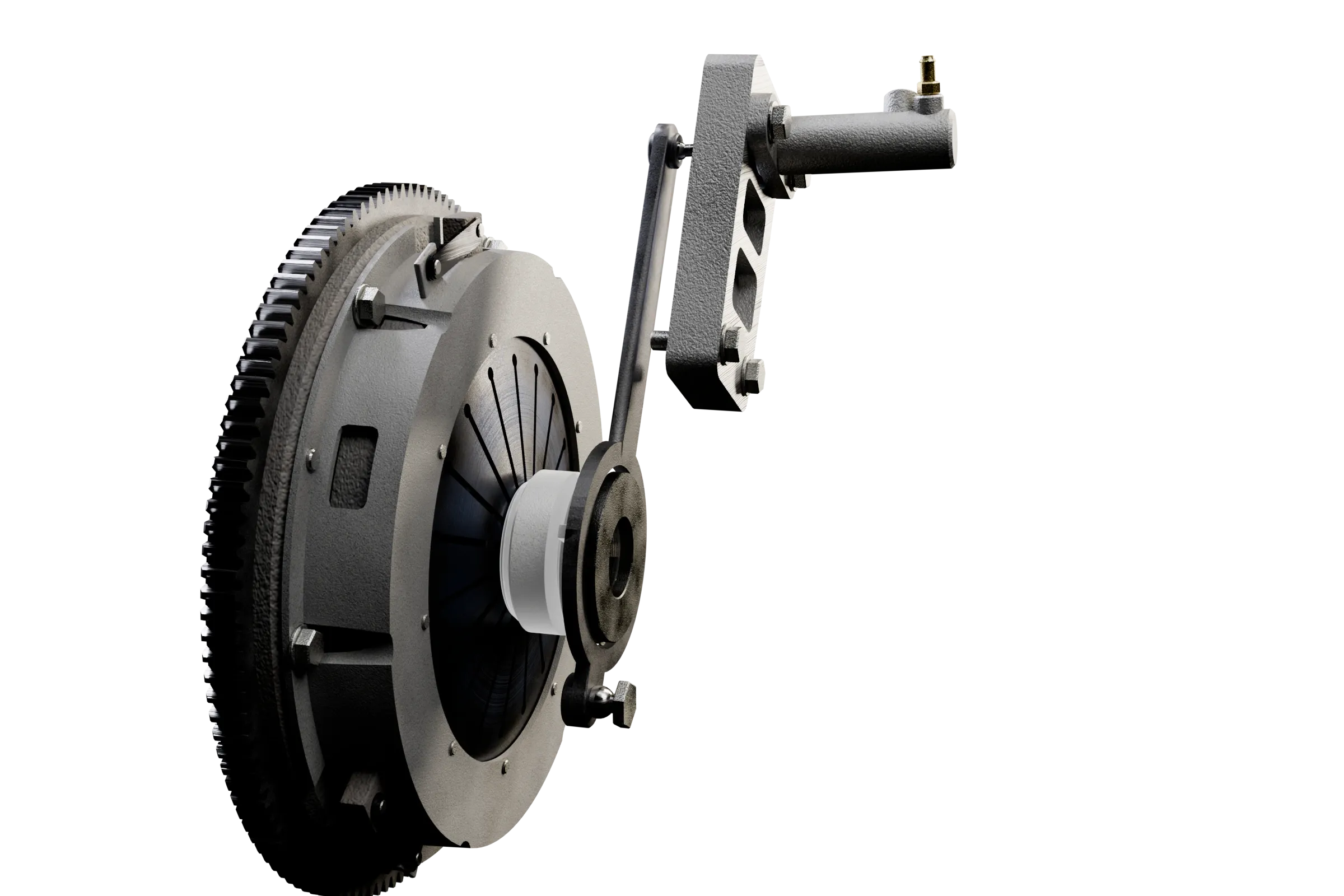
- Release bearing US: Throwout bearing
- Release fork US: Clutch fork
- Diaphragm spring
- Slave cylinder
What does a clutch release bearing do?
It lets a part that stands still push on one that spins. The diaphragm spring's fingers turn with the engine, while the release fork that pushes them only rocks on its pivot. The bearing's carrier slides on a guide tube around the input shaft and takes the fork's push, while its nose turns with the fingers.
Press the pedal and the fork slides the bearing 8.5 mm towards the engine in the app's model, pushing the fingers in until the spring lets go of the pressure plate, with a load that peaks at 742 N about halfway down. On many cars, as in the model, a light spring keeps it touching the fingers with the pedal up, so it turns whenever the engine runs but carries almost nothing until you press.
What does a worn release bearing sound like?
- A whirr, squeal or chirp when you press the pedal. The classic sign: it starts as the pedal goes down and stops when you let it up. Why does my car make a noise when I press the clutch?
- A noise that changes as the pedal moves. Where the bearing always touches the fingers, a worn one can hum faintly with the pedal up and grow louder as you press.
- A grind or rumble with the pedal held down. A bearing that has lost its grease grinds under load, most noticeably while you wait in gear at the lights.
- A buzz through the pedal. A rough bearing can often be felt through your foot as well as heard.
- A stiff or notchy pedal. A carrier sticking on its guide tube, or a dry fork pivot, makes the pedal rough and the release less clean.
Is a noisy release bearing safe to drive with?
Fix it soon
Usually, for a while. A bearing that only whirs with the pedal down is worn but still working, and many carry on like that for months. Once it grinds, or the noise is there all the time, it can break up, and a collapsed bearing can stop the clutch releasing, leaving you unable to change gear. Until it is replaced, wait at junctions in neutral with your foot off the pedal, so it turns unloaded.
How can you tell a release bearing from a gearbox bearing?
By when the noise comes and goes. With the engine idling in neutral, listen with the pedal up, then press it slowly to the floor and hold it. A noise that appears or grows as the pedal goes down is the release bearing. A rumble with the pedal up that stops as you press is the gearbox input shaft bearing, because the shaft stops turning when the clutch releases.
Some cars also have a spigot bearing (US: pilot bearing) in the end of the crankshaft, which only spins with the clutch released, so a worn one whines with the pedal down too. The app’s gearbox, like many front-wheel-drive designs, has none.
Why does a release bearing wear out?
It is sealed and greased for life, and heat and hours under load dry the grease out. How the pedal is used matters most: holding the clutch down at junctions, or resting a foot on the pedal, keeps the bearing loaded far longer than changing gear ever does.
What does replacing a release bearing involve?
- The bearing sits inside the bellhousing, so the gearbox has to come out: on most front-wheel-drive cars the driveshafts, gear linkage and starter come off first, and the slave cylinder is unbolted.
- Take the gearbox's weight on a jack and draw it straight back off its dowels, keeping it level so it never hangs on the input shaft.
- Slide the old bearing off its guide tube. Check the tube for scoring, the fork for cracks and its ball stud for wear, and grease the pivot and the fork's pads sparingly.
- Look at the diaphragm spring's fingers: grooves worn into their tips mean the cover needs replacing too, which is why the bearing usually goes in as part of a clutch kit.
- Fit the new bearing, slide the gearbox back on square and reconnect everything, bleeding the clutch if its hydraulics were opened.
- With the engine idling in neutral, press the pedal and listen: the whirr should be gone.
Tighten every nut and bolt to the figure in the maker's manual for your car.
Because the gearbox has to come out, the release bearing is nearly always replaced with the clutch plate and pressure plate rather than on its own. On cars with a concentric slave cylinder, the bearing is part of it.
Questions people ask
Is a release bearing the same as a throw-out bearing?
Yes. Release bearing is the UK name and throw-out bearing the US one; some parts lists say clutch thrust bearing. On cars with a concentric slave cylinder, the bearing is built into the slave cylinder and comes as one part.
Can a bad release bearing cause clutch slip?
It can, though it is not the usual cause. A bearing seized on its guide tube, or a fork that will not return, can keep pressing the diaphragm spring's fingers with the pedal up, which takes some of the clamp off the plate.
Why change the release bearing when only the clutch plate is worn?
Because reaching it takes the same labour as the clutch itself. A bearing that has done the same miles as the old plate is likely to start whirring within the life of the new one, and the gearbox would have to come out again.
How long does a release bearing last?
Usually about as long as the clutch plate, which is why the two are changed together. Holding the pedal down at junctions and resting a foot on it shorten its life the most.
Related
Symptoms
- Why does my car make a noise when I press the clutch? A whirr, squeal or chirp that starts when you press the clutch pedal is usually a worn release bearing (US: throw-out bearing), which works only while the pedal is down.
- Why does my gearbox grind when I change gear? A gearbox grinds when the gear you select is still turning at a different speed from the shaft it is being locked to.
Parts nearby
- What does a clutch plate do? A clutch plate (US: clutch disc) is the friction disc clamped between the engine's flywheel and the pressure plate.
- What does a clutch slave cylinder do? A clutch slave cylinder is the small hydraulic cylinder on the gearbox that releases the clutch.
The whole system
- How does a car clutch work? The clutch, part by part, with an interactive diagram.
