
What does a clutch slave cylinder do?
A clutch slave cylinder is the small hydraulic cylinder on the gearbox that releases the clutch. When you press the pedal, fluid from the master cylinder pushes its piston out, and its push rod swings the release fork, which pushes the release bearing into the diaphragm spring. A leaking one gives a soft pedal and a clutch that drags.
Also called slave cylinder, clutch release cylinder
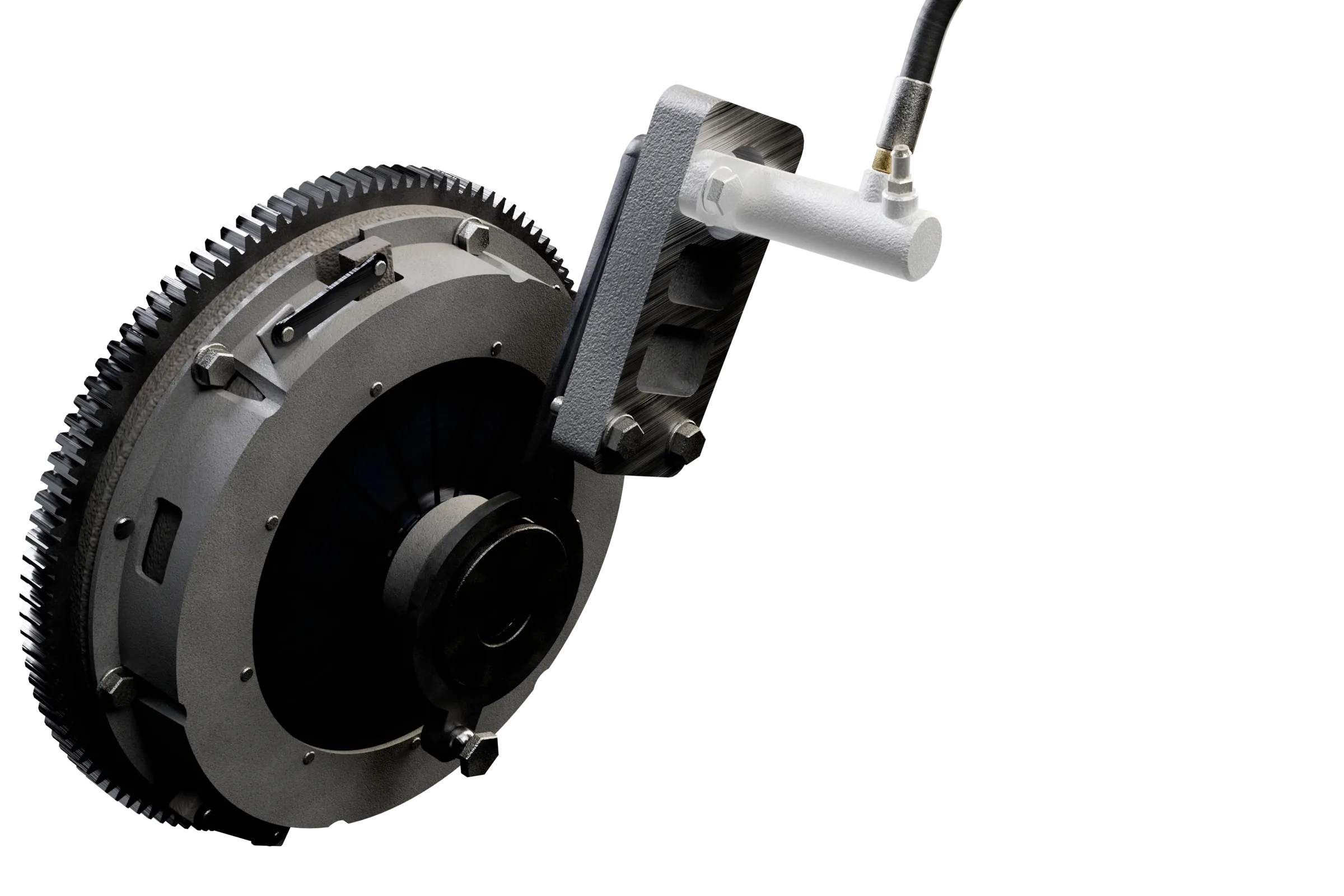
- Slave cylinder
- Release fork US: Clutch fork
- Clutch hose
How does a clutch slave cylinder work?
It is the far end of the clutch hydraulics. The pedal drives the master cylinder's piston, which pushes fluid through a pipe and a flexible hose to the slave cylinder on the gearbox. The fluid pushes the slave's piston out, its push rod swings the release fork, and the fork turns the slave's long push into a short, hard one that presses the release bearing into the diaphragm spring and frees the clutch plate.
Many newer cars have a concentric slave cylinder instead: a ring-shaped cylinder around the input shaft, inside the bellhousing, that pushes the release bearing directly, with no fork. It works the same way, but it can only be reached with the gearbox out.
What are the signs of a bad clutch slave cylinder?
- A soft or spongy pedal. Air in the fluid, often drawn in past a worn seal, squashes before the piston moves, so the clutch releases late.
- A pedal that sinks or stays on the floor. Once the seal lets enough fluid past, the pedal no longer moves the fork at all. Why is my clutch pedal stuck to the floor?
- Fluid on the bellhousing or a wet dust boot. Fluid weeping from the rubber boot over the push rod, or a damp patch under the gearbox, means the seal is leaking.
- A biting point near the floor. Air or a leak uses up the first part of the pedal's travel, so the clutch releases only at the bottom, if at all.
- Gears that crunch or will not go in. A piston that cannot push the fork its full travel leaves the clutch dragging. Why does my gearbox grind when I change gear?
Can you drive with a leaking slave cylinder?
Have it checked before you drive far
Not far. A leaking slave cylinder can stop releasing the clutch at any time, and then you cannot change gear, or stop without stalling. Keep the reservoir topped up with the right fluid, watch for drips under the bellhousing and have it seen before you drive far. If the pedal goes to the floor, do not drive the car: you may not be able to release the clutch.
Why do slave cylinders fail?
Mostly through their seals. The piston has a single rubber cup facing the fluid, in a bore low on the gearbox where it gets hot and dirty. Brake fluid absorbs water over the years, the water pits the bore, and a pitted bore wears the cup until it lets fluid past or air in. Changing the fluid every few years, usually with the brake fluid, slows that down. A clutch uses no fluid, so a level that keeps dropping between top-ups means a leak somewhere.
Is it the master or the slave cylinder?
A visible leak usually settles it: fluid on the bellhousing or inside the slave’s dust boot points to the slave, fluid on the carpet behind the pedal to the master. With no leak anywhere, a pedal that sinks slowly while you hold it usually means worn seals inside the master cylinder. A concentric slave cylinder leaks inside the bellhousing, showing only as a drip from below, or as a clutch that slips once fluid reaches the plate.
How do you bleed a clutch slave cylinder?
- Time
- About 30 minutes
- Difficulty
- Straightforward
- Parts
-
- Fresh DOT 4 fluid
- A helper, or a one-man bleed kit
- Fill the reservoir to MAX with fresh fluid of the maker's type from a sealed bottle, and keep it above MIN throughout, or air is drawn into the system.
- Put a ring spanner on the slave cylinder's bleed screw, push a clear tube over the screw and run the tube into a bottle.
- Have a helper press the pedal slowly to the floor and hold it, then open the bleed screw about half a turn: fluid and air run down the tube.
- Close the screw before the pedal comes back up, or air is pulled back in, and only then let the pedal rise.
- Repeat until the fluid in the tube runs clear with no bubbles, topping up every few presses, then close the small screw gently and fill the reservoir to MAX.
- Check the pedal: it should feel the same every time and return fully, and with the engine running, first and reverse should go in without a crunch.
Tools
- Brake fluid (DOT 4)
- Ring spanner (US: Box-end wrench)
- Bleed tube and bottle (US: Bleeder hose and bottle)
- Torque wrench
Work safely
- Brake and clutch fluid strips paint and harms skin and eyes: wear gloves and glasses, wipe up spills at once.
- Never work under a car held only by a jack: set it on axle stands.
Tighten every nut and bolt to the figure in the maker's manual for your car.
Replacing an external slave cylinder means undoing its hydraulic union and its mounting bolts, fitting the new one and bleeding the clutch as above. A concentric slave cylinder comes out with the gearbox, so it is usually renewed with the clutch.
Questions people ask
Where is the clutch slave cylinder?
On the gearbox. Traditionally it is bolted to the outside of the bellhousing, with its push rod on the end of the release fork; many newer cars have a concentric slave cylinder inside the bellhousing instead, with the release bearing built in.
Can a clutch slave cylinder be rebuilt?
Some can, with a seal kit, if the bore is smooth and free of pitting. Most are now sold only as complete units, and a new one is usually the better choice: a pitted bore wears a new seal out quickly.
Can a slave cylinder leak without showing?
Yes. The first fluid past a worn seal collects inside the rubber dust boot, so peel back its edge to look. A concentric slave cylinder leaks inside the bellhousing, where you may see nothing but a drip from the bottom of the housing.
Why won't my clutch bleed?
Usually because air is trapped high in the line, or drawn back in at the bleed screw between presses. Some clutches, often those with a concentric slave cylinder, are hard to bleed with the pedal alone and need a pressure bleeder, or fluid pushed up from the bleed screw.
Related
Symptoms
- Why is my clutch pedal stuck to the floor? A clutch pedal that sinks to the floor or stays there is nearly always a hydraulic fault: a fluid leak, air in the line or a failed seal in the master or slave cylinder.
- Why does my gearbox grind when I change gear? A gearbox grinds when the gear you select is still turning at a different speed from the shaft it is being locked to.
Parts nearby
- What is a clutch release bearing? A clutch release bearing (US: throw-out bearing) presses the clutch's diaphragm spring when you push the pedal.
- What does brake fluid do? Brake fluid carries the push from the brake pedal to the calipers.
- What does a clutch plate do? A clutch plate (US: clutch disc) is the friction disc clamped between the engine's flywheel and the pressure plate.
The whole system
- How does a car clutch work? The clutch, part by part, with an interactive diagram.
