
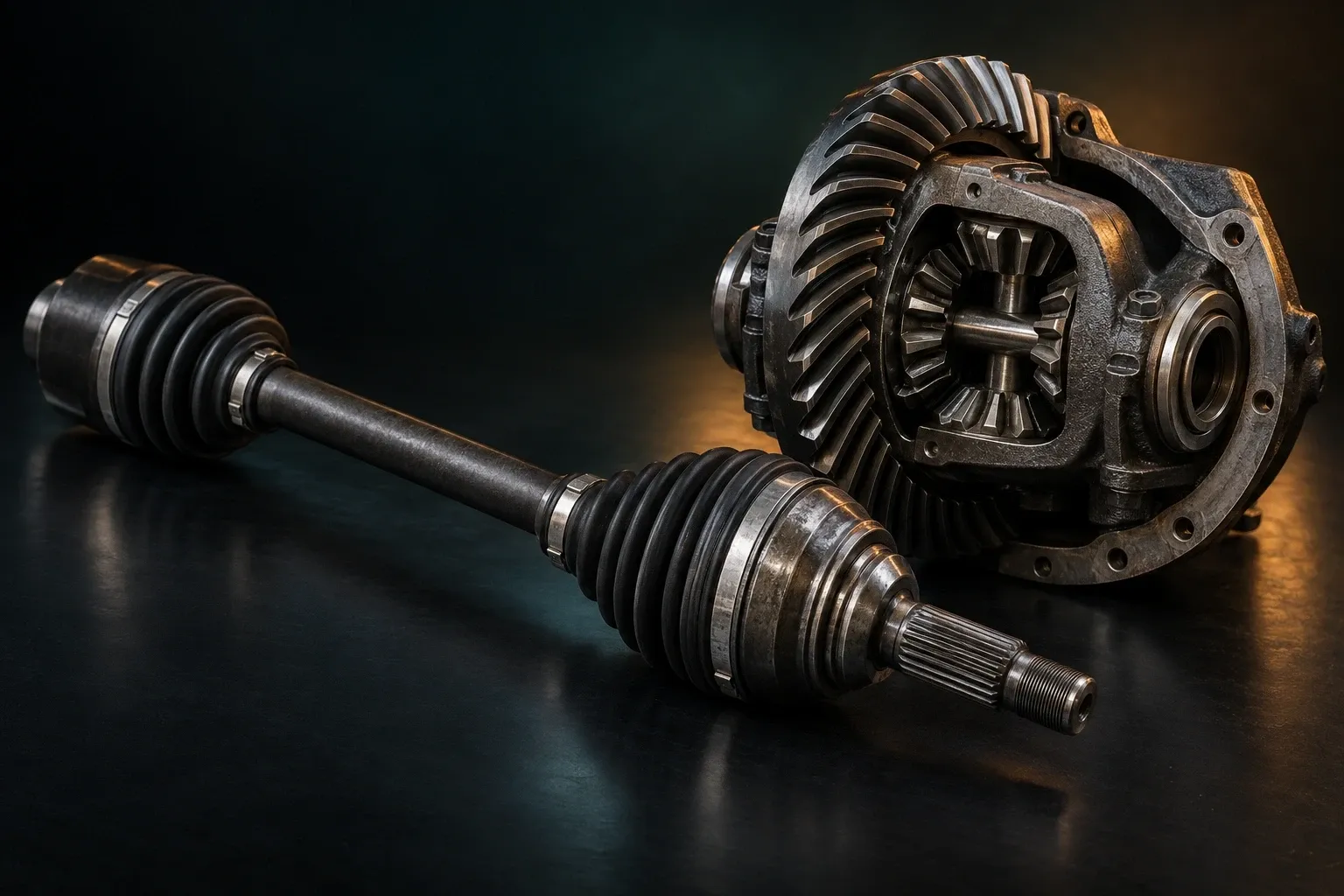
Drivetrain · CV axle and differential
How do a CV axle and a differential work?
In a front-wheel-drive car the gearbox turns a differential, which splits the drive between two half-shafts, one to each front wheel. In a corner the outer wheel has further to travel, and the differential's spider gears let it turn faster than the inner one. Each half-shaft has a constant velocity (CV) joint at each end, so it can carry the drive smoothly while the wheel steers and the suspension moves.
In 3D Mechanic you drive and steer the CV axle and differential, watch the joints bend and the gears turn, and strip all 71 parts down.
Drive round a corner
Interactive- Left wheel
- 167 rpm
- Right wheel
- 167 rpm
- Ring gear and case
- 167 rpm
- Spider gears
- Not turning
- Final-drive pinion (from the gearbox)
- Ring gear
- Differential case
- Spider gears
- Side gears
- Inner CV joint (tripod)
- Outer CV joint (Rzeppa)
- Half-shaft
What happens, step by step
-
The gearbox drives the ring gear
A 17-tooth pinion on the gearbox output shaft turns a 72-tooth ring gear: a final-drive ratio of 4.24:1 that multiplies the torque once more.
-
The ring gear turns the case
The ring gear is bolted to the differential case, which carries a cross shaft and two small spider gears round with it.
-
Spider gears drive the side gears
The spider gears mesh with two side gears, one splined to each half-shaft. Driving straight, the spider gears don't spin on their shaft, so the whole assembly turns as one.
-
In a corner the spider gears turn
When one wheel has to turn faster, the spider gears roll round the side gears, speeding one up and slowing the other down. The case always turns at the average of the two.
-
The inner joint lets the shaft plunge
A tripod joint at the gearbox end lets the shaft slide in and out as the suspension moves, up to 15 mm each way.
-
The outer joint lets the wheel steer
A Rzeppa ball joint at the wheel end bends up to 46° while turning at exactly the shaft's speed, so the wheel doesn't surge as you steer.
Why do the wheels need different speeds in a corner?
Because they follow different circles. In a turn the outer wheel runs on a bigger circle than the inner one, so it has to cover more ground in the same time. In the example in the diagram above, at 20 km/h in a turn of 4.5 m radius, the inner front wheel turns at 147 rpm and the outer at 188 rpm.
If both wheels were locked to one shaft, one of the tyres would have to slip to make up the difference. The car would fight the steering, the tyres would scrub and wear, and the drive would wind up stress in the shafts. A differential lets each wheel find its own speed while still driving both.
How does an open differential work?
The gearbox’s final-drive pinion turns the ring gear, and the ring gear is bolted to the differential case. Inside the case, a cross shaft carries two small spider gears with 10 teeth each. They mesh with two larger side gears, 16 teeth each, one splined to each half-shaft.
Driving straight, the spider gears don’t turn on their shaft. They are carried round with the case and push both side gears at the same speed. In a corner, the spider gears start to turn on their shaft, rolling round the side gears: one side gear speeds up and the other slows by the same amount. The case always turns at the average of the two wheels, 168 rpm in the example, and the spider gears spin at 33 rpm.
Why does one wheel spin on ice?
An open differential always splits the torque equally between the two wheels. That is fine when both have grip, but it means the drive to both wheels can only be as large as the weaker wheel can take. Put one wheel on ice and that wheel needs almost no torque to spin, so the other wheel gets almost none either.
Switch the diagram to the icy road: the car stops, the wheel on the ice spins at 334 rpm, twice the speed of the case, and the wheel with grip doesn’t turn at all. Limited-slip differentials resist that, and traction control does a similar job by braking the spinning wheel so the differential sends more torque to the other one.
What makes a CV joint constant velocity?
A simple universal joint, the kind on a rear-wheel-drive propshaft, speeds up and slows down twice every turn when it runs at an angle. A front wheel steers through big angles, so that would make the wheel surge as you turn.
The outer joint in the app’s model is a Rzeppa joint: six hardened 11/16 inch balls running in curved tracks between an inner and an outer race. A cage holds all the balls in one plane, and because the two sets of tracks are offset, by 3.5 mm each way, that plane always bisects the angle of the joint. The result is that the output turns at exactly the same speed as the input at any angle, up to 46°.
Why are there two different joints on one shaft?
They do different jobs. The outer joint has to bend a long way for steering but doesn’t need to change length. The inner joint, at the gearbox end, has to let the shaft get longer and shorter as the suspension moves the wheel up and down.
The inner joint is a tripod: three rollers, each running on 26 needle rollers, slide along three parallel tracks in a housing. It allows up to 15 mm of plunge each way and up to 23° of angle. At an angle its centre wobbles slightly, 1.2 mm at full angle, three times every turn. A worn tripod joint turns that wobble into a shudder you feel under hard acceleration.
Why do CV boots matter so much?
Every CV joint lives in a rubber or thermoplastic boot packed with special grease. A split boot lets the grease fling out and lets water and grit in, and the joint wears out within weeks. That is the most common reason a CV axle is replaced, and the classic symptom is a clicking from the outer joint on full lock. Checking the boots at every service is the cheapest way to make the joints last.
The parts that make it work
Final-drive pinion and ring gear
What it does
The pinion on the gearbox output shaft turns the ring gear, which is bolted to the differential case: 17 and 72 teeth, a ratio of 4.24:1.
How it fails
Worn or badly set gears whine, and the note changes between accelerating and coasting.
Differential case and bearings US: Differential carrier
What it does
The case carries the cross shaft and the spider gears and turns in two tapered roller bearings, set with a little preload.
How it fails
Worn bearings rumble, getting louder with road speed.
Spider gears US: Spider gears (pinion gears)
What it does
Two 10-tooth bevel gears on the cross shaft. They only spin on their shaft when the two wheels turn at different speeds.
How it fails
Wear or a lack of oil shows as clunks in tight turns or noise in corners.
Side gears
What it does
Two 16-tooth bevel gears, each splined to one half-shaft. Their speeds always average out to the case's speed.
How it fails
They wear with the spider gears, giving the same clunks and noises.
Half-shafts US: Axle shafts
What it does
Solid 25 mm steel bars with a 24-tooth spline at each end, carrying the drive out to the wheels.
How it fails
They rarely fail, but worn splines can click or clunk as drive is taken up.
Inner CV joint (tripod)
What it does
Three rollers on trunnions slide in three parallel tracks, letting the shaft change length by up to 15 mm each way and bend up to 23°.
How it fails
A worn tripod joint shudders or vibrates under hard acceleration.
Outer CV joint (Rzeppa)
What it does
It has six hardened balls in curved tracks, held in one plane by a cage, so the wheel turns at exactly the shaft's speed even at 46°.
How it fails
A worn outer joint clicks rhythmically when you turn on full lock, usually after its boot has split.
CV boots
What it does
Rubber or thermoplastic bellows packed with special grease that keep water and grit out of each joint.
How it fails
A split boot ruins its joint within weeks, the most common reason a CV axle is replaced.
The numbers
| Quantity | Value |
|---|---|
| Final-drive ratio | 4.24:1 (17 and 72 teeth) |
| Side and spider gears | 16 and 10 teeth |
| Half-shaft | 25 mm solid steel, 460 mm long |
| Outer joint, most it bends | 46° |
| Inner joint, angle and plunge | 23°, 15 mm each way |
| Balls in the outer joint | six, 11/16 inch |
| Wheels at 20 km/h, straight | 167 rpm each (the final-drive pinion turns at 708 rpm) |
| Wheels in a 4.5 m turn | inner 147 rpm, outer 188 rpm (case 168 rpm, spider gears 33 rpm) |
| One wheel on ice, car stuck | 334 rpm on the ice, nothing on the other |
Gear counts, joint angles and shaft sizes come from 3D Mechanic's drivetrain model. The wheel speeds are worked out for a typical small car with a 1,500 mm track and a 2,600 mm wheelbase.
Common problems and what they mean
| Symptom | Likely cause | What to check |
|---|---|---|
| Clicking when turning on full lock | A worn outer CV joint, usually after its boot split | Look at the boots; a clicking joint needs replacing. |
| Shudder or vibration under hard acceleration | A worn inner tripod joint | Have the driveshafts checked. |
| Grease flung round the inside of the wheel | A split CV boot | Replace the boot quickly, before grit gets into the joint. |
| A whine that changes between accelerating and coasting | Worn or badly set final-drive gears | Check the gearbox oil level and have the noise diagnosed. |
| A clunk when taking up drive | Worn differential gears or bearings, or worn engine and gearbox mounts | Check the mounts first, then the gearbox oil. |
| Oil where a driveshaft enters the gearbox | A worn axle oil seal | Replace the seal; it is normally changed whenever the shaft comes out. |
UK and US names
| UK | US |
|---|---|
| Driveshaft | CV axle (half-shaft) |
| Gearbox | Transmission (transaxle) |
| Planet wheels | Spider gears |
| Crown wheel | Ring gear |
| Tyre | Tire |
Questions people ask
What does a differential do?
It lets the two driven wheels turn at different speeds while still driving both. In a corner the outer wheel travels further than the inner one, so without a differential one tyre would have to scrub.
Why does one wheel spin when the other has grip?
An open differential always sends the same torque to both wheels. If one wheel is on ice, the torque is limited to what that wheel can take, so it spins while the other stays still.
What is a limited-slip differential?
A differential that resists one wheel spinning faster than the other, so more of the drive can go to the wheel with grip. Many cars without one get a similar effect from traction control, which brakes the spinning wheel.
What does a clicking noise when turning mean?
Usually a worn outer CV joint. The clicking is loudest on full lock, often when pulling away, and it gets worse over time.
Can I drive with a split CV boot?
For a short while, but have it replaced soon. Once the grease is gone and grit gets in, the joint wears quickly, and a new joint or driveshaft costs far more than a boot.
