
Why does my manual transmission whine?
A whine from a manual transmission (gearbox) usually comes from worn bearings, low or wrong gear oil, or worn gear teeth. A whine in every gear points to the bearings, the oil or the final drive; a whine in one gear only points to that pair of gears. A whine that changes with the clutch pedal is the throwout bearing.
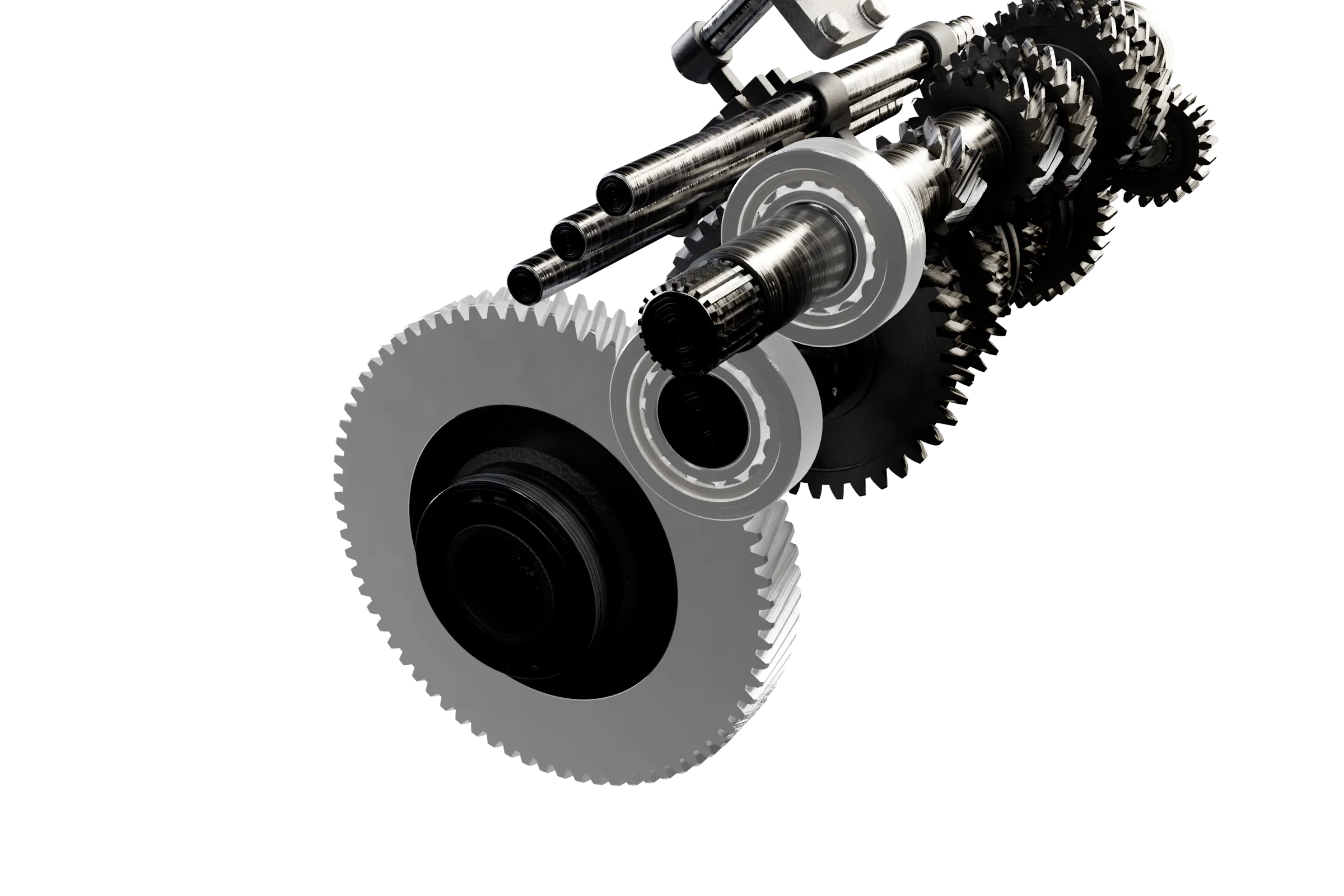
- Input shaft bearing
- Output shaft bearing
- Ring gear
- Output shaft
The likely causes, most common first
-
Worn input or output shaft bearings
Most likelyHow it shows A whine or growl in every gear that rises with road speed, often loudest on the gas. A worn input shaft bearing also rumbles in neutral with the clutch up and goes quiet when you press the pedal.
Check Listen at idle in neutral with the pedal up, then pressed, and compare the gears at one steady speed.
Have it checked soon
-
Low or wrong gear oil
CommonHow it shows A whine that has crept in over months in several gears, sometimes with shifts that have turned notchy.
Check Have the level checked at the fill plug with the car level, and look for oil at the axle seals and the case joints. Use the oil the automaker specifies.
Fix it soon
-
A worn gear pair
CommonHow it shows A whine or grumble in one gear only, usually under load or as you let off the gas, while the other gears stay quiet.
Check A whine that comes and goes with one gear points to that pair's teeth or the needle bearing under its free gear.
Fix it soon
-
Worn final drive gears or differential bearings
Less likelyHow it shows A whine that changes between accelerating and coasting, or a rumble that rises with road speed in any gear, from low down in the transaxle.
Check A note that changes between accelerating and coasting at one speed points here. A shop confirms it on a road test, then with the oil drained and checked for metal.
Have it checked soon
-
A worn throwout bearing
Less likelyHow it shows A whir or squeal that starts as you press the clutch pedal and stops when you let it up, at a standstill as well as on the move.
Check With the engine idling in neutral, press the pedal slowly and hold it. A noise that comes with the pedal is the throwout bearing, not the transmission.
Fix it soon
-
A belt-driven accessory
Less likelyHow it shows A whine that rises and falls with engine speed, there even with the car parked as you rev the engine in neutral.
Check Rev the engine gently with the car parked. A whine that follows the revs comes from the engine compartment: the alternator, a power steering pump or an idler pulley.
Fix it soon
How to narrow it down
- With the car parked in neutral, rev the engine gently. A whine that follows the revs is not in the transmission.
- At idle in neutral, listen with the clutch pedal up, then press it and hold it. A noise that stops as you press is the input shaft bearing; one that starts is the throwout bearing.
- On a quiet road, hold a steady speed in each gear you can. A whine in one gear only points to that gear pair; in every gear, to the bearings, the oil or the final drive.
- Accelerate gently, then let off the gas at the same speed. A note that changes between the two points to the final drive.
- Have the gear oil level checked at the fill plug before any part is replaced.
Is it safe to drive with a whining transmission?
Fix it soon
Usually, for a while. A whine on its own rarely stops a car without warning, but it does not go away: bearings and gears that whine are wearing, and a bearing that breaks up can take the gears around it with it. Have the oil level checked soon, because running low speeds up every kind of wear in there. If the whine turns into a grinding or a knock, or the transmission starts to pop out of gear, stop driving it and have it checked.
How do you tell a transmission whine from a hum?
By what the noise follows. A transmission whine is a higher, purer note that answers to the gear and the load: it grows on the gas, fades or changes pitch as you let off, and changes when you shift at the same road speed. A hum from a wheel bearing or the tires is lower and follows road speed alone, the same in any gear and on or off the gas, but it grows or fades as you weave. A worn output shaft bearing blurs the line, because it rises with road speed too, but it still answers to load and not to steering. Why a car hums when you drive covers the hum.
An automatic or a CVT can whine for reasons of its own, from its fluid pump to its planetary gears or its belt. This page is about manual transmissions and the transaxles of front-wheel-drive manual cars, like the one in the app.
Why do the gears whine at all?
Because they are always in mesh. In the app’s five-speed the gears on the input shaft turn with the engine and drive their partners on the output shaft all the time, even the ones not in use, which spin on needle bearings until a synchro sleeve locks one to the shaft. In first, 11 teeth drive 38, and every gear drives through the final drive, a 17-tooth pinion turning a 72-tooth ring gear.
Each tooth coming into mesh gives a tiny push, and at speed the pushes make a tone. Helical teeth, cut at an angle, slide into mesh gradually and keep it faint, as long as the bearings hold the two shafts exactly 75 mm apart. Worn bearings let the shafts move and worn teeth meet roughly, and the tone grows into a whine. The manual transmission guide shows the gears turning.
Why does it whine in one gear only?
Because only one gear pair carries the load at a time. Each forward gear has its own pair, so worn teeth, or a worn needle bearing under that pair’s free gear, sing only when that gear is engaged and loaded. A whine in every gear means something they all share: the shaft bearings, the oil, or the final drive that every gear drives through.
Questions people ask
Why does my manual transmission whine in reverse?
Because reverse usually runs on straight-cut gears. The forward gears are helical, their angled teeth sliding into mesh gradually, while straight-cut teeth meet all at once and sing. In the app's transmission, as in most manual cars, the forward gears are helical and reverse is straight-cut. A whine in reverse is normal; a grind or a knock is not.
Is some whine from a manual transmission normal?
A faint, steady gear whine is normal in many manual cars and should sound the same for years. A whine that is new, getting louder or coming with notchy shifts or a gear popping out is wear, and worth having checked.
Can new gear oil stop a transmission whine?
Sometimes, if the oil was low or of the wrong kind: fresh oil of the right grade can quiet bearings and teeth that were short of it. It cannot undo wear. Use the oil the automaker specifies, because the synchros depend on its friction to match speeds.
Related
The parts
- What is a throwout bearing? A throwout bearing presses the clutch's diaphragm spring when you push the pedal.
Similar symptoms
- Why is my car humming when I drive? A humming noise that rises with road speed is usually a worn wheel bearing, especially if it changes as you go around a curve.
- Why does my transmission grind when I shift? A manual transmission grinds when the gear you select is still turning at a different speed from the shaft it locks to.
- Why does my car pop out of gear? Popping out of gear happens when the sleeve locking a gear to its shaft in a manual transmission is pushed back to neutral.
- Why does my car make a noise when I press the clutch? A whir, squeal or chirp that starts as you press the clutch is usually a worn throwout bearing, which works only with the pedal down.
