
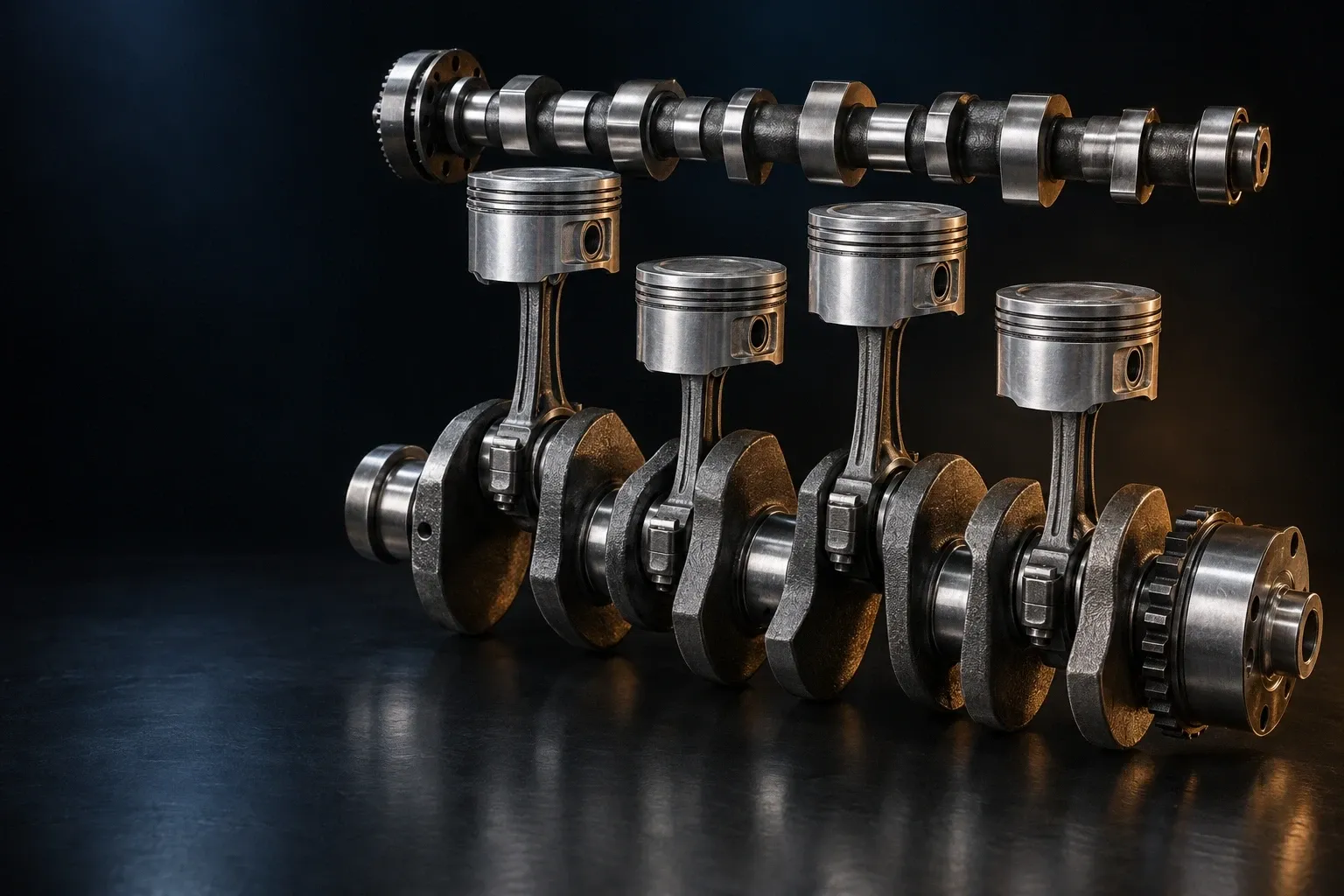
Engine · Cutaway inline-four
How does a four-stroke engine work?
A four-stroke engine makes power in a cycle of four piston strokes, which take two turns of the crankshaft. The piston draws in air and fuel, squeezes it, is driven down when a spark lights it, then pushes the burnt gas out. A connecting rod and crankshaft turn that up-and-down motion into rotation, and camshafts open the valves at the right moments.
In 3D Mechanic you run the four-stroke cycle on a cutaway inline-four and watch every part move, from the valves and camshafts down to the crankshaft.
Turn the crankshaft through one cycle
Interactive- Stroke
- Intake
- Piston below the top
- 85.8 mm
- Intake valve lift
- 5.4 mm
- Exhaust valve lift
- 0 mm
- Intake valve
- Exhaust valve
- Spark plug
- Piston
- Connecting rod
- Crankshaft
What happens, step by step
-
Intake
The piston moves down with the intake valves open, drawing air and fuel into the cylinder. In the app's engine each intake valve lifts up to 8.6 mm off its seat.
-
Compression
Both valves close and the piston rises, squeezing the mixture into the small space under the cylinder head. Squeezing it first is what makes the burn so strong.
-
Power
Just before the top of the stroke the spark plug fires. The burning gas pushes the piston down hard. This is the only one of the four strokes that makes power.
-
Exhaust
The exhaust valves open and the rising piston pushes the burnt gas out into the exhaust manifold, ready for the next intake stroke.
-
The crankshaft makes it turn
The connecting rod links the piston to an offset pin on the crankshaft, so the pistons' up-and-down motion turns the shaft, the way your legs turn a bicycle's cranks.
-
The camshafts keep time
A chain drives the camshafts at half the crankshaft's speed, so each valve opens once every two turns of the engine: once per cycle.
What are the four strokes, in degrees?
Engines are timed in degrees of crankshaft rotation. One stroke of the piston, top to bottom or bottom to top, is half a turn: 180 degrees. The four strokes therefore take 720 degrees, two full turns. 3D Mechanic counts from 0 degrees with cylinder 1 at the top of its firing stroke, the same convention as the diagram above: 0 to 180 is power, 180 to 360 exhaust, 360 to 540 intake and 540 to 720 compression.
Only one of the four strokes pushes the crankshaft round. For the other three the engine has to keep turning on its own momentum, carried by the flywheel and by the other cylinders, which take turns to fire.
Why do the valves open early and close late?
Gas has weight, and it is moving fast. The valves are timed to use that. In the app’s engine the intake valve starts to open 34° before the piston reaches the top, so it is already open when the piston starts to draw. It stays open until 74° after the bottom, because the incoming air keeps flowing in on its own momentum even as the piston starts back up.
The exhaust valve opens 70° before the bottom of the power stroke, letting most of the gas blow out under its own pressure, and closes 30° after the top. For 64° of rotation both valves are open at once. That overlap lets the outgoing exhaust help pull the fresh charge in.
How does a four-cylinder engine run smoothly?
The four cylinders take turns. With a firing order of 1-3-4-2, a cylinder fires every 180 degrees, so there is always one on its power stroke. The crankshaft has its first and fourth throws at one angle and the second and third at the opposite angle, which balances the pistons against each other, and eight counterweights balance the rotating parts.
What is left is a pulse with each firing. The flywheel, a heavy disc on the end of the crankshaft, smooths that out, and the crankshaft pulley carries a rubber-mounted damper ring that soaks up the shaft’s twisting vibration.
How big is a 2.0 litre engine, exactly?
The capacity is the volume the pistons sweep. Each cylinder in the app’s engine has a bore of 86 mm and a stroke of 86 mm, so one cylinder sweeps 500 cc, and four of them make 1,998 cc. When the bore and stroke are equal, as here, engineers call the engine square.
What keeps it from wearing itself out?
Oil, mostly. The crankshaft does not touch its bearings: it floats on a pressurised film of oil about 0.03 mm thick, fed by a pump on the front of the crankshaft from the 4.2 litres in the sump. Lose the oil and the film collapses, which is why the red oil warning light means stop the engine at once.
Heat is the other enemy. Coolant flows through passages around the cylinders and in the head. A thermostat keeps it out of the radiator until it reaches about 88 °C, so the engine warms up quickly, then opens to stop it getting any hotter.
How does the engine know when to make a spark?
A sensor reads a toothed ring on the crankshaft with 36-1 teeth: one gap in the teeth marks a known angle, so the engine computer always knows exactly where the crankshaft is. A second sensor on a camshaft tells it which cylinders are on their compression strokes. It then fires each coil a little before top dead centre, around 10° at light load in this illustration, and moves the timing with speed and load. A knock sensor listens for uncontrolled burning and retards the spark on any cylinder that knocks.
The parts that make it work
Piston and rings
What it does
A cast-aluminium piston. Combustion pressure on its crown drives it down, and its rings seal it against the cylinder wall and scrape oil back down.
How it fails
Worn rings let oil past, seen as blue smoke and oil use, and let gas into the crankcase. Overheating can scuff or crack a piston.
Connecting rod US: Con rod
What it does
A forged I-beam rod. Its small end turns on the piston pin and its big end on the crank pin, so it swings as the crankshaft turns.
How it fails
A worn big-end bearing knocks, loudest under load. A bearing that fails completely can break the rod.
Crankshaft
What it does
A forged steel shaft that turns the pistons' movement into rotation. Counterweights balance it, and it spins in five main bearings on a film of oil about 0.03 mm thick.
How it fails
Oil starvation scores the journals and bearings. A damaged crankshaft usually means a rebuild or a replacement engine.
Camshafts
What it does
Two camshafts, one for the intake valves and one for the exhaust, turn at half crank speed. Each lobe pushes a bucket to open a valve.
How it fails
Worn lobes reduce valve lift and power. Poor oiling wears them fastest.
Valves and springs
What it does
16 valves, four per cylinder: two intake, two exhaust. Springs close them onto 45° seats. The exhaust valves run hotter, so they are smaller and made of heat-resistant steel.
How it fails
A burnt exhaust valve loses compression. Worn stem seals let oil into the cylinders, seen as blue smoke at start-up.
Timing chain
What it does
A 126-link roller chain runs from a 17-tooth crank sprocket to 34-tooth cam sprockets, so the camshafts turn at exactly half speed.
How it fails
A stretched chain or a weak tensioner rattles at start-up. If it jumps a tooth the valve timing is wrong, and on many engines the valves can hit the pistons.
Spark plugs and coils
What it does
A coil on each plug steps 12 volts up to tens of thousands when the engine computer tells it to, and the spark lights the mixture.
How it fails
Worn plugs or a failing coil cause misfires: rough running, lost power and a flashing engine warning light.
Cylinder head and gasket
What it does
The aluminium head holds the valves, the camshafts and the pent-roof combustion chambers. A multi-layer steel gasket seals it to the block.
How it fails
A failed head gasket lets coolant into the cylinders or the oil, or gas into the cooling system: white smoke, overheating and a creamy residue under the oil filler cap.
Oil pump and sump US: Oil pump and oil pan
What it does
A gerotor pump on the nose of the crankshaft pushes oil from the 4.2 litres sump to every bearing.
How it fails
Low oil or a blocked pickup starves the bearings. The red oil warning light means stop the engine now.
The numbers
| Quantity | Value |
|---|---|
| Layout | Inline four cylinders, 16 valves |
| Bore and stroke | 86 mm by 86 mm |
| Capacity | 1,998 cc (500 cc per cylinder) |
| Connecting rod length | 140 mm |
| Firing order | 1-3-4-2 |
| Maximum valve lift | 8.6 mm intake, 8.2 mm exhaust |
| Valve head diameter | 31 mm intake, 27 mm exhaust |
| Intake valve open | 34° before top dead centre to 74° after bottom dead centre |
| Exhaust valve open | 70° before bottom dead centre to 30° after top dead centre |
| Valve overlap | 64° of crank rotation |
| Main bearings | five, on an oil film about 0.03 mm thick |
| Oil in the sump | 4.2 litres |
| Thermostat opens at | 88 °C |
From 3D Mechanic's engine model, a 2.0 litre petrol inline-four. Valve timing here is where each valve starts to lift; makers usually quote it at a small lift, so their figures are shorter.
Common problems and what they mean
| Symptom | Likely cause | What to check |
|---|---|---|
| A deep knock that rises with engine speed | Worn big-end or main bearings, often after running low on oil | Check the oil level. A loud, deep knock means stop driving and have it inspected. |
| A rattle for a few seconds after a cold start | A worn timing chain or chain tensioner | Have it checked soon: a chain that jumps a tooth can wreck the engine. |
| Blue smoke from the exhaust | Oil burning: worn valve stem seals if it shows at start-up, worn piston rings if it shows under load | Keep an eye on the oil level between services. |
| White smoke and the coolant level keeps dropping | A failing head gasket letting coolant into the cylinders | Watch the temperature gauge: overheating makes the damage worse. |
| Rough idle and a flashing engine warning light | A misfire from a spark plug, an ignition coil or an injector | Slow down and get it checked: unburnt fuel can overheat the catalytic converter. |
| A light tapping from the top of the engine | Valve clearances out of adjustment or a worn camshaft | Have the clearances measured against the maker's figures. |
UK and US names
| UK | US |
|---|---|
| Petrol | Gas (gasoline) |
| Sump | Oil pan |
| Gudgeon pin | Wrist pin (piston pin) |
| Cam cover | Valve cover |
| Engine management light | Check engine light |
Questions people ask
What are the four strokes of an engine?
Intake, compression, power and exhaust. The piston draws in air and fuel, squeezes it, is pushed down by the burning mixture, then pushes the burnt gas out. The four strokes take two turns of the crankshaft.
Why is it called a four-stroke engine?
Because each cycle takes four strokes of the piston, two up and two down. A two-stroke engine does the same jobs in one up and one down stroke, using ports in the cylinder wall instead of most of the valves.
What does the camshaft do?
It opens the valves. Lobes on the camshaft push the valves open and springs close them again. It turns at half the crankshaft's speed, so each valve opens once per cycle.
What is the firing order of a four-cylinder engine?
Usually 1-3-4-2, as in 3D Mechanic's engine. A cylinder fires every 180 degrees of crank rotation, which keeps the engine smooth and spreads the load along the crankshaft.
What does top dead centre mean?
It is the highest point of the piston's travel, where it stops and reverses; bottom dead centre is the lowest. Engine timing is measured in degrees of crankshaft rotation from top dead centre.
