
What do spark plugs do?
Spark plugs light the compressed fuel and air in each cylinder of a petrol engine. A coil sends tens of thousands of volts to the plug just before the piston reaches the top of its compression stroke, and the spark that jumps between its electrodes starts the burn. Worn plugs cause misfires, rough idling, hard starting and lost power.
Also called sparking plugs
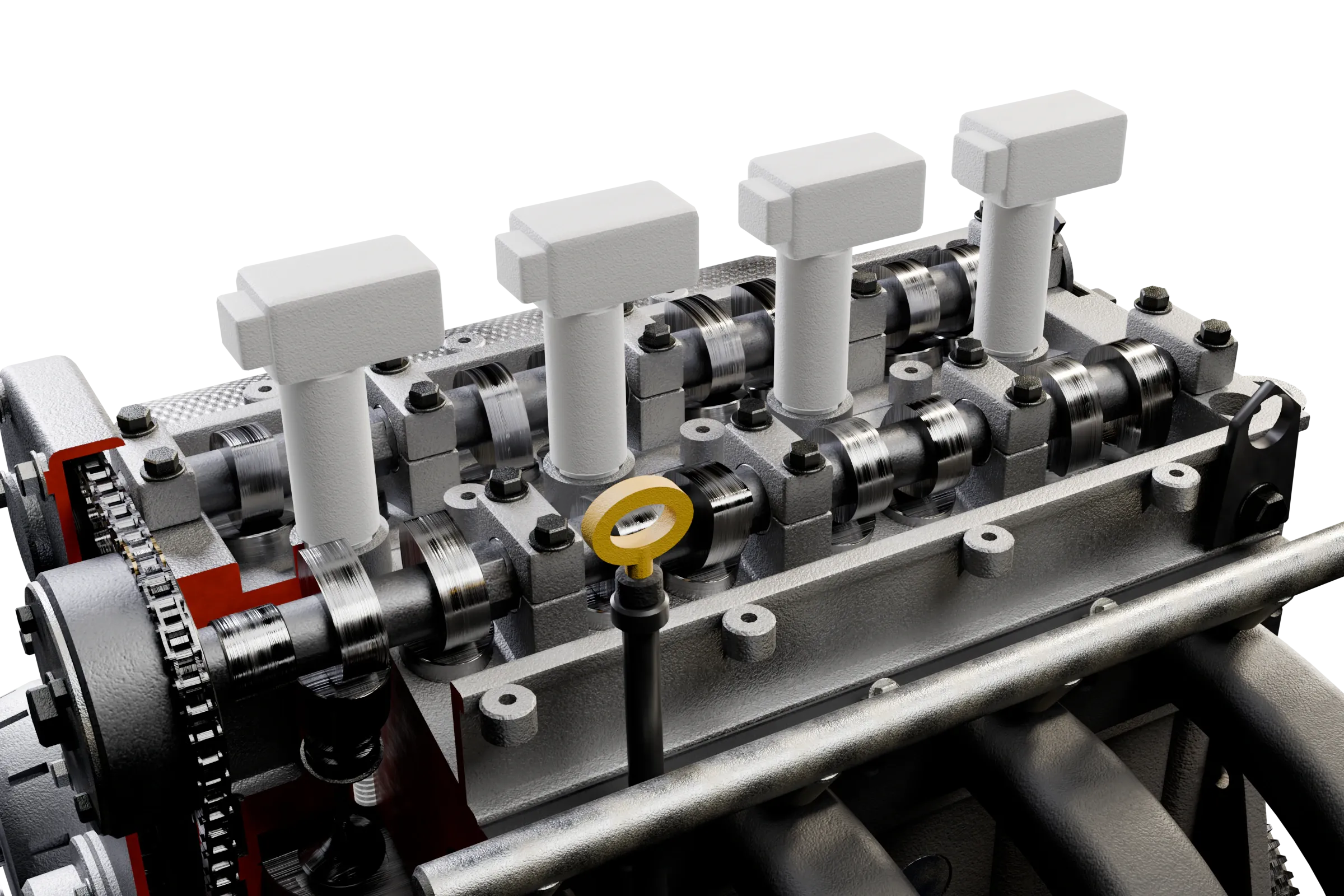
- Spark plug
- Ignition coil
- Cylinder head
How does a spark plug work?
Each cylinder has one, screwed into the cylinder head with its tip in the combustion chamber. A ceramic insulator carries a centre electrode down its middle, and a ground electrode on the threaded steel body bends over the tip, leaving a small gap. In the app's engine each plug has its own coil sitting on top of it: when the engine computer cuts the coil's current, the coil makes tens of thousands of volts, enough for a spark to jump the gap.
The spark comes a little before top dead centre, so the flame has spread and the pressure peaks just after the piston passes the top. The engine computer times every spark from the crankshaft's position, moves it with speed and load, and retards it on any cylinder where the knock sensor hears uncontrolled burning.
A plug also has to shed heat at the right rate: hot enough to burn off soot, cool enough never to light the mixture on its own. That balance is its heat range, which is why the maker specifies a particular plug for each engine.
What are the symptoms of bad spark plugs?
- A misfire and a flashing engine warning light. A plug that cannot spark reliably leaves a cylinder unburnt, the engine shakes, and a flashing light means the misfire is bad enough to harm the catalytic converter.
- Rough or uneven idling. The engine shakes or hunts at idle as one cylinder fires weakly or not at all.
- Hard starting, worst when cold or damp. A gap worn wider needs a higher voltage to jump, which a tired coil may not manage.
- Hesitation when you accelerate. The voltage needed to jump the gap rises with cylinder pressure, so worn plugs misfire first when you ask for power.
- Higher fuel use. Weak or missed sparks waste fuel, and the economy drops.
Can you drive with bad spark plugs?
Fix it soon
For a short while, gently, but change them soon. Worn plugs mostly cost you smoothness and economy. A misfire is more serious: unburnt fuel goes into the exhaust and burns in the catalytic converter, which can overheat and be ruined. If the engine warning light flashes, slow down and have the car checked before you drive far.
How often should spark plugs be changed?
At the interval in the service schedule for your engine, because plugs vary a lot. Plugs with plain nickel-alloy tips, often sold as copper plugs, wear fastest and were usually changed every 20,000 miles or so on older cars. The platinum and iridium plugs in most modern petrol engines have fine, hard tips that wear slowly, and makers often set 40,000 to 100,000 miles for them, or a number of years, whichever comes first. Some turbocharged engines, with their higher cylinder pressures, need them sooner.
What do old spark plugs tell you?
They are a quick check on the engine’s health. A light tan or grey tip is normal. Dry black soot points to rich running or a lot of short trips, and a wet, oily tip to oil getting past the piston rings or valve stem seals. A white, blistered tip means the plug has been running too hot, for example from a weak mixture or a plug of the wrong heat range. There is more on the spark’s timing in how a four-stroke engine works.
What does changing the spark plugs involve?
- Time
- About 40 minutes
- Difficulty
- Straightforward
- Parts
-
- Four new spark plugs to the maker's type
- Start with a cold engine and the ignition off. Unplug each coil and undo its bolt, then ease it out of its well with a slight twist, keeping the coils in order.
- Unscrew the old plugs one at a time with a plug socket on an extension, and look at each tip as it comes out.
- Check the gap of each new plug with a feeler gauge against the maker's figure. Most come set: never bend the fine tip of an iridium or platinum plug.
- Start each new plug by hand, so it cannot cross-thread in the aluminium head, then screw it down and tighten it to the maker's figure.
- Push each coil down its well until it clicks onto its plug, bolt it down and reconnect it.
- Start the engine: it should idle smoothly. A misfire straight afterwards usually means a coil is not fully home.
Tools
- Socket and ratchet
- Spark plug socket
- Feeler gauge
- Torque wrench
Work safely
- Work on a cold engine: plugs taken out of a hot aluminium head can strip its threads.
- Switch the ignition off before you unplug the coils.
Tighten every nut and bolt to the figure in the maker's manual for your car.
On most four-cylinder engines with a coil on each plug, this is one of the easier tasks to do at home. On many transverse V6 engines the rear plugs sit under the intake manifold, which takes much longer.
Questions people ask
Do diesel engines have spark plugs?
No. A diesel squeezes its air until it is hot enough to light the fuel as it is injected. Its glow plugs look a little like spark plugs, but they heat the combustion chamber, mainly to help a cold start.
Should you change all the spark plugs at once?
Yes. They have all done the same miles and worn at the same rate, and the engine runs most smoothly when every cylinder fires the same way.
Is it the spark plug or the ignition coil?
Swapping them shows you. Move the misfiring cylinder's coil to another cylinder: if the misfire follows the coil, the coil is at fault; if it stays put, look at the plug, then the injector. A fault code reader tells you which cylinder is misfiring.
Can you clean spark plugs instead of replacing them?
It is rarely worth it. Cleaning removes deposits but does nothing for worn electrodes, which are what make old plugs misfire, and a wire brush can damage the fine tips of iridium and platinum plugs.
Related
Parts nearby
- What does a timing chain do? A timing chain links the crankshaft to the camshafts, so the valves open and close in step with the pistons.
The whole system
- How does a four-stroke engine work? The four-stroke engine, part by part, with an interactive diagram.
