
Clutch · Pedal to flywheel
How does a car clutch work?
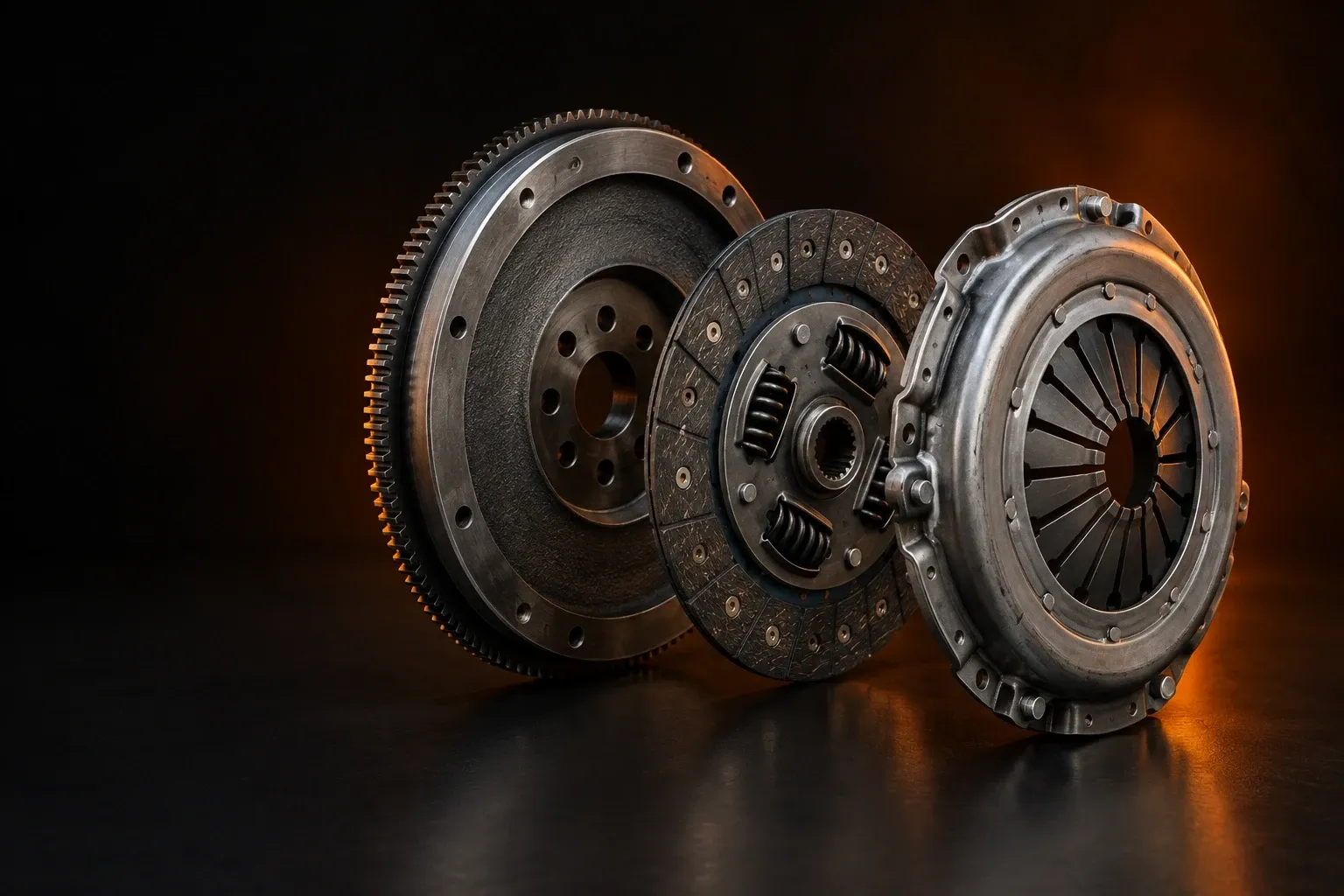
A clutch connects and disconnects the engine and the gearbox (transmission). A diaphragm spring clamps a friction disc between the engine's flywheel and a pressure plate, so the disc and the gearbox turn with the engine. Pressing the pedal pushes a release bearing into the spring's fingers, which pulls the plate back and frees the disc, so the gearbox can stop while the engine keeps running.
In 3D Mechanic you press the pedal yourself and watch all 62 parts move, from the pedal box to the flywheel, then start the engine and find the bite point.
Press the clutch pedal
Interactive- Clamp force
- 5,176 N
- Torque it can hold
- 302 N·m
- Plate lift
- 0 mm
- Clutch
- Engaged
- Crankshaft
- Flywheel
- Clutch disc (friction plate)
- Pressure plate
- Diaphragm spring
- Release (throw-out) bearing
- Release fork
- Slave cylinder
- Gearbox input shaft
What happens, step by step
-
Your foot moves the pedal
The pedal is a lever with a ratio of about 5.6 to 1. Over 145 mm of travel it pushes a rod into the master cylinder, which turns the force from your foot into pressure in the hydraulic line, up to 9.2 bar.
-
The slave cylinder pushes the fork
Fluid carries that pressure to the slave cylinder on the gearbox. Its bore is smaller than the master's, so its piston moves further: 34.7 mm at full pedal. It pushes the outer end of the release fork, which rocks on a ball stud.
-
The release bearing presses the fingers
The fork's arms push the release bearing 8.5 mm along its guide tube towards the engine, 4.08 times less far than the slave moves and so 4.08 times harder. The bearing's nose presses the 18 spinning fingers of the diaphragm spring.
-
The diaphragm spring lets go
The spring rolls on the fulcrum rings inside the clutch cover. Its fingers go in, its rim comes out, and the pressure plate backs off by up to 1.35 mm, pulled clear by its drive straps.
-
The disc is free to stop
With the clamp gone, nothing makes the friction disc turn with the flywheel. The gearbox input shaft can slow down, stop or change speed, so you can select a gear or stand still with the engine running.
-
Lifting the pedal reverses it all
As the pedal rises the spring clamps the disc again. Cushion segments inside the disc let the grip build over the last 0.6 mm of plate movement, and that gradual grip is the bite point you feel through your foot.
What does a clutch do in a car?
An engine has to keep turning to run, but a car often has to stand still. Gears can only be changed cleanly when they are not carrying torque. The clutch handles both jobs. It sits between the engine and the gearbox and lets the driver couple or uncouple them, smoothly, thousands of times a week.
Most manual cars use a single-plate dry clutch, the type in the diagram above and the one modelled in 3D Mechanic. Dry means the friction surfaces run in air, not oil. Motorbikes and most automatic gearboxes use wet clutches instead, with several plates running in oil.
Where does the clamping force come from?
From one part: the diaphragm spring. It is a dished steel disc with 18 fingers pointing inwards, riveted inside the clutch cover between two wire fulcrum rings. Its outer rim presses on a ridge on the back of the pressure plate. In the app’s model that clamp is 5,176 N, roughly the weight of half a tonne pressing the disc against the flywheel.
The torque a clutch can carry follows from that clamp. Multiply the friction coefficient by the clamp force, by the number of friction faces and by the mean radius of the facings. With a coefficient of 0.30, two faces and a mean radius of 97.1 mm, the model’s clutch holds 302 N·m. A 2.0 litre petrol engine makes about 190 N·m, so there is a margin of about 1.6 times. That margin is what stops a healthy clutch slipping, and it is what a worn one loses.
Why does the pedal get lighter near the floor?
A coil spring pushes back harder the more you squash it. A diaphragm spring does not. Its force rises as it flattens, peaks, then falls as it is pressed past its installed point. In the model the load on the release bearing peaks at 742 N about halfway down, then drops away.
That curve has two useful effects. The pedal gets easier while you hold it down at traffic lights, and the clamp barely changes as the facings wear thinner, so the clutch keeps its grip for most of its life.
The pedal box adds a second trick: an over-centre helper spring. For the first 42% of the travel it pushes the pedal back up, with 26 N at the pad. Past that point it flips over and helps your foot, with 32 N at the floor. Together they keep the peak effort at the pedal to about 51 N.
What is the bite point, exactly?
The bite point is the stretch of pedal travel where the disc starts to grip. Push the pedal to the floor and the clutch stays fully released until you lift it back to 48% of its travel. From there the clamp builds as the pedal rises. The facings slip against the flywheel and drag the disc up to speed, and the damper springs in the disc’s hub take up the shock.
By 18% of travel the model’s clutch clamps with 3,075 N, enough to hold 179 N·m, nearly all the engine’s torque. The cushion segments between the facings make the change gradual: they flatten over the last 0.6 mm of plate movement, so the grip builds over a few millimetres of pedal travel instead of arriving all at once.
A bite point that keeps creeping higher is a common sign of a worn disc. Slide the pedal in the diagram above and watch the clamp and the torque the clutch can hold change through that zone.
What does the damper in the disc do?
Between the facings and the hub sit four coil springs. They let the facings twist up to 8° against the hub, at about 31 N·m per degree, which smooths the engine’s firing pulses before they reach the gearbox. Without them the gears would rattle at low revs, and broken damper springs are one cause of a clunk as you take up drive.
Why is a clutch replaced as a kit?
The cover, diaphragm spring and pressure plate come as one assembly: the spring is riveted in and cannot come out without destroying the rivets. The disc wears out alongside them, and the release bearing can only be reached with the gearbox removed, so garages fit all of them at once and check the flywheel while they are there.
The facings in the model are 3.5 mm thick on each side, with their rivet heads 2 mm below the surface. Once a facing wears down to the rivets, the disc is finished.
The parts that make it work
Flywheel
What it does
A heavy cast-iron disc bolted to the crankshaft. Its machined face is one of the two surfaces the disc is clamped between, its mass smooths the engine's power pulses, and its 120-tooth ring gear is what the starter motor turns.
How it fails
A glazed, scored or heat-cracked face causes judder. Dual-mass flywheels, fitted to many diesels, wear inside and knock or rattle at idle.
Clutch disc (clutch plate)
What it does
Splined to the gearbox input shaft and clamped between the flywheel and the pressure plate. It has friction facings on both sides, eight cushion segments between them for a smooth take-up, and four damper springs in the hub.
How it fails
The facings wear until the clutch slips. Oil from a leaking crankshaft or gearbox seal makes it slip and judder. Broken damper springs rattle or clunk.
Pressure plate and cover US: Pressure plate
What it does
A cast-iron ring with a ground face, carried in a pressed-steel cover bolted to the flywheel. Drive straps turn it with the cover and pull it back off the disc when the clutch releases.
How it fails
Overheating can warp the face, which causes judder. Weak or broken straps can make the clutch drag.
Diaphragm spring
What it does
A dished steel spring with 18 fingers. Its rim clamps the pressure plate with 5,176 N. Pressing the finger tips makes it roll on its fulcrum rings and lift the rim.
How it fails
The fingers wear where the release bearing runs on them, faster if a foot rests on the pedal. A weakened spring lets the clutch slip.
Release bearing US: Throw-out bearing
What it does
A sealed ball bearing that slides on a guide tube around the input shaft. It lets the fork, which does not turn, press on the fingers, which do.
How it fails
A worn bearing whirs or chirps, and the noise appears or changes when you press the pedal.
Release fork
What it does
A lever that rocks on a ball stud. The slave cylinder pushes its outer end 34.7 mm; its arms push the bearing 8.5 mm, a ratio of 4.08 to 1.
How it fails
A worn pivot or a cracked fork gives a heavy, notchy pedal or a clutch that will not fully release.
Master cylinder
What it does
Turns the push from the pedal into hydraulic pressure through a 19.05 mm bore. On many cars it shares its fluid reservoir with the brakes.
How it fails
Worn internal seals make the pedal sink slowly or stay on the floor, often with no visible leak.
Slave cylinder
What it does
Mounted on the gearbox, it turns hydraulic pressure back into movement. Its 15.88 mm bore is smaller than the master's, so its piston travels 1.44 times as far.
How it fails
Leaks show as fluid on the gearbox bell housing. Air in the system gives a spongy pedal and a clutch that drags.
Pedal and helper spring
What it does
A lever with a 5.6 to 1 ratio over 145 mm of travel. An over-centre spring pushes it up at first and helps your foot later. A switch at the top stops the engine cranking unless the pedal is pressed.
How it fails
A broken helper spring makes the pedal heavy or leaves it down. A faulty pedal switch can stop the engine starting or cancel cruise control.
The numbers
| Quantity | Value |
|---|---|
| Clamp force, pedal up | 5,176 N |
| Torque the clutch can hold | 302 N·m (about 1.6 times the 190 N·m a typical 2.0 litre engine makes) |
| Friction coefficient of the facings | 0.30 |
| Mean radius of the facings | 97.1 mm |
| Pedal travel and ratio | 145 mm, 5.6 to 1 |
| Peak effort at the pedal | 51 N |
| Master and slave cylinder bores | 19.05 mm and 15.88 mm |
| Peak pressure in the line | 9.2 bar |
| Release bearing travel | 8.5 mm |
| Peak load on the release bearing | 742 N |
| Pressure plate lift | 1.35 mm |
| Fully released from | 48% of pedal travel |
| Holds nearly full torque up to | 18% of pedal travel (3,075 N of clamp) |
Teaching values from 3D Mechanic's clutch model: a single-plate dry clutch for a 2.0 litre front-wheel-drive car. Real clutches vary by make and model.
Common problems and what they mean
| Symptom | Likely cause | What to check |
|---|---|---|
| Revs rise but the car does not speed up, worst in high gears | Clutch slip: worn facings, oil on the disc or a weak diaphragm spring | Slip gets worse quickly and overheats the parts, so have it inspected soon. |
| Shudder when pulling away | Oil on the facings, a glazed or uneven flywheel, or worn engine and gearbox mounts | Look for oil around the bell housing and check the mounts. |
| Bite point very high, near the top of the pedal | A worn clutch disc | A common sign that the clutch is near the end of its life. |
| Grinding into first or reverse, gears hard to select | The clutch is not fully releasing: air in the hydraulics, low fluid, or a failing master or slave cylinder | Check the fluid level and look for leaks. Bleeding the system removes air. |
| A whirr or chirp that changes when you press the pedal | A worn release bearing | It is replaced with the clutch, because the gearbox has to come out to reach it. |
| Pedal sinks to the floor or stays down | A hydraulic fault: a leak, or a failed master or slave cylinder seal | Do not drive until it is fixed: you may not be able to release the clutch. |
UK and US names
| UK | US |
|---|---|
| Gearbox | Transmission |
| Clutch plate | Clutch disc |
| Release bearing | Throw-out bearing |
| Clutch cover | Pressure plate |
| Bite point | Engagement point or friction point |
Questions people ask
What is the bite point on a clutch?
It is the part of the pedal's travel where the clutch starts to grip and the car begins to move. In 3D Mechanic's model the clutch stays fully released until the pedal comes back up to 48% of its travel, and by 18% it holds 179 N·m, nearly all the engine's torque.
Is it bad to rest your foot on the clutch pedal?
Yes. Light pressure can unload the diaphragm spring enough to let the disc slip, and it keeps the release bearing turning against the fingers. Both wear faster. Rest your foot on the floor or the footrest instead.
Why does a clutch slip?
Because the clamp can no longer hold the engine's torque. Worn or oil-soaked facings lose friction, and a weakened spring loses clamp. The revs rise but the car does not speed up to match, most clearly in high gears.
Do automatic cars have a clutch?
Not one with a pedal. Conventional automatics use a torque converter and wet clutch packs inside the gearbox. Dual-clutch gearboxes have two clutches that the car operates for you.
How do you know when a clutch needs replacing?
Slipping under load, a bite point that has crept high, judder when pulling away, or a burning smell after a hill start. Mileage alone tells you little, because driving style makes the biggest difference.
