
What does a clutch master cylinder do?
A clutch master cylinder turns the push of the pedal into fluid pressure. It is bolted to the engine side of the firewall, ahead of the pedal, and the fluid it pushes moves the slave cylinder on the transmission (gearbox), which releases the clutch. Worn seals inside it make the pedal sink, often with no leak you can see.
Also called clutch master, hydraulic clutch master cylinder
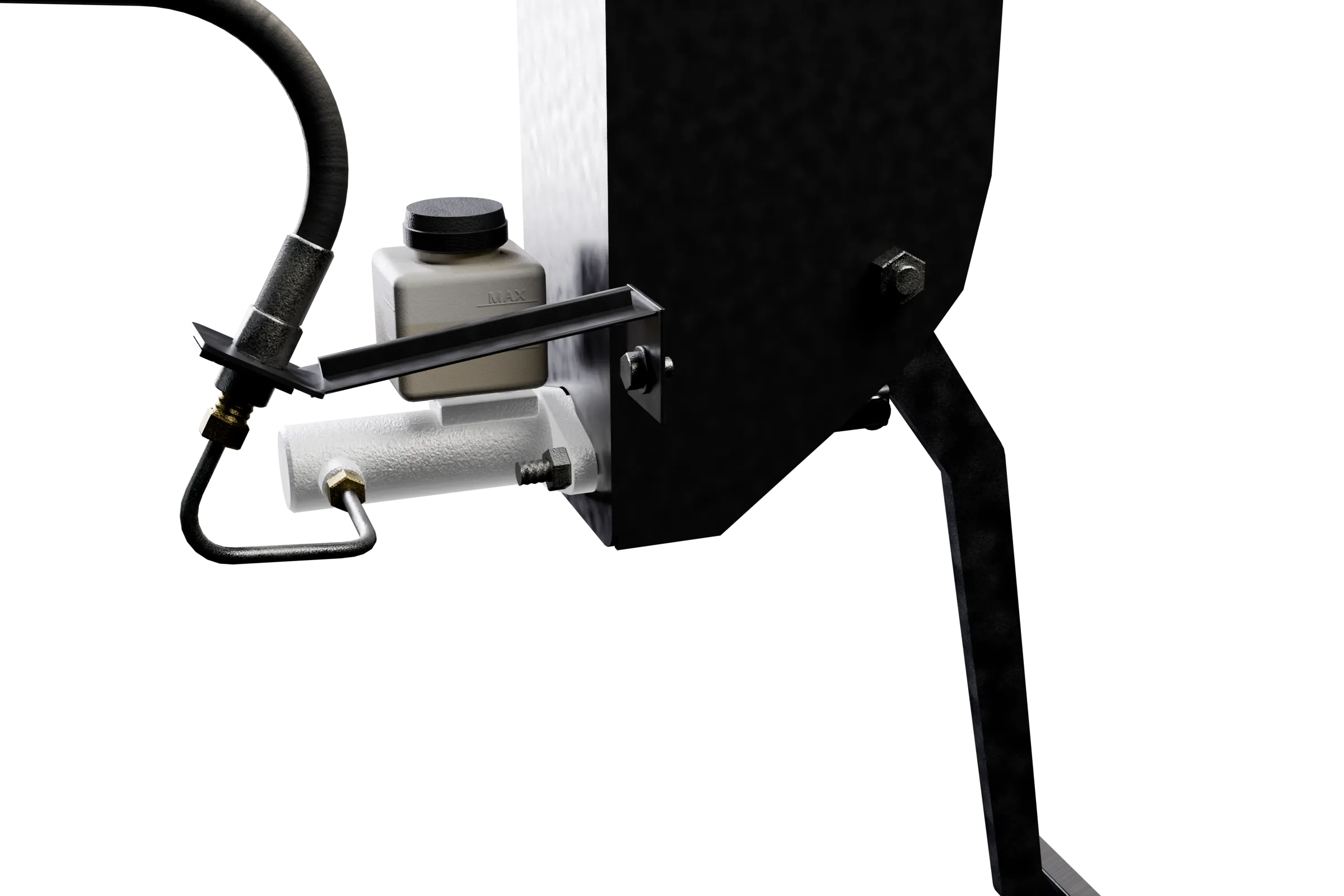
- Master cylinder
- Fluid reservoir
- Master push rod
- Clutch pedal
- Clutch line UK: Clutch pipe
How does a clutch master cylinder work?
It starts the clutch's hydraulics. The pedal is a lever of about 5.6 to 1, and its push rod drives a piston along the cylinder's 19.05 mm bore, 25.6 mm at full pedal in the app's model. As soon as the piston's front seal passes a small port to the reservoir, the fluid ahead of it is trapped and pushed down the line to the slave cylinder, at up to 133 psi (9.2 bar).
The two bores are sized as a pair. The slave's 15.88 mm bore is the smaller one, so its piston travels 1.44 times as far as the master's, the long stroke the clutch fork needs. When you let the pedal up, a spring returns the piston past the port, the line is open to the reservoir again, and any fluid the clutch pushes back as its facings wear flows home. That is why a hydraulic clutch needs no adjusting.
What are the signs of a bad clutch master cylinder?
- A soft or sinking pedal. Worn seals let fluid slip back past the piston, so the pedal creeps down while you hold it at a light and the clutch starts to drag.
- A pedal that stays on the floor. Once the seals pass enough fluid, the pedal builds no pressure at all, and the clutch stays engaged. Why is my clutch pedal stuck to the floor?
- Fluid on the carpet or the firewall. A damp patch under the pedal, or a wet trail down the firewall below the cylinder, means fluid is escaping from the back of it.
- A falling level with nothing wet underneath. If the transmission end is dry, look behind the pedal: fluid lost from the master cylinder collects in its dust boot and on the floor before it shows anywhere else.
- Gears that are hard to select. A pedal that cannot push enough fluid leaves the clutch dragging, so first and reverse crunch at a standstill. Why does my transmission grind when I shift?
- A pedal that works only after pumping. A few quick presses can build enough pressure for a while, which points to air in the system or seals that let fluid by.
Can you drive with a bad clutch master cylinder?
Have it checked before you drive far
Not far. A master cylinder that is starting to pass fluid can stop releasing the clutch with little warning, and then you cannot select a gear or come to a stop without the engine stalling. Keep the fluid at the right level, avoid long trips and have it checked before you drive far. If the pedal sinks to the floor, leave the car where it is until the fault is fixed.
Why do clutch master cylinders fail without a leak?
Because the seal that wears is inside. The piston carries two rubber cups: the front one does the pumping, and the rear one keeps the fluid in at the pedal end. When the front cup wears, or the bore it runs in is scored or pitted by old, wet fluid, fluid slips back past it toward the reservoir instead of going down the line. Nothing leaks out, the level stays where it was, and the only sign is a pedal that sinks while you hold it.
A worn rear cup is different: it lets fluid out of the back of the cylinder, into its rubber boot and then down behind the pedal onto the carpet. A leak at the other end of the system shows on the transmission instead, as the slave cylinder page describes.
Why does the pedal need a little free play?
Because the piston has to come all the way back. The push rod’s length sets the free play at the pedal: in the app’s model it is an adjustable rod with a clevis and a lock nut. With a little slack, the piston returns past the port at the top of every stroke, so the system can take back fluid as the clutch wears and as the fluid warms and expands.
With none, the port stays covered, the fluid is trapped, and the clutch is held partly released, which shows as slip and a take-up at the very top of the pedal. Too much free play does the opposite and wastes travel, so the clutch releases late and the gears crunch. The clutch guide follows the fluid from the pedal to the diaphragm spring.
What does replacing a clutch master cylinder involve?
- Draw the old fluid out of the reservoir with a clean syringe and lay rags under the cylinder and behind the pedal, because clutch fluid strips paint.
- Under the dashboard, unhook the push rod from the pedal by taking out its clip and clevis pin.
- With the hood open, undo the clutch line's fitting with a flare-nut wrench, then the nuts that hold the cylinder to the firewall, and lift it out with its reservoir hose if it has one.
- Bench bleed the new cylinder if its instructions call for it: fill it and work the piston until the fluid comes out with no bubbles.
- Install it, reconnect the line and the push rod, and fill the reservoir with the fluid the automaker specifies.
- Bleed the clutch at the slave cylinder, then check the pedal's free play and that first and reverse go in cleanly with the engine running.
Tighten every nut and bolt to the torque spec in the manufacturer's service manual for your car.
Moderate work on most cars. The slow part is usually reaching the push rod's clip and the mounting nuts behind the dashboard, and the work always ends with bleeding the clutch.
Questions people ask
Is the clutch master cylinder the same as the brake master cylinder?
No, although they work the same way. The clutch has its own, smaller master cylinder, driven by the clutch pedal and feeding only the clutch line. On many cars the two share one reservoir and the same brake fluid.
Should the master and slave cylinders be replaced together?
Often, though it is not required. They are the same age, their seals have soaked in the same fluid, and doing both at once means bleeding the clutch only once. A slave cylinder replaced more recently, or with the clutch, can stay.
Can a clutch master cylinder fail suddenly?
It can. Usually the pedal sinks a little more each week first, but a seal can give way at once, especially in fluid that has gone many years unchanged, and the pedal then drops to the floor.
Can a bad clutch master cylinder make noise?
Sometimes. A dry or worn piston can squeak or groan as the pedal moves, which is easy to mistake for the pedal's own pivot. If the squeak comes from where the push rod enters the cylinder, the cylinder is the likely source.
Related
Symptoms
- Why is my clutch pedal stuck to the floor? A clutch pedal that sinks to the floor or stays there is nearly always a hydraulic fault: a fluid leak, air in the line or a failed seal in the master or slave cylinder.
- Why does my transmission grind when I shift? A manual transmission grinds when the gear you select is still turning at a different speed from the shaft it locks to.
- Why does my clutch engage so high? A clutch that engages high, gripping only near the top of the pedal, usually has a worn clutch disc, above all if it also slips in high gears.
Parts nearby
- What does a clutch slave cylinder do? A clutch slave cylinder is the small hydraulic cylinder on the transmission that releases the clutch.
- What does brake fluid do? Brake fluid carries the push from the brake pedal to the calipers.
- What does a clutch disc do? A clutch disc is the friction disc clamped between the engine's flywheel and the pressure plate.
- What is a throwout bearing? A throwout bearing presses the clutch's diaphragm spring when you push the pedal.
The whole system
- How does a car clutch work? The clutch, part by part, with an interactive diagram.
