
What does a clutch plate do?
A clutch plate (US: clutch disc) is the friction disc clamped between the engine's flywheel and the pressure plate. Its hub is splined to the gearbox input shaft, so while it is clamped, the engine's torque passes through its facings into the gearbox. The facings wear each time the clutch slips, and a worn plate slips in high gears.
US clutch disc Also called driven plate, friction plate
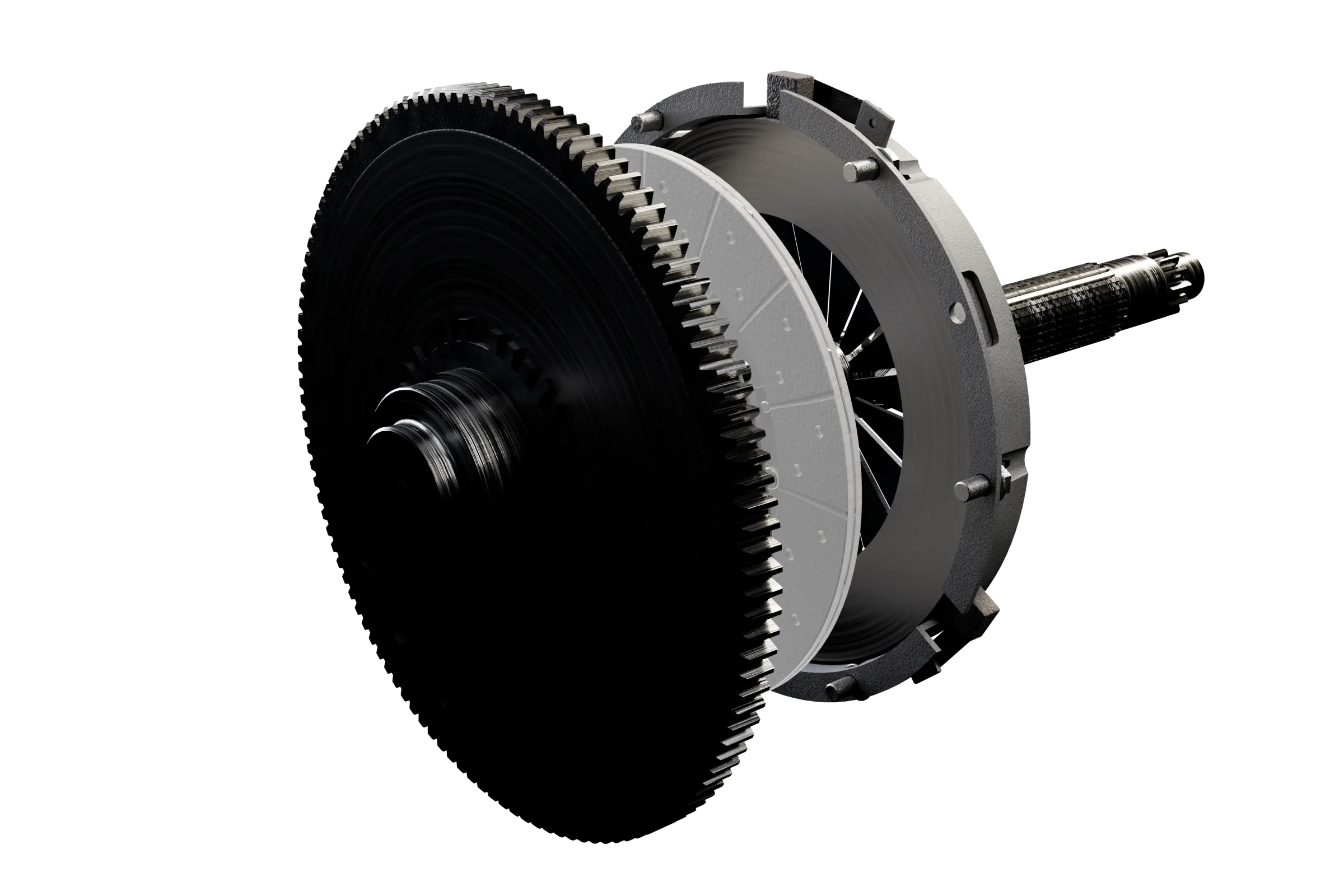
- Friction facing
- Flywheel
- Pressure plate
- Diaphragm spring
How does a clutch plate work?
It carries the engine's drive into the gearbox. The plate sits between the flywheel and the pressure plate, its hub sliding on the splines of the gearbox input shaft. With the pedal up, the diaphragm spring clamps it with 5,176 N in the app's model, and friction on its two facings makes it turn with the engine. Press the pedal and the clamp lets go, so the input shaft can slow or stop while the engine runs on.
It also takes up the drive gently. Between the facings, eight wavy cushion segments flatten as the clamp comes on, so the grip builds through the biting point, and four coil springs in the hub soak up the engine's firing pulses before they reach the gears.
What are the signs of a worn clutch plate?
- The revs rise but the car does not speed up. Most obvious under full throttle from low revs in fourth or fifth, or on a steep hill. How can you tell if a clutch is slipping?
- A biting point that has crept up the pedal. Grip only near the top of the pedal's travel often means the plate is nearly worn out.
- A burning smell. An acrid smell after a hill start or a tow means the facings are overheating.
- Judder as you pull away. Oil on the facings makes the grip come and go. A glazed flywheel or worn engine mounts can feel the same.
- A rattle or clunk as you take up drive. Broken damper springs in the hub let the facings knock against it.
- Gears that crunch going in. Less often, a buckled plate, or one sticking on rusty splines, keeps dragging with the pedal down. Why does my gearbox grind when I change gear?
Can you drive with a worn clutch plate?
Have it checked before you drive far
Gently, and not for long. Each time it slips, the facings and the flywheel heat up and glaze, so the slip worsens quickly, until the car may struggle to climb a hill or pull away with a load. Keep the revs low, avoid full throttle in high gears and have it inspected before you drive far. If oil is the cause, the leak has to be cured as well.
Why does a clutch plate wear out?
Only while it slips. A clamped plate turns with the flywheel and loses nothing; the facings wear as they slide against the flywheel and the pressure plate, each time you pull away, change gear, hold the car on the biting point or rest a foot on the pedal.
In the app’s model each facing is 3.5 mm thick, with its rivet heads 2 mm below the surface. Once the facing wears down to them, the rivets score the flywheel and the plate is finished. Until then the diaphragm spring hides the wear, because its force barely changes as the facings thin. On most hydraulic clutches the reservoir shows it instead: the level creeps up as the facings wear.
Why does oil make a clutch plate slip?
Because the grip is all friction. The model’s plate holds 302 N·m, about 1.6 times what its engine makes, and a film of oil on the facings cuts their friction enough to use that margin up. The oil usually comes from the crankshaft’s rear seal or the gearbox input shaft seal, both right beside the clutch, and a new plate fitted without curing the leak soon slips too.
What does replacing a clutch plate involve?
- Time
- About 5 hours
- Difficulty
- Demanding
- Parts
-
- A clutch kit: disc, pressure plate, release bearing
- A new slave cylinder
- Fresh DOT 4 fluid
- High-melting-point grease
- Disconnect the battery, support the engine and clear the way for the gearbox: on most front-wheel-drive cars the driveshafts, gear linkage and starter come off first.
- Take off the slave cylinder, then take the gearbox's weight on a jack and draw it straight back, keeping it level so it never hangs on the input shaft.
- Undo the cover's bolts a turn at a time in a diagonal pattern, lift off the cover and pressure plate, and take out the old clutch plate, noting which way it faced.
- Check the flywheel for glazing and cracks, a dual-mass flywheel for excess play, and the seals on either side for oil, then fit the new release bearing.
- Grease the input shaft splines very lightly, centre the new plate with an alignment tool and draw the new cover down evenly.
- Slide the gearbox back on square, never pulling it home on its bolts, fit the new slave cylinder, refit the rest and bleed the clutch.
Tools
- Flare-nut spanner (US: Flare-nut wrench)
- Flat screwdriver (US: Flat-blade screwdriver)
- Open-ended spanner (US: Open-end wrench)
- Socket and ratchet
- Gearbox jack (US: Transmission jack)
- Paint pen (US: Paint marker)
- High-melting-point grease (US: High-temperature grease)
- Clutch alignment tool
- Torque wrench
- Bleed tube and bottle (US: Bleeder hose and bottle)
Work safely
- Brake and clutch fluid strips paint and harms skin and eyes: wear gloves and glasses, wipe up spills at once.
- Never work under a car held only by a jack: set it on axle stands.
- A gearbox is heavy: support it on a gearbox jack and get help to move it.
- Clutch dust can be harmful: clean it with brake cleaner or a damp cloth, never with an air line.
Tighten every nut and bolt to the figure in the maker's manual for your car.
Demanding work on most front-wheel-drive cars, because the gearbox has to come out, so most owners leave it to a garage. The plate is fitted as a kit with a new pressure plate and release bearing.
Questions people ask
Is a clutch plate the same as a clutch disc?
Yes. Clutch plate is the usual UK name and clutch disc the US one, and parts lists also say driven plate or friction plate. The pressure plate is a different part: the cast-iron ring that clamps it.
How long does a clutch plate last?
There is no service interval, and the mileage says less than the use. A plate that mostly sees the motorway can outlast the car; town traffic, hill starts and towing wear one out far sooner.
Should the flywheel be replaced with the clutch plate?
Only if it needs it. It is checked whenever the gearbox is out: a glazed or heat-cracked face, or a dual-mass flywheel with too much free play, means a new one, though a solid flywheel can often be resurfaced.
Which way round does a clutch plate go?
The way its markings say, usually flywheel side or gearbox side. The hub stands out further on one side, and fitted backwards it can foul the flywheel or the cover, so the clutch will not release.
Related
Symptoms
- How can you tell if a clutch is slipping? A slipping clutch lets the engine's revs rise without the car speeding up to match, most clearly when you accelerate hard in a high gear or climb a hill.
- Why does my gearbox grind when I change gear? A gearbox grinds when the gear you select is still turning at a different speed from the shaft it is being locked to.
Parts nearby
- What is a clutch release bearing? A clutch release bearing (US: throw-out bearing) presses the clutch's diaphragm spring when you push the pedal.
- What does a clutch slave cylinder do? A clutch slave cylinder is the small hydraulic cylinder on the gearbox that releases the clutch.
The whole system
- How does a car clutch work? The clutch, part by part, with an interactive diagram.
