
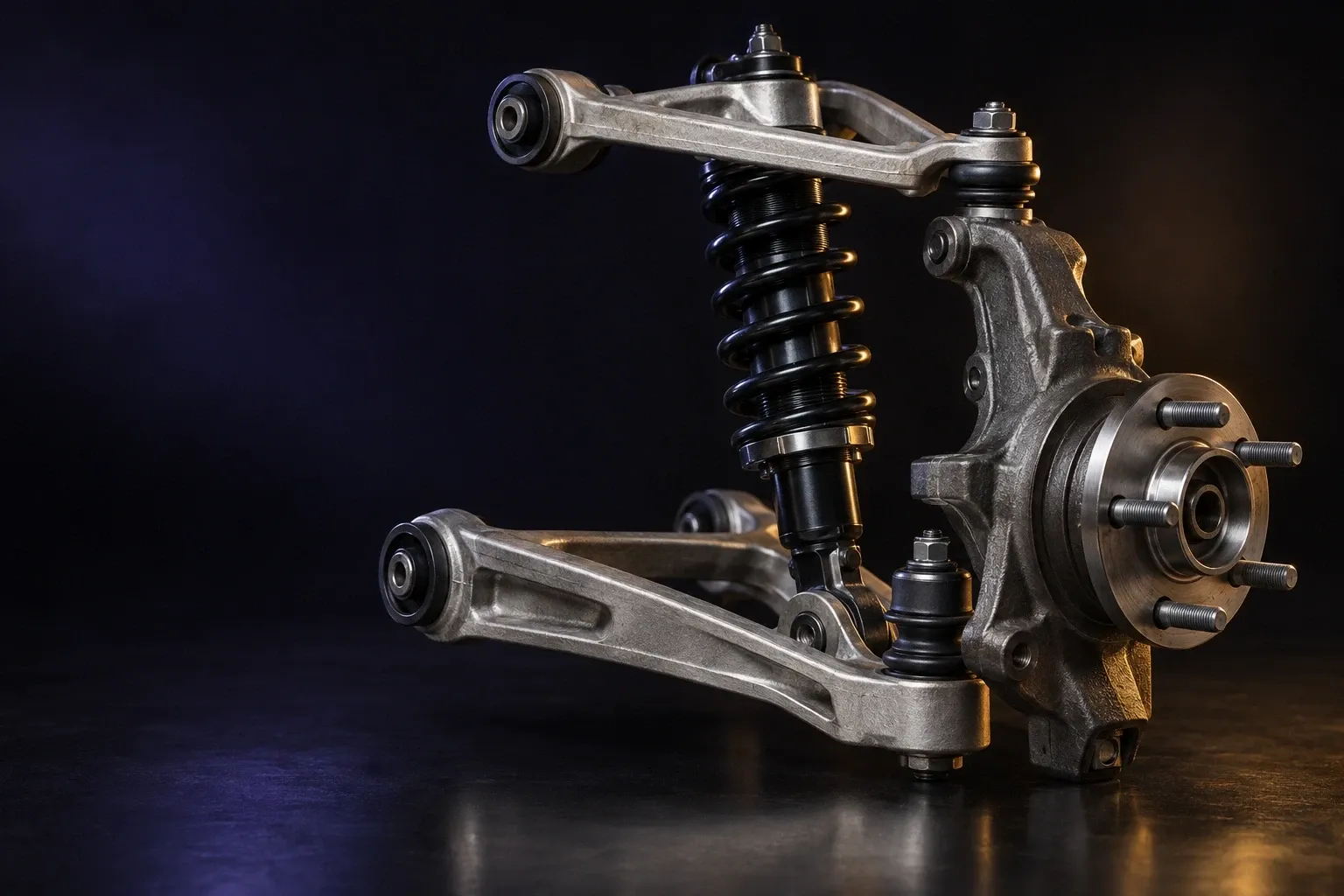
Wishbone · Double A-arm
How does double wishbone suspension work?
Double wishbone suspension holds each wheel between two A-shaped arms, an upper and a lower, which pivot on the body and meet the wheel's knuckle at ball joints. A separate spring and damper carry the weight and control the movement. Because the upper arm is usually shorter, the wheel leans in as it rises, which keeps the tyre flatter on the road in corners than a MacPherson strut can.
In 3D Mechanic you run the camber test on a double wishbone corner and watch both arms swing, then take it apart and build it back up.
Run the camber test
InteractiveDouble wishbone MacPherson strut, for comparison
- Wheel travel
- 0 mm
- Camber change
- 0.00°
- Spring compression
- 0 mm
- Upper wishbone
- Lower wishbone
- Upper ball joint
- Lower ball joint
- Coilover (spring and damper)
- Steering knuckle
What happens, step by step
-
Two arms hold the wheel
The upper and lower wishbones each pivot on two bushes on the body or subframe and carry a ball joint at their outer end.
-
The knuckle joins them
The steering knuckle, which carries the hub, links the two ball joints. The arms and the knuckle form a four-bar linkage.
-
A bump pushes the wheel up
Both arms swing upwards. The shorter upper arm moves through a tighter arc, so it pulls the top of the knuckle inwards more than the bottom.
-
The wheel gains negative camber
So the wheel leans in as it rises: −1.1° at 40 mm of bump in the typical layout shown, against −0.6° for the app's strut.
-
The coilover takes the load
A spring and damper, usually built together as a coilover between the lower arm and the body, carry the weight and damp the movement.
-
Steering turns only the knuckle
The steering axis runs through the two ball joints, so only the knuckle turns when you steer. The spring and damper stay put.
What does each wishbone do?
Between them, the two arms decide exactly how the wheel moves. Each one pivots on two bushes on the body or subframe, so it can only swing up and down, and each ends in a ball joint on the steering knuckle. The knuckle carries the hub and the brake, and with the two arms it forms a four-bar linkage: change the length or angle of either arm and the wheel follows a different path.
The lower arm is usually the longer and stronger of the two. It carries most of the weight, often through the bottom of the coilover, and it takes the braking and cornering loads into the body. The upper arm’s main job is to control the angle of the wheel.
Why is the upper arm shorter?
To make the wheel lean in as it rises. A shorter arm swings through a tighter arc, so as the wheel moves up its top end is pulled inwards more than the bottom. The tyre gains negative camber: its top leans towards the car.
That is exactly what a tyre needs in a corner. As the car leans, the outer wheel rises relative to the body, and the body’s lean would otherwise tip that tyre onto its outer edge. The extra camber cancels much of the lean and keeps the tread flatter on the road. In the typical layout shown, with an upper arm 0.65 times as long as the lower one, the wheel gains −1.1° at 40 mm of bump and −2.7° at 80 mm.
How does it compare with a MacPherson strut?
The chart in the diagram above plots both. The app’s strut gains only −0.6° at 40 mm of bump and −0.8° at 80 mm, so in a hard corner its outer tyre ends up leaning out with the body. The wishbone holds the tyre more upright, which means more grip and steadier handling.
The strut wins on everything else. It needs fewer parts and less room, it weighs less and costs less to make, and it leaves space for a sideways engine and the driveshafts. That trade is why most small cars use struts and many sports cars and larger cars use wishbones.
Where do the spring and damper go?
Usually in a coilover, a spring around a damper, mounted between the lower arm and the body. Because it sits partway along the arm rather than at the wheel, it moves less than the wheel does. In the layout shown the spring compresses 48 mm for 80 mm of wheel travel, about 0.6 times as far, which is why it needs to be stiffer than the wheel rate the car actually feels.
Unlike a strut, the coilover plays no part in the steering. Only the knuckle turns, on its two ball joints, so the steering axis is set by the joints alone and the spring and damper never have to rotate.
The parts that make it work
Upper wishbone US: Upper control arm (A-arm)
What it does
The shorter of the two arms. Its length and angle decide how much the wheel leans in as it rises.
How it fails
Worn bushes or a worn ball joint let the wheel shift under braking and cornering: clunks, vague steering and uneven tyre wear.
Lower wishbone US: Lower control arm
What it does
The longer, stronger arm. It carries most of the load and, on most designs, the bottom of the coilover.
How it fails
Worn bushes show as clunks over bumps and the car pulling or shimmying under braking.
Ball joints
What it does
One at the outer end of each arm, letting the knuckle steer and move up and down at the same time.
How it fails
Play in a ball joint knocks over bumps and makes the car wander. A failed joint can let the wheel collapse.
Steering knuckle US: Knuckle (spindle)
What it does
The upright between the two ball joints. It carries the hub, the wheel bearing and the brake, and the tie rod turns it to steer.
How it fails
It rarely wears, but a hard kerb strike can bend it.
Coilover
What it does
A coil spring around a damper. It carries the weight and controls the movement, and because it is not part of the steering it does not turn with the wheel.
How it fails
Like any damper it can leak and stop controlling the bounce; a broken spring drops the corner.
Bushes
What it does
Rubber or polyurethane bushes where the arms meet the body. They soak up vibration while keeping the arms in line.
How it fails
Cracked or soft bushes cause clunks, wandering and uneven tyre wear.
Anti-roll bar and links US: Sway bar and links
What it does
A torsion bar linking the left and right wheels to cut body roll in corners.
How it fails
Worn links knock over broken roads; worn bar bushes creak.
The numbers
| Quantity | Value |
|---|---|
| Upper arm length | 237 mm |
| Lower arm length | 365 mm |
| Upper arm as a share of the lower | 0.65 |
| Camber change at 40 mm of bump | −1.1° (strut: −0.6°) |
| Camber change at 80 mm of bump | −2.7° (strut: −0.8°) |
| Camber change at 80 mm of droop | +1.3° (strut: +1.9°) |
| Spring compression at 80 mm of bump | 48 mm (the spring moves about 0.6 times as far as the wheel) |
Typical proportions for a short-long-arm double wishbone, not measurements from a particular car. The strut figures come from 3D Mechanic's MacPherson strut model.
Common problems and what they mean
| Symptom | Likely cause | What to check |
|---|---|---|
| A clunk over bumps or when braking | Worn wishbone bushes or ball joints | Have the arms checked for play with the wheel off the ground. |
| The car wanders or follows ruts | Worn ball joints or bushes, or the alignment out | Check for play first, then have the alignment set. |
| Uneven tyre wear on the inner or outer edge | Camber or toe out of adjustment, often after a kerb strike, or worn bushes | Have the alignment measured and adjusted. |
| The car keeps bouncing after a bump | A worn coilover damper | Push down on the corner: it should settle at once. |
| A light knock over broken roads | Worn anti-roll bar links | Check the links: they are cheap and quick to replace. |
UK and US names
| UK | US |
|---|---|
| Wishbone | A-arm (control arm) |
| Upright | Knuckle (spindle) |
| Anti-roll bar | Sway bar |
| Track rod end | Tie rod end |
| Tyre | Tire |
Questions people ask
What is the difference between double wishbone and MacPherson strut suspension?
A strut uses the damper itself as the upper link, with one lower arm. A double wishbone uses two arms and a separate spring and damper. The wishbone controls camber better and keeps the tyre flatter in corners; the strut is lighter, cheaper and more compact.
Why are the arms called wishbones?
Seen from above, each arm is a V or A shape, with two pivots on the body and one ball joint at the wheel, like the wishbone of a chicken.
Which cars use double wishbone suspension?
Many sports cars, larger saloons and pickups use it at the front, and many cars use multi-link suspension, a development of the same idea, at the rear. Most small front-wheel-drive cars use struts at the front instead.
Is double wishbone suspension better than a strut?
For grip and control, usually, because it keeps the tyre more upright. It costs more, weighs more and needs more room, which is why most small cars don't use it.
