
What does a shock absorber do?
A shock absorber (US: shock) controls the spring. Without it the car would keep bouncing after every bump; with it, the body settles after one movement and the tyre stays pressed on the road. It works by forcing oil through small valves, turning the movement into heat. Worn ones let the car float and take longer to stop.
US shock Also called damper
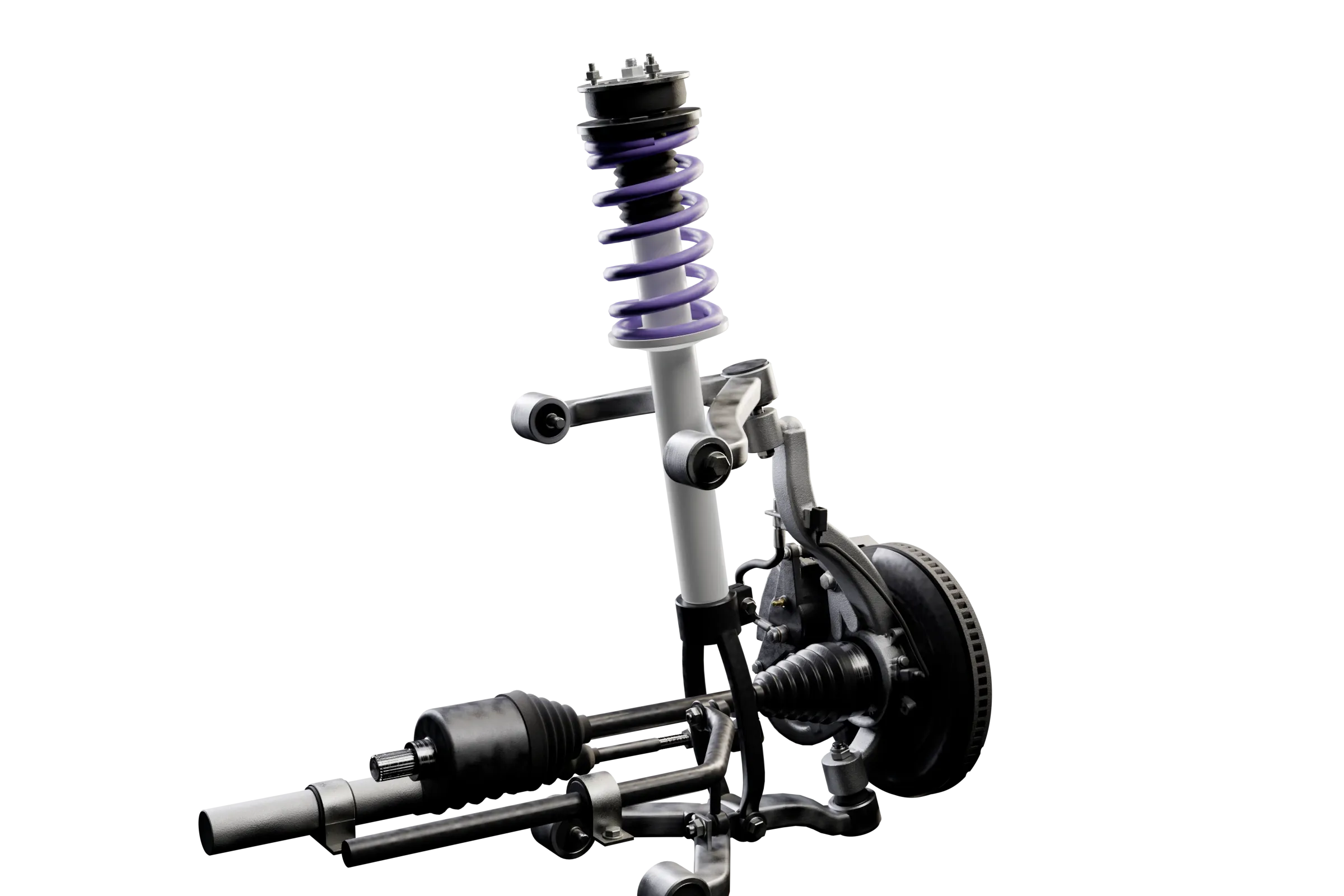
- Damper US: Shock absorber
- Coil spring
- Upper wishbone US: Upper control arm
- Lower wishbone US: Lower control arm
How does a shock absorber work?
Inside its sealed tube, a piston on a rod moves through oil as the wheel rises and falls, and the oil has to squeeze through small valves in the piston to get past. That resistance slows the movement and turns its energy into heat. The resistance rises with the speed of the movement, so a slow lean into a corner meets a gentle force and a sharp bump a much firmer one.
That matters for grip as much as comfort. Over a bump the wheel is thrown upwards, and the spring would fling it back down and past its normal position; the damper slows both movements, so the tyre follows the road instead of skipping across it. It also slows the body's dive under braking and its roll into a corner. It does not hold the car up, which is the spring's work, and unlike a strut a plain shock absorber does not locate the wheel either.
What are the signs of worn shock absorbers?
- Bouncing after bumps. After a dip or a hump the body floats and bobs instead of settling at once, and the car feels unsettled on undulating roads.
- Nose-diving under braking. The front dips sharply when you brake and the back squats when you accelerate, and the body sways more in corners.
- Longer stopping on rough roads. Over ridges and potholes the tyres skip instead of gripping, so the car takes further to stop and the ABS can cut in on bumpy surfaces.
- Patchy tyre wear. A bouncing wheel wears the tread in scallops, or cups, around the tyre, which also makes it noisier. What causes uneven tyre wear?
- Oil on the outside of the damper. A wet, oily body means the seal has failed and the damper is losing fluid. A light film of oil and dust is not a fault on its own, and the MOT does not fail it.
- A knock over big bumps. From worn mounting rubbers, or a damper so weak that the suspension crashes into its bump stops. What causes a knocking noise over bumps?
Can you drive with a broken shock absorber?
Fix it soon
Yes, carefully, but have it replaced soon. The spring still holds the car up, so the corner will not drop. What you lose is control of the wheel: over bumps the tyre can lose touch with the road, so the car takes longer to stop and has less grip in corners, and it can wallow in a crosswind or a sudden swerve. If the damper is part of a strut and its rod or a mounting has broken, do not drive it, because the strut also holds the wheel in place. A damper that has lost its damping or leaks badly fails the MOT.
How long do shock absorbers last?
There is no fixed interval. Dampers lose their control so gradually that most drivers never notice the change, and many are well past their best long before the car feels unsafe. Rough roads and heavy loads wear them out sooner, and so does a split dust boot, which lets grit reach the rod and cut its seal.
Garages check them at services, and the MOT fails one that leaks badly or has almost stopped damping. The bounce test, pushing a corner down hard and letting go, only catches dampers that are badly worn: a car that settles at once can still have tired dampers, which show up better on a drive over a bumpy road or on a garage’s damper tester.
What does replacing a shock absorber involve?
- Raise the car onto axle stands on firm ground and take the wheel off.
- Support the arm or the axle with a jack, because on many cars the damper is what stops the wheel dropping further.
- Undo the top mounting, under the bonnet or inside the boot on some cars, then the bottom one, and take the damper out.
- Where the spring is fitted around the damper, compress it with proper spring compressors and move it, with its seats and mount, onto the new damper.
- Fit the new damper with new mounting rubbers, and a new bump stop and dust boot if the old ones are worn.
- Tighten mountings that have rubber bushes with the suspension at ride height, then refit the wheel and lower the car.
- Replace the damper on the other side of the axle the same way.
Tighten every nut and bolt to the figure in the maker's manual for your car.
Shock absorbers are replaced in pairs across an axle. A plain damper is one of the simpler suspension repairs; a strut or a coilover means compressing the spring, which is usually left to a garage, and a new strut needs an alignment check afterwards.
Questions people ask
Why is a shock absorber also called a damper?
Because damping is what it does. The spring takes the shock of a bump; the shock absorber controls the spring's movement afterwards and turns its energy into heat. Engineers call it a damper, and most drivers call it a shock absorber, or a shock in the US.
What is the difference between twin-tube and monotube shock absorbers?
A twin-tube damper has the piston's tube inside an outer one that holds spare oil, with a valve between them, and most road cars use it. A monotube has a single tube, with a floating piston keeping the oil apart from gas at high pressure. It runs cooler and stays consistent when worked hard, which suits performance cars.
Are gas shock absorbers better?
They hold their damping better when worked hard, which is why most modern dampers are gas-charged. A little nitrogen under pressure stops the oil foaming, so the damping stays consistent over a long, rough road. It does not make the ride any harder.
Why does the car feel firmer with new shock absorbers?
Usually because the old ones had faded so slowly that the floating felt normal. New dampers control every movement again, so the body feels tighter and settles straight away. The springs, which set how soft the ride is, have not changed.
Related
Symptoms
- What causes a knocking noise over bumps? A knocking or clunking noise over bumps usually comes from a worn joint in the front suspension.
- What causes uneven tyre wear? Uneven tyre wear usually means the wheel alignment is out, the tyre pressures are wrong or a suspension part is worn, and the pattern points to which.
Parts nearby
- What does a coil spring do? A coil spring holds the car up. Each corner rests on one, and when the wheel hits a bump the spring compresses, stores the energy and pushes the wheel back down, while its length sets the ride height.
- What is a strut top mount? A strut top mount (US: strut mount) is the rubber-bonded mounting that bolts the top of a MacPherson strut into the car's body and carries that corner's weight.
- What do control arm bushes do? Control arm bushes (US: bushings) are the rubber mountings where a control arm pivots on the subframe.
- What does a ball joint do? A ball joint is the ball-and-socket joint that connects a suspension arm to the wheel's steering knuckle.
Explained
- Struts vs shocks: what's the difference? A shock absorber only damps movement: it stops the car bouncing after a bump.
The whole system
- How does double wishbone suspension work? The double wishbone suspension, part by part, with an interactive diagram.
