
What is a strut top mount?
A strut top mount (US: strut mount) is the rubber-bonded mounting that bolts the top of a MacPherson strut into the car's body and carries that corner's weight. At the front it also holds the bearing that lets the strut turn when you steer. A worn one knocks over bumps or makes the steering crunch.
US strut mount Also called strut top mount, suspension top mount
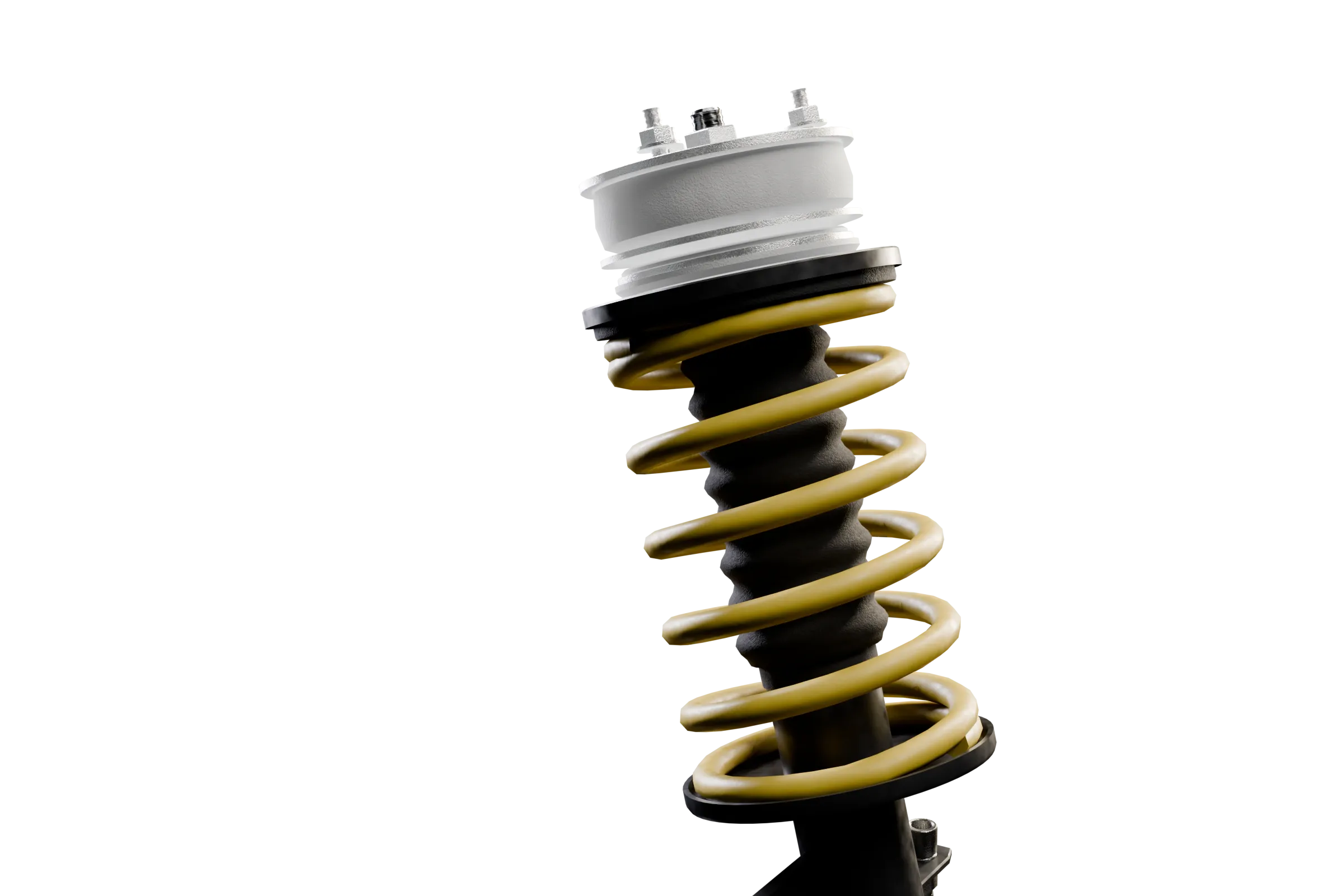
- Top mount US: Strut mount
- Strut top bearing US: Strut mount bearing
- Coil spring
- Strut body
What does a top mount do?
It holds the top of the strut and carries that corner of the car. The mount sits under the strut tower, the reinforced dome you can see under the bonnet at each side of the engine bay, and the coil spring pushes up against it through the upper spring seat. So the weight of that corner rests on the mount, and the strut's bending loads from braking and cornering pass through it into the body.
Its rubber keeps road noise and vibration out of the cabin and gives a little, so the strut can tilt as the wheel moves. At the front there is a second part, the strut bearing: a thrust bearing between the mount and the spring seat. The steering axis runs up through the middle of the mount, so the spring and the damper turn with the wheel every time you steer, and the bearing lets them turn smoothly under the full weight of the car.
What are the signs of a worn top mount?
- A knock or thud from the top of the strut. Over bumps and potholes, as the strut moves about in rubber that has perished or split. What causes a knocking noise over bumps?
- A creak, click or crunch when you steer. Loudest when you turn the wheel slowly at parking speed, from a strut bearing that has run dry or broken. Why does my car click when turning?
- Stiff or notchy steering. A binding bearing makes the steering feel stiff, stick slightly off centre or return to the centre unevenly.
- A clunk as the steering unwinds. When the bearing sticks, the spring winds up as you turn and then lets go with a clunk or a twang.
- Movement you can see under the bonnet. Watch the top of the strut while a helper pushes down hard on that corner: the centre of the mount should barely move, and the rubber should not be torn from its metal.
Is it safe to drive with a worn top mount?
Have it checked before you drive far
Usually for a short while, but have it checked before you drive far. A mount with tired rubber still holds the strut and is mostly a noise. A sticking bearing is more serious, because the steering can feel heavy and may not return to the centre on its own, and a mount whose rubber has torn right through no longer holds the strut firmly in the tower. The MOT fails a top mount with play caused by wear.
What does a worn strut bearing sound like?
Usually a creak or a dry, gritty crunch as you turn the steering, sometimes with clicks, and often worst when parking with the car barely moving. The noise follows the steering rather than the road speed: it comes as the wheel turns, even with the car standing still, and stops when you hold the wheel steady.
That is the easiest way to tell it from a worn CV joint, which clicks in a steady rhythm as you drive slowly on full lock, and only while the car is moving. For a closer look, watch the coil spring through the wheel arch while a helper turns the steering slowly: a spring that jumps as it turns shows a bearing that is binding.
What does replacing a top mount involve?
- Raise the car onto axle stands, take the wheel off and mark the strut's position on the knuckle, so the camber is not lost.
- Disconnect what is fixed to the strut, such as the drop link and the clips for the brake hose and ABS lead, then undo the bolts that hold it to the knuckle.
- Support the strut, undo the nuts on top of the strut tower under the bonnet and lift the strut out of the wheel arch.
- Compress the spring with proper spring compressors until it is free of its seats, then undo the nut on the piston rod and take off the old mount and bearing.
- Fit the new mount and bearing, check that the spring's ends sit in their recesses, fit the rod nut and release the compressors slowly and evenly.
- Refit the strut and everything attached to it, refit the wheel and lower the car.
- Have the alignment checked.
Tighten every nut and bolt to the figure in the maker's manual for your car.
Usually a garage repair, because the spring has to be compressed, and a compressed spring holds a great deal of energy. Top mounts are often renewed whenever the struts are, and in pairs across the axle.
Questions people ask
Is a top mount the same as a strut bearing?
Not quite. The top mount is the rubber-bonded part bolted to the body; the strut bearing is the thrust bearing under it that lets the strut turn. On many cars they are sold as a kit, and on some the bearing is built into the mount.
Should you replace top mounts with new struts?
It is usually worth it. The strut has to be taken apart to fit a new one anyway, so the mount and bearing need no extra work then, and an old mount can knock or crunch long before the new strut is worn.
Do rear struts have top mounts?
Yes. Rear struts and dampers have rubber top mounts too, but no bearing, because on most cars the rear wheels do not steer.
Can a worn top mount affect the alignment?
A little. Rubber that has sagged or split lets the top of the strut sit out of place, which moves the camber and caster on that side. Fit the new mount first and have the alignment checked afterwards, not the other way round.
Related
Symptoms
- What causes a knocking noise over bumps? A knocking or clunking noise over bumps usually comes from a worn joint in the front suspension.
- Why does my car click when turning? A clicking noise when you turn, loudest on full lock as you pull away, is usually a worn outer CV joint on a front driveshaft, most often after its boot has split.
Parts nearby
- What does a coil spring do? A coil spring holds the car up. Each corner rests on one, and when the wheel hits a bump the spring compresses, stores the energy and pushes the wheel back down, while its length sets the ride height.
- What does a shock absorber do? A shock absorber (US: shock) controls the spring. Without it the car would keep bouncing after every bump; with it, the body settles after one movement and the tyre stays pressed on the road.
- What does a CV joint do? A CV (constant velocity) joint lets a driveshaft turn a wheel through an angle without the speed pulsing.
- What do control arm bushes do? Control arm bushes (US: bushings) are the rubber mountings where a control arm pivots on the subframe.
Explained
- Struts vs shocks: what's the difference? A shock absorber only damps movement: it stops the car bouncing after a bump.
The whole system
- How does a MacPherson strut work? The MacPherson strut, part by part, with an interactive diagram.
