
What does a coil spring do?
A coil spring holds the car up. Each corner rests on one, and when the wheel hits a bump the spring compresses, stores the energy and pushes the wheel back down, while its length sets the ride height. A broken spring makes that corner sit low and clunk, and its broken end can cut into the tyre.
Also called road spring, suspension spring
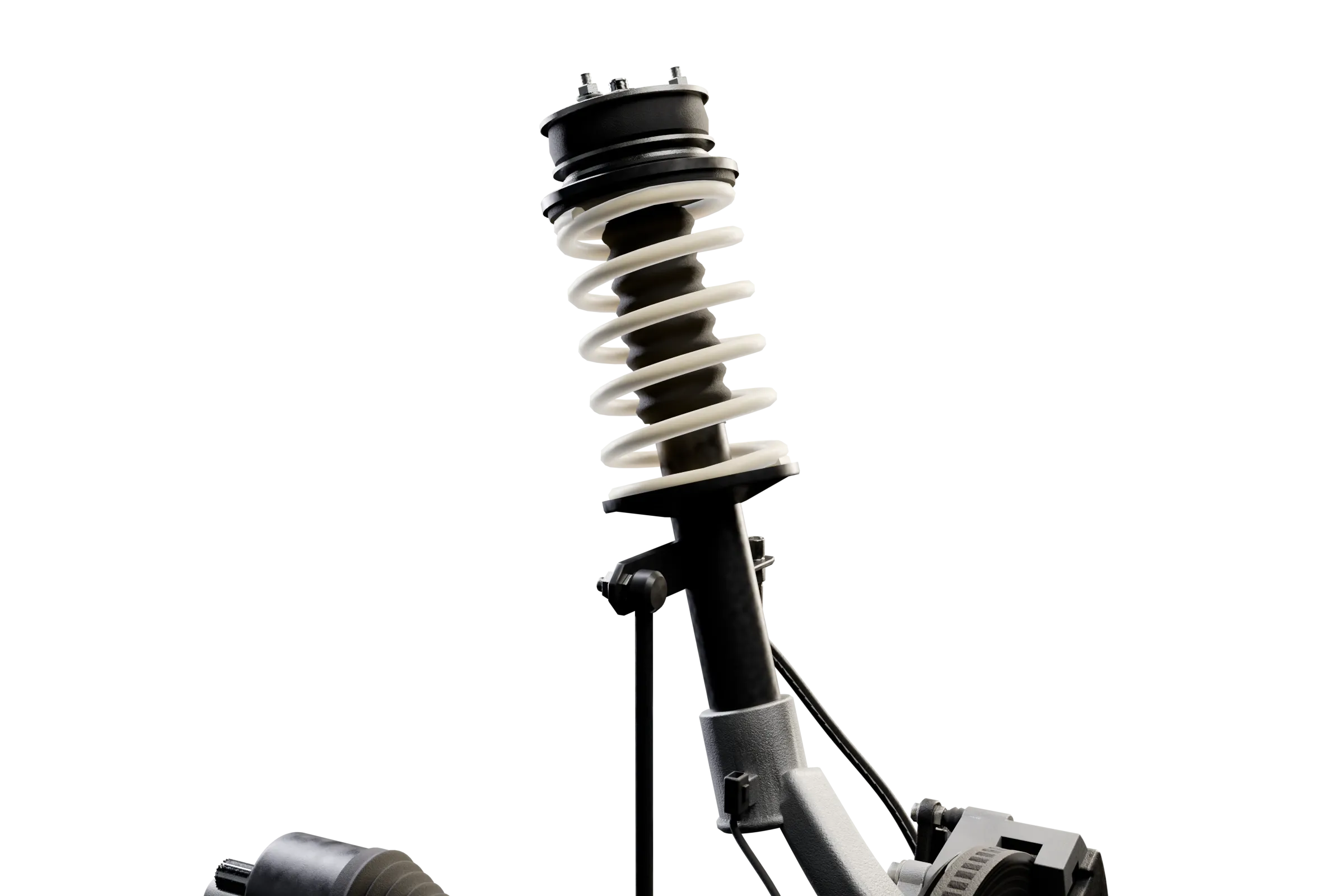
- Coil spring
- Top mount US: Strut mount
- Strut body
How does a coil spring work?
It is a bar of spring steel wound into a helix, sitting between a seat below and a mounting on the body above: on a MacPherson strut, between a perch on the strut tube and the top mount. The car's weight squeezes it to its ride height. A bump compresses it further, twisting the steel along its length and storing the energy, and as the bump passes the spring pushes the wheel back down so the tyre stays on the road.
Its stiffness, the spring rate, trades comfort against body control. Ride height depends on the spring's length, so a spring that sags with age, or breaks, lowers its corner and changes the wheel angles. The spring only stores the energy: the damper turns it into heat, or the car would keep bobbing after every bump.
What are the symptoms of a broken coil spring?
- A loud clunk or bang. Often at the moment the spring snaps, over a bump or as you turn, and then a clunk from that corner over bumps afterwards. What causes a knocking noise over bumps?
- One corner sitting lower. Park on level ground and compare the gap between each tyre and its wheel arch. A broken or sagging spring leaves its corner low, and the car leans.
- Scraping or rubbing from the wheel. The broken end can grind against its seat or the next coil as the suspension moves, and a clunk when turning at low speed is common too.
- Damage to the inner tyre wall. Look at the inside of the tyre for scuffs or a cut where the broken end has touched it. A cut sidewall means a new tyre.
- A break you can see. Look through the wheel arch with a torch, with the steering on full lock for a better view. The break is usually near the bottom coil, where water and dirt collect on the seat.
Can you drive with a broken coil spring?
Have it checked before you drive far
Only slowly and as far as a garage. When a spring snaps near its end, the coils usually settle onto the seat and still hold the car up, so the corner drops but does not collapse. The danger is the broken end, which can cut into the tyre and cause a sudden deflation. The car also leans, brakes less evenly and may hit its bump stop over big bumps. If the spring has broken in the middle, or that corner sits right down on its bump stop, do not drive it. A broken spring fails the MOT.
Why do coil springs break?
Mostly through corrosion and fatigue. A spring is coated to keep water off the steel, but stones chip the coating and road salt gets in, and the rust pits that form are where cracks start. Every bump flexes the steel and the crack grows a little, until a pothole or a speed bump finishes it.
Modern springs work harder than older ones. To save weight they are made from thinner, higher-strength steel that runs closer to its limit, so a rust pit that a heavier spring would survive can be enough to start a crack in a modern one. That is why broken springs are common wherever the roads are salted in winter, as in the UK, even on cars that are not very old.
What does replacing a coil spring involve?
- Raise the car onto axle stands and take the wheel off.
- Free the strut: disconnect what is fixed to it, undo it from the knuckle and undo the top mount's nuts under the bonnet, then lift it out.
- Fit proper spring compressors on opposite sides of the spring and wind them in evenly until the spring is free of its seats.
- Undo the nut on the piston rod, take off the top mount and upper seat, lift the old spring off and let the compressors out slowly.
- Compress the new spring, fit it with its ends in the seats' recesses, rebuild the strut and release the compressors slowly and evenly.
- Refit the strut, everything attached to it and the wheel, then replace the spring on the other side the same way and have the alignment checked.
Tighten every nut and bolt to the figure in the maker's manual for your car.
Springs are replaced in pairs across the axle, so both sides sit at the same height. At the front this is usually a garage repair, because of the compressed spring. On many rear axles the spring sits apart from the damper and comes out once the damper is undone and the axle lowered on a jack.
Questions people ask
Will a broken coil spring fail an MOT?
Yes. A fractured spring is a major defect, and so is a spring that is insecure or missing. The tester looks for breaks, especially in the end coils, and checks that the springs are seated securely.
Do coil springs have to be replaced in pairs?
Yes, across an axle. A new spring stands taller than an old one that has settled over the years, so a single new spring would leave the car leaning and behaving differently on each side.
Can a broken coil spring be repaired?
No. Springs are never welded or heated, because heat destroys the steel's temper and the spring would sag or break again. A broken spring is always replaced, along with the one on the other side.
What are progressive coil springs?
Springs with their coils wound closer together at one end. Those coils close up first as the spring is squeezed, so it gets stiffer the further it is compressed: soft over small bumps, firmer in corners and over big ones.
Related
Symptoms
- What causes a knocking noise over bumps? A knocking or clunking noise over bumps usually comes from a worn joint in the front suspension.
Parts nearby
- What does a shock absorber do? A shock absorber (US: shock) controls the spring. Without it the car would keep bouncing after every bump; with it, the body settles after one movement and the tyre stays pressed on the road.
- What is a strut top mount? A strut top mount (US: strut mount) is the rubber-bonded mounting that bolts the top of a MacPherson strut into the car's body and carries that corner's weight.
- What do control arm bushes do? Control arm bushes (US: bushings) are the rubber mountings where a control arm pivots on the subframe.
- What does a ball joint do? A ball joint is the ball-and-socket joint that connects a suspension arm to the wheel's steering knuckle.
Explained
- Struts vs shocks: what's the difference? A shock absorber only damps movement: it stops the car bouncing after a bump.
The whole system
- How does a MacPherson strut work? The MacPherson strut, part by part, with an interactive diagram.
