
Struts vs shocks: what's the difference?
A shock absorber only damps movement: it stops the car bouncing after a bump. A strut is a damper that is also part of the suspension's structure. It carries the coil spring, holds the top of the wheel in place and, at the front of most cars, turns with the steering. Every strut contains a damper, but not every damper is a strut.
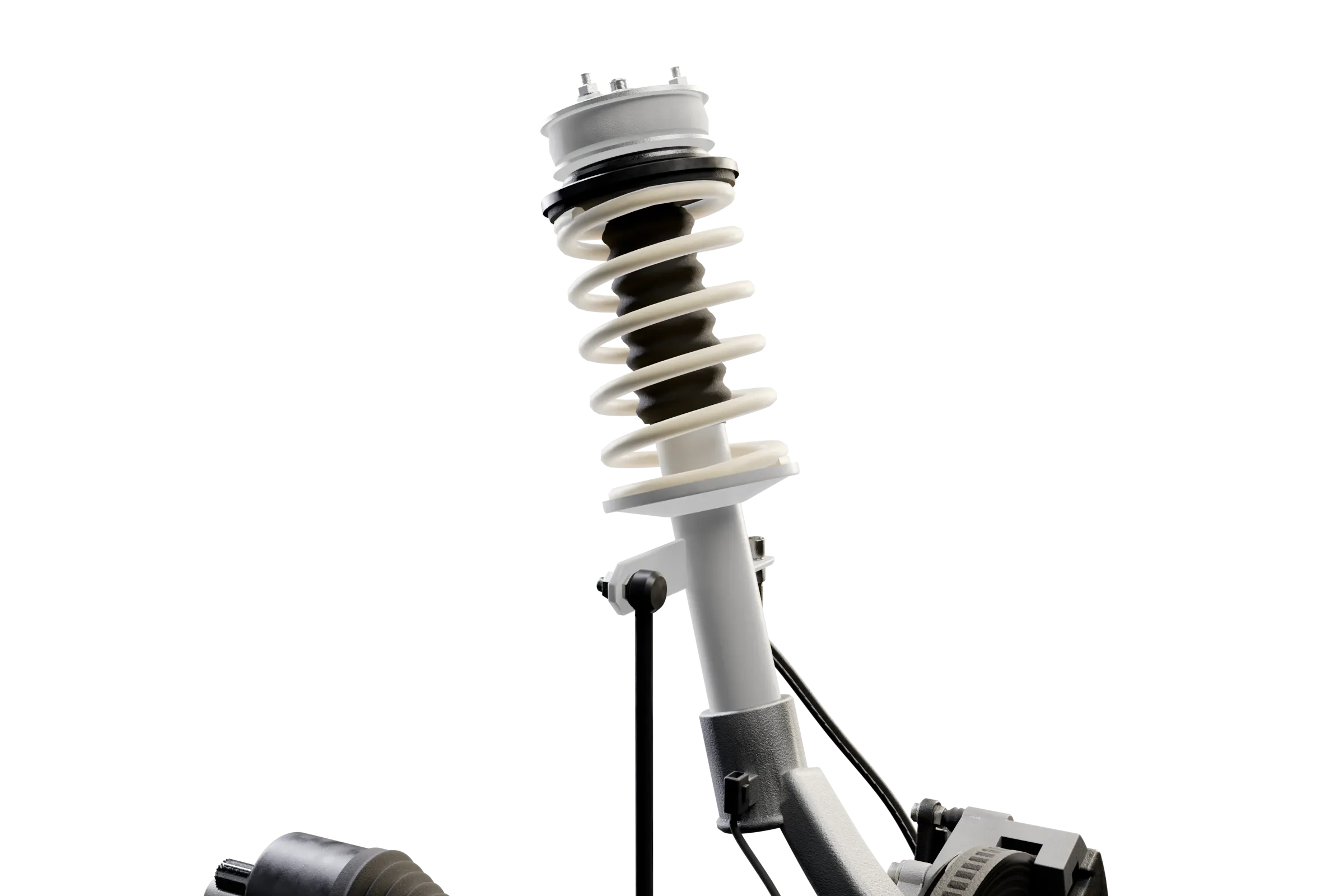
- Strut body
- Coil spring
- Top mount US: Strut mount
At a glance
| Strut | Shock absorber | |
|---|---|---|
| Damps the bounce | Yes, with a damper inside its tube | Yes: it is all it does |
| Holds up the car | Yes: the coil spring sits on it | No: the spring is separate, or fitted around it on a coilover |
| Locates the wheel | Yes: it is the upper link of the suspension | No: arms do that |
| Turns with the steering | At the front, yes, on a bearing in its top mount | No |
| Piston rod | Thick, to take bending loads | Slim: it only slides |
| Usually found | At the front of most small and medium cars | With double wishbone and multi-link suspension, and at the rear of many cars |
| After replacing it | Have the alignment checked: the camber can shift | No wheel angles change |
How does a shock absorber damp the bounce?
By turning the spring’s bouncing into heat. Inside a sealed tube, a piston on a rod pushes oil through small valves as the wheel moves, and the oil’s resistance soaks up the energy. A car on its springs alone would keep bobbing after every bump, at its ride frequency: 1.35 Hz on the app’s MacPherson strut model. With a working damper it settles after one movement.
That is all a shock absorber does. It does not hold up the car or decide where the wheel goes: the springs carry the weight, and the suspension arms locate the wheel. In the app’s double wishbone, the damper sits between the two arms with the spring around it, and the arms do the locating.
What makes a strut different?
A strut damps the bounce too, and does two more things. Its tube is clamped to the steering knuckle, so it holds the top of the wheel in place and takes the bending loads from the tyre in braking and cornering. The coil spring sits on a perch on the tube, so the strut also carries that corner’s weight. That is why a strut’s piston rod is much thicker than a shock absorber’s.
At the front, the strut is also the top of the steering axis: when you steer, the whole strut turns on a bearing in its top mount. There is more on that in how a MacPherson strut works.
How do you tell which one a car has?
Look behind a front wheel. If a thick tube runs from the hub up into the body, with the coil spring around it and nothing above the wheel but its top mount, it is a strut. If there are arms above and below the wheel with a slimmer damper between them, the car has shock absorbers. Many cars have struts at the front and shock absorbers at the rear.
Do they wear out the same way?
Yes: both lose damping as their seals and valves wear. The car bounces after bumps, dives under braking and wears its tyres in patches, and oil on the outside of the tube means a seal has gone. A strut is replaced as an assembly, often with its top mount, while a shock absorber is usually a simpler swap. Both are changed in pairs across an axle.
Questions people ask
Can you replace struts with shocks?
No. A car built with struts needs struts, because they hold the wheel in place and a plain shock absorber cannot. Fit the part made for the car.
Do you need an alignment after replacing struts?
Usually, yes. The strut is bolted to the steering knuckle, so taking it off can shift the camber a little, and an alignment check afterwards stops the tyres wearing on one edge. Replacing a plain shock absorber moves no wheel angles.
Should struts and shocks be replaced in pairs?
Yes, across an axle. A new damper on one side and a worn one on the other makes the car behave differently on each side under braking and in corners.
What is a coilover?
A damper with the coil spring fitted around it as one unit, as on the app's double wishbone. A MacPherson strut carries its spring the same way, but it is also a structural part of the suspension, which a coilover on its own is not.
Related
More explained
- Toe in vs toe out: what's the difference? Toe is the angle of a pair of wheels seen from above. With toe in, their fronts point slightly towards each other; with toe out, slightly apart.
- What is camber? Camber is the lean of a wheel seen from the front of the car.
