
Toe in vs toe out: what's the difference?
Toe is the angle of a pair of wheels seen from above. With toe in, their fronts point slightly towards each other; with toe out, slightly apart. Toe in makes a car steadier in a straight line and toe out makes it turn in more sharply. Too much of either scrubs the tyres and wears their edges.
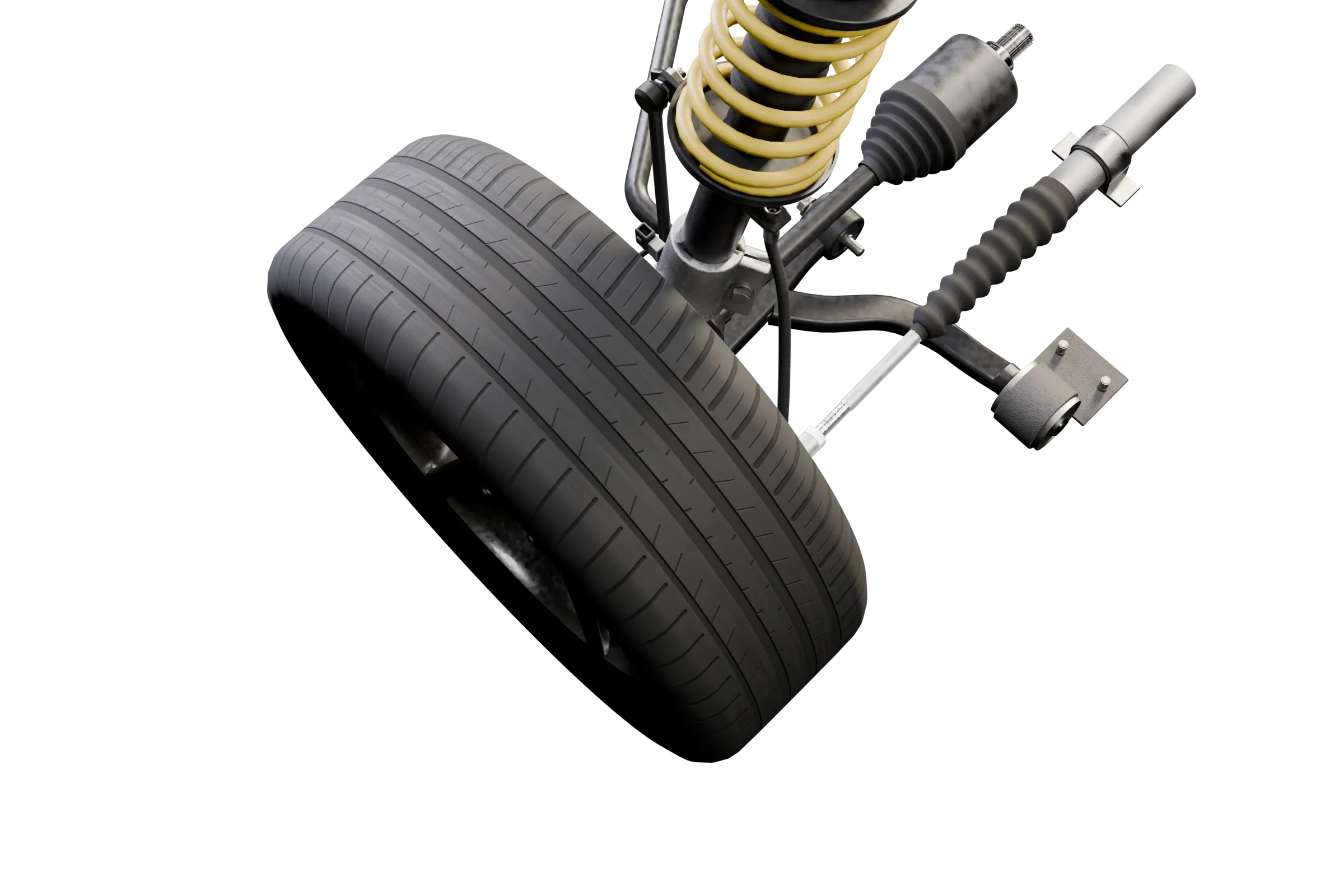
- Track rod US: Inner tie rod
- Track rod end US: Outer tie rod end
- Tyre 225/45 R17 US: Tire 225/45 R17
At a glance
| Toe in | Toe out | |
|---|---|---|
| The fronts of the wheels | Point slightly towards each other | Point slightly apart |
| In a straight line | Steadier: the car holds its line | Livelier: the car can wander and follow ruts |
| Turning into a corner | A little slower to respond | Quicker to respond |
| Too much of it wears | The outer edges, with a feathered feel | The inner edges, with a feathered feel |
| Why it is used | Stability; on rear-wheel drive it also allows for the front wheels splaying out as they roll | Sharper steering; on front-wheel drive it also allows for the driven wheels pulling in |
| Usually found | At the rear of almost every road car, and at the front of many | At the front of some front-wheel-drive cars, and of many track cars |
What is toe, exactly?
The angle each wheel makes with the car’s centre line, seen from above. A wheel whose front points in towards that line has toe in, or positive toe; one pointing away has toe out, or negative toe. The settings are tiny, usually a fraction of a degree, or a millimetre or two across the rim, and they are measured with the car at its normal ride height and the steering straight.
Why are the wheels not set dead straight?
Because a rolling wheel does not stay quite where it was set: the bushes and joints in the steering and suspension give a little under load. Front wheels that are pushed along, as on a rear-wheel-drive car, are dragged back by their tyres and tend to splay apart, so they are set with a little toe in. Driven front wheels pull the car, which tends to draw them together, so many front-wheel-drive cars are set near zero, and some with a touch of toe out.
Toe also shapes how the car feels. Toe in makes it settled in a straight line, at the cost of a slightly slower response when you start to turn; toe out makes it turn in eagerly but more inclined to wander.
How does wrong toe wear the tyres?
A wheel with too much toe rolls slightly sideways all the time, so its tread is scrubbed across the road on every turn. That wears the tread blocks into a saw-tooth: run a flat hand across the tread and it feels smooth one way and sharp the other. The feathered feel is the sign of a toe problem, and because the scrub never stops, toe wears tyres far faster than the same error in camber. The other wear patterns are in what causes uneven tyre wear.
An error on one side shows in the steering too: you steer to make up the difference, so the steering wheel sits off centre when the car runs straight.
How is toe set?
At the front, on the track rods (US: tie rods). Each one screws into its track rod end, so turning the rod changes its length and steers that wheel slightly. In the app’s MacPherson strut model, the track rod’s own description says it plainly: turning it in the track rod end sets the toe. Which way gives toe in depends on whether the rack sits behind or ahead of the wheel centres, and a lock nut holds the setting.
On a four-wheel alignment, with sensors or camera targets on every wheel, the rear wheels are measured first, because they set the line the car actually follows, the thrust line. The front toe is then set to that line, both sides equally, so the steering wheel ends up straight. Many rear axles have no toe adjustment: on a twist beam it is built in, while multi-link axles usually have adjusters.
Questions people ask
Is tracking the same as a wheel alignment?
Near enough. In the UK, having the tracking done usually means having the front toe set on the track rods. A four-wheel alignment goes further: it measures the toe at all four wheels, the camber and the caster, and adjusts whatever the car allows.
What is total toe?
The toe of the two wheels on an axle added together. An axle can have the right total with one wheel pointing in and the other straight ahead, which leaves the steering wheel off centre, so an alignment printout shows each wheel as well as the total.
What happens if the rear toe is wrong?
If the two rear wheels are out by different amounts, they steer the car slightly, so it runs a little crabwise and the steering wheel sits off centre. Too much toe either way wears the rear tyres' edges, and toe out at the rear can make the car nervous in fast bends.
Can hitting a kerb change the toe?
Yes, and it is one of the most common reasons it changes. A hard knock can bend a track rod or a steering arm. If the steering wheel sits off centre or the car pulls after a kerb strike, have the alignment checked before the tyres start to feather.
Related
The parts
- What is a track rod end? A track rod end (US: tie rod end) is the ball joint at the outer end of each track rod, where the steering connects to the front wheel.
- What do control arm bushes do? Control arm bushes (US: bushings) are the rubber mountings where a control arm pivots on the subframe.
More explained
- What is camber? Camber is the lean of a wheel seen from the front of the car.
- Struts vs shocks: what's the difference? A shock absorber only damps movement: it stops the car bouncing after a bump.
