
What is a track rod end?
A track rod end (US: tie rod end) is the ball joint at the outer end of each track rod, where the steering connects to the front wheel. It passes the rack's push and pull to the steering arm, and screwing it along its thread sets the toe. A worn one knocks over bumps and makes the steering vague.
US tie rod end Also called outer track rod end
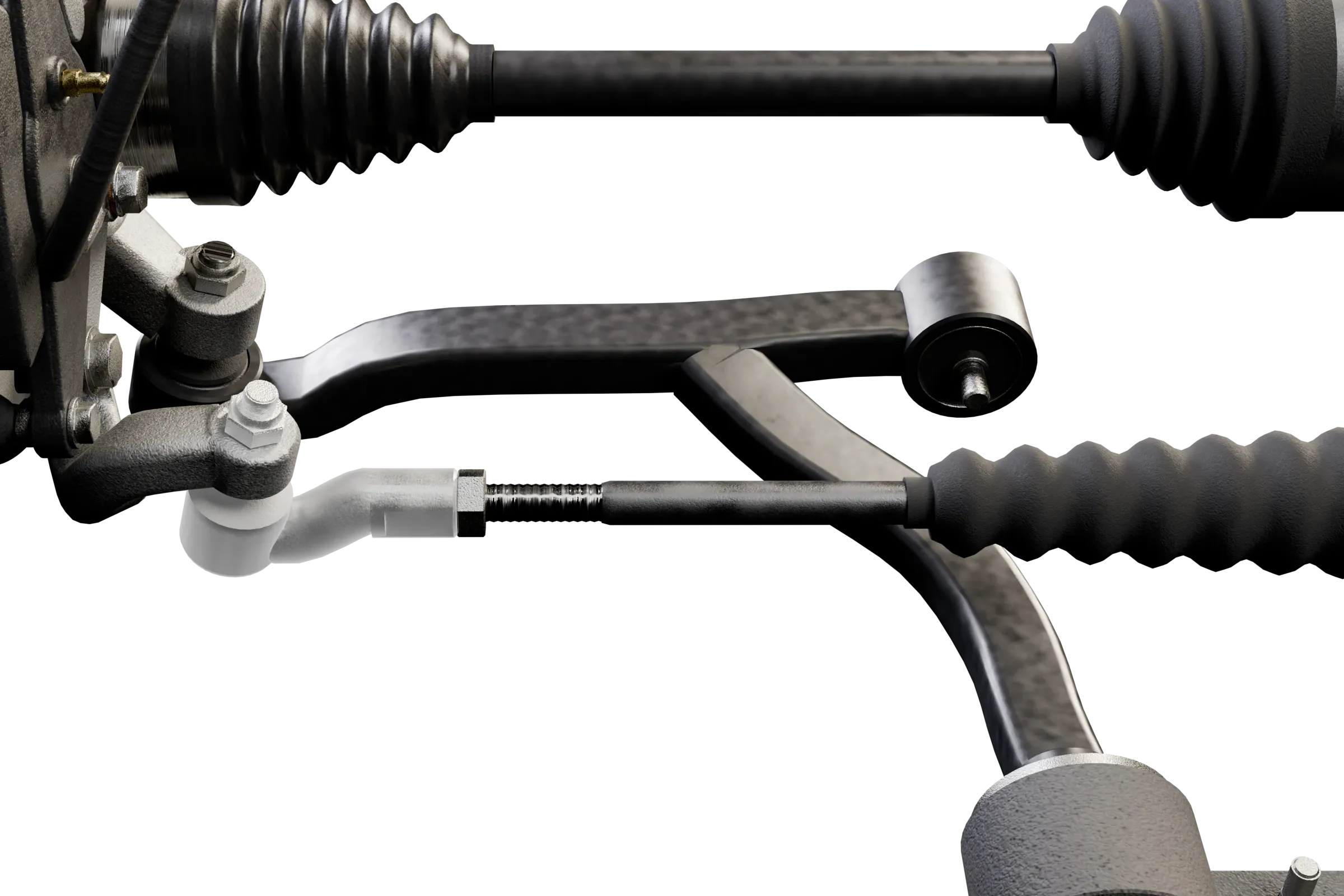
- Track rod end US: Outer tie rod end
- Track rod US: Inner tie rod
- Lower ball joint
- Track control arm US: Lower control arm
What does a track rod end do?
It joins the steering to the wheel. A track rod runs from each end of the steering rack out to an arm on the front wheel's knuckle, and the track rod end is the joint at its outer end: a ball in a greased socket under a rubber boot, with a tapered stud locked into the steering arm and a threaded body that screws onto the rod.
When you turn the steering wheel, the rack slides across the car and the track rods push one knuckle and pull the other. The ball lets the stud tilt and swivel as the wheel rises, falls and steers. Screwing the end further on or off the rod changes the rod's working length, which turns that wheel very slightly: that is how the toe is set, and a lock nut holds it there.
What are the symptoms of a worn track rod end?
- A knock through the steering over bumps. A dull knock from the front on broken roads and potholes, often felt as a tremor in the steering wheel. What causes a knocking noise over bumps?
- Vague steering. Free play around the straight-ahead position, so the car wanders and needs small corrections to hold its line.
- Tyres wearing on their edges. Play in the joint lets the toe wander as you drive, which scrubs the inner or outer shoulder of the front tyres. What causes uneven tyre wear?
- Play you can see. With the car on its wheels, have a helper rock the steering wheel a little each way while you watch the joint: the steering arm should move with the track rod at once, with no knock or lag.
- A split boot. Grease gets out and water gets in, and the joint wears quickly after that. A boot that no longer keeps the dirt out fails the MOT.
Can you drive with a broken track rod end?
Have it checked before you drive far
Not if it has broken, and not far if it is worn. A worn track rod end still steers the wheel, but the play grows and the car wanders more as it does. If the joint wears through or its stud pulls out of the steering arm, that wheel is no longer held by the steering: it can turn on its own and the car can swerve without warning. Have a worn one replaced before you drive far. Excessive play in a track rod end fails the MOT.
How do you tell a worn track rod end from a worn ball joint?
By the direction of the play. Raise the front of the car safely so the wheel is clear of the ground, grip the tyre at the sides, at nine and three o’clock, and push and pull it as if to steer. A knock or free movement there is usually in the track rod end or the inner joint on the rack, and watching each joint while you rock the wheel shows which one is moving.
Then grip the tyre at the top and bottom and rock it the other way. Movement in that direction comes from a ball joint or the wheel bearing instead; a worn bearing usually shows play both ways and hums at speed as well. A garage can check every joint on a lift in a few minutes.
What does replacing a track rod end involve?
- Time
- About 45 minutes
- Difficulty
- Moderate
- Parts
-
- A new track-rod end with a new nyloc nut
- Chock the wheels and loosen the wheel nuts, then raise the car onto an axle stand and take the front wheel off.
- Mark where the lock nut sits on the track rod with a line of paint, or count the threads showing, then slacken the lock nut by a turn.
- Undo the nut on the ball stud and free the stud's taper from the steering arm with a ball joint splitter.
- Unscrew the old end from the track rod, counting the turns, and screw the new one on by the same number, up to your mark.
- Push the stud into the steering arm, fit the new nyloc nut that comes with the end, and tighten the lock nut back against the end at your mark.
- Refit the wheel, lower the car and tighten the wheel nuts in a star pattern.
- Have the tracking checked and set: a new end always moves the toe a little.
Tools
- Wheel chocks
- Breaker bar
- Socket and ratchet
- Trolley jack (US: Floor jack)
- Axle stand (US: Jack stand)
- Flat screwdriver (US: Flat-blade screwdriver)
- Paint pen (US: Paint marker)
- Open-ended spanner (US: Open-end wrench)
- Ring spanner (US: Box-end wrench)
- Ball-joint splitter (US: Ball joint separator)
- Torque wrench
- Crow's-foot spanner (US: Crowfoot wrench)
Work safely
- Work on firm, level ground with the handbrake on and the other wheels chocked.
- Never work under a car held only by a jack: set it on an axle stand.
Tighten every nut and bolt to the figure in the maker's manual for your car.
Track rod ends are usually replaced one at a time, as they wear. The other side is worth checking while the car is up, and setting the tracking afterwards needs a garage's alignment equipment.
Questions people ask
Is a track rod end the same as a tie rod end?
Yes. Track rod end is the UK name and tie rod end, or outer tie rod end, the US one, though tie rod end is common in the UK too. The rod it screws onto is the track rod, called the inner tie rod in the US.
What is the difference between an inner and an outer track rod end?
The outer one is the track rod end itself, at the wheel. The inner one is a ball joint where the track rod screws onto the end of the rack, hidden under the rack gaiter, and it is replaced together with the track rod. It wears too, with the same vague steering and knock.
Why do you count the turns when taking off a track rod end?
Because the end's position on the thread sets the toe of that wheel. Screwing the new end on by the same number of turns, or up to a paint mark, keeps the tracking close enough to drive to the alignment check.
Can a worn track rod end make the steering wheel shake?
It can add to a shake. Play in the joint lets the wheel shimmy over ridges and under braking, but a shake is more often a wheel out of balance or a warped brake disc, so have those checked as well.
Related
Symptoms
- What causes a knocking noise over bumps? A knocking or clunking noise over bumps usually comes from a worn joint in the front suspension.
- What causes uneven tyre wear? Uneven tyre wear usually means the wheel alignment is out, the tyre pressures are wrong or a suspension part is worn, and the pattern points to which.
Parts nearby
- What does a ball joint do? A ball joint is the ball-and-socket joint that connects a suspension arm to the wheel's steering knuckle.
- What is a control arm? A control arm is a hinged suspension link between the car's subframe or body and the wheel.
- What does a wheel bearing do? A wheel bearing lets the wheel spin freely while carrying the car's weight and the cornering and braking loads.
Explained
- Toe in vs toe out: what's the difference? Toe is the angle of a pair of wheels seen from above. With toe in, their fronts point slightly towards each other; with toe out, slightly apart.
The whole system
- How does rack and pinion steering work? The rack and pinion steering, part by part, with an interactive diagram.
