
What causes uneven tyre wear?
Uneven tyre wear usually means the wheel alignment is out, the tyre pressures are wrong or a suspension part is worn, and the pattern points to which. Wear on one edge comes from camber or toe, a feathered feel from toe, both edges from under-inflation, the centre from over-inflation, and cupped patches from worn shock absorbers.
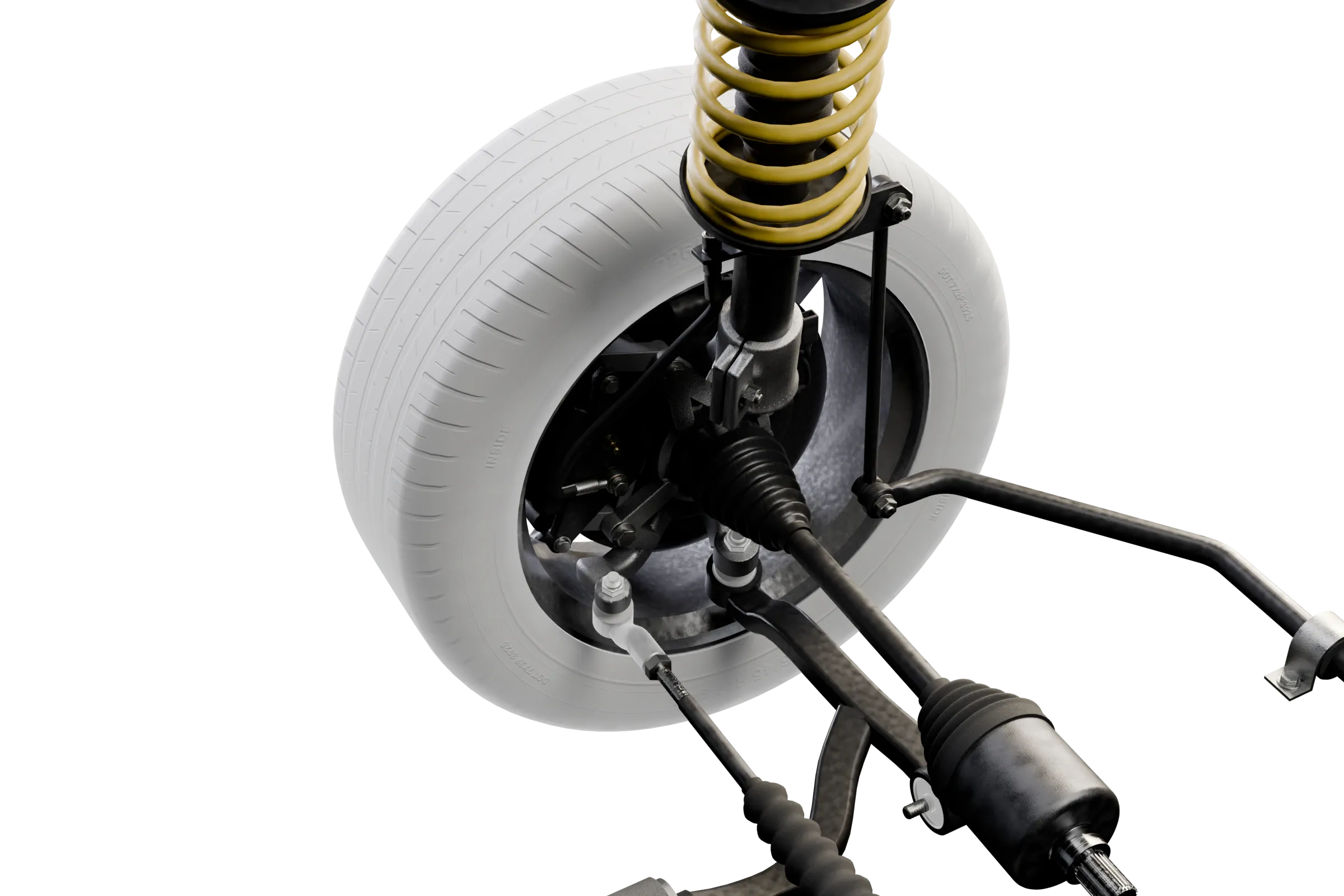
- Tyre 225/45 R17 US: Tire 225/45 R17
- Track rod end US: Outer tie rod end
- Track control arm bush, front US: Lower control arm bushing, front
The likely causes, most common first
-
Toe out of adjustment, or a worn track rod end
Most likelyHow it shows Wear on the inner or outer edge of the front tyres, with a feathered, saw-tooth feel across the tread and sometimes the steering wheel off centre.
Check Have the toe measured, and the track rod ends (tie rod ends) checked for play with the wheels off the ground.
Have it checked soon
-
Wrong tyre pressures
Most likelyHow it shows Too little air wears both shoulders faster than the centre and makes the steering heavy; too much wears the centre and makes the ride harder.
Check Check the pressures cold against the maker's figures. Some cars list higher pressures for a full load, which wear the centre if they are used all the time.
Fix it soon
-
Camber out of range, often after a kerb strike
CommonHow it shows Smooth, even wear along one whole edge, most often the inner, without the feathered feel of a toe problem.
Check Have the alignment measured. Many cars cannot adjust camber at the front, so a reading out of range points to a bent part or a sagging spring.
Fix it soon
-
A worn ball joint
CommonHow it shows Patchy or one-edge wear, often with a knock from low down at the wheel or steering that feels vague.
Check Raise the wheel and rock it by its top and bottom: a clunk or movement at the ball joint means it needs replacing.
Have it checked soon
-
Worn control arm bushes
CommonHow it shows Edge wear or feathering that comes back after an alignment, because the wheel shifts out of line under braking and over bumps.
Check Look for cracked or split rubber where the arm meets the subframe.
Have it checked soon
-
Worn shock absorbers
Less likelyHow it shows Cupping or scalloping: dips worn into the tread at intervals round the tyre, often with a drone at speed.
Check Bounce each corner hard and let go: a good damper stops the movement at once. A wheel out of balance can cup a tyre too.
Fix it soon
How to narrow it down
- Turn the steering to full lock and look across each front tyre, inner edge included, comparing both shoulders with the centre, then do the same at the rear.
- Run a flat hand across the tread both ways. Smooth one way and sharp the other is feathering, the sign of a toe problem.
- Check the pressures with the tyres cold, against the figures for the load you usually carry.
- Measure the tread depth across and round each tyre. The UK legal minimum is 1.6 mm across the central three quarters of the tread, all the way round.
- With the car safely on axle stands, rock each front wheel: play top to bottom points to a ball joint or the wheel bearing, play side to side to a track rod end. Then have the alignment measured.
Is it safe to drive with uneven tyre wear?
Have it checked before you drive far
For a while, if the tread is still above the legal limit, but find the cause before it ruins the tyre. The inner edge is hard to see and can wear down to the cords while the rest of the tread looks fine, and a worn steering or suspension joint behind the wear is a safety problem in its own right. If you can see cords, a bulge or a bald patch, do not drive on the tyre until it is replaced.
What does a wheel alignment check?
The angles of all four wheels, measured with the car on a level ramp at its normal ride height and compared with the maker’s figures. Toe wears tyres fastest, and it is the angle almost every car can adjust: at the front, by turning the track rods in their ends. Camber and caster are fixed at the front of many strut cars, so a reading out of range there means a bent or worn part rather than a setting to change.
Ride height comes into it too. In the app’s MacPherson strut model the wheel gains −0.6° of camber at 40 mm of bump, so a corner sitting 40 mm low on a tired spring wears its inner edge as if the camber had been set that way. What camber is and toe in vs toe out explain both angles.
Questions people ask
Does a wheel alignment fix uneven tyre wear?
It stops it getting worse, but it cannot put back tread that has gone, and a badly worn tyre still needs replacing. If a worn joint or bush is behind the wear, replace that first: an alignment set on worn parts will not hold.
Why are my front tyres wearing faster than the rear?
On a front-wheel-drive car that is normal. The front tyres steer, drive and do most of the braking, so they wear faster than the rears even when everything is right. Uneven wear across the tread is the sign of a fault.
Is a tyre that is bald on one edge legal?
It can be, but it is not safe. The UK legal minimum of 1.6 mm applies across the central three quarters of the tread, so the edges can be worn smooth and still pass. A tyre with cords showing or a bulge anywhere is illegal and dangerous.
Related
The parts
- What is a track rod end? A track rod end (US: tie rod end) is the ball joint at the outer end of each track rod, where the steering connects to the front wheel.
- What does a ball joint do? A ball joint is the ball-and-socket joint that connects a suspension arm to the wheel's steering knuckle.
- What do control arm bushes do? Control arm bushes (US: bushings) are the rubber mountings where a control arm pivots on the subframe.
- What does a shock absorber do? A shock absorber (US: shock) controls the spring. Without it the car would keep bouncing after every bump; with it, the body settles after one movement and the tyre stays pressed on the road.
Similar symptoms
- Why is my car humming when I drive? A humming noise that rises with road speed is usually a worn wheel bearing, especially if it changes as you go round a bend.
- What causes a knocking noise over bumps? A knocking or clunking noise over bumps usually comes from a worn joint in the front suspension.
- Why does my car pull to one side when braking? A car that pulls to one side when braking usually has a brake that grips harder on one side than the other.
- Why does my car click when turning? A clicking noise when you turn, loudest on full lock as you pull away, is usually a worn outer CV joint on a front driveshaft, most often after its boot has split.
Explained
- What is camber? Camber is the lean of a wheel seen from the front of the car.
- Toe in vs toe out: what's the difference? Toe is the angle of a pair of wheels seen from above. With toe in, their fronts point slightly towards each other; with toe out, slightly apart.
- Struts vs shocks: what's the difference? A shock absorber only damps movement: it stops the car bouncing after a bump.
