
What do control arm bushes do?
Control arm bushes (US: bushings) are the rubber mountings where a control arm pivots on the subframe. The rubber twists as the arm swings, so the wheel moves up and down with no metal rubbing on metal, while it stays in line and road noise is filtered out. Worn ones clunk over bumps and under braking.
US control arm bushing Also called wishbone bush, track control arm bush
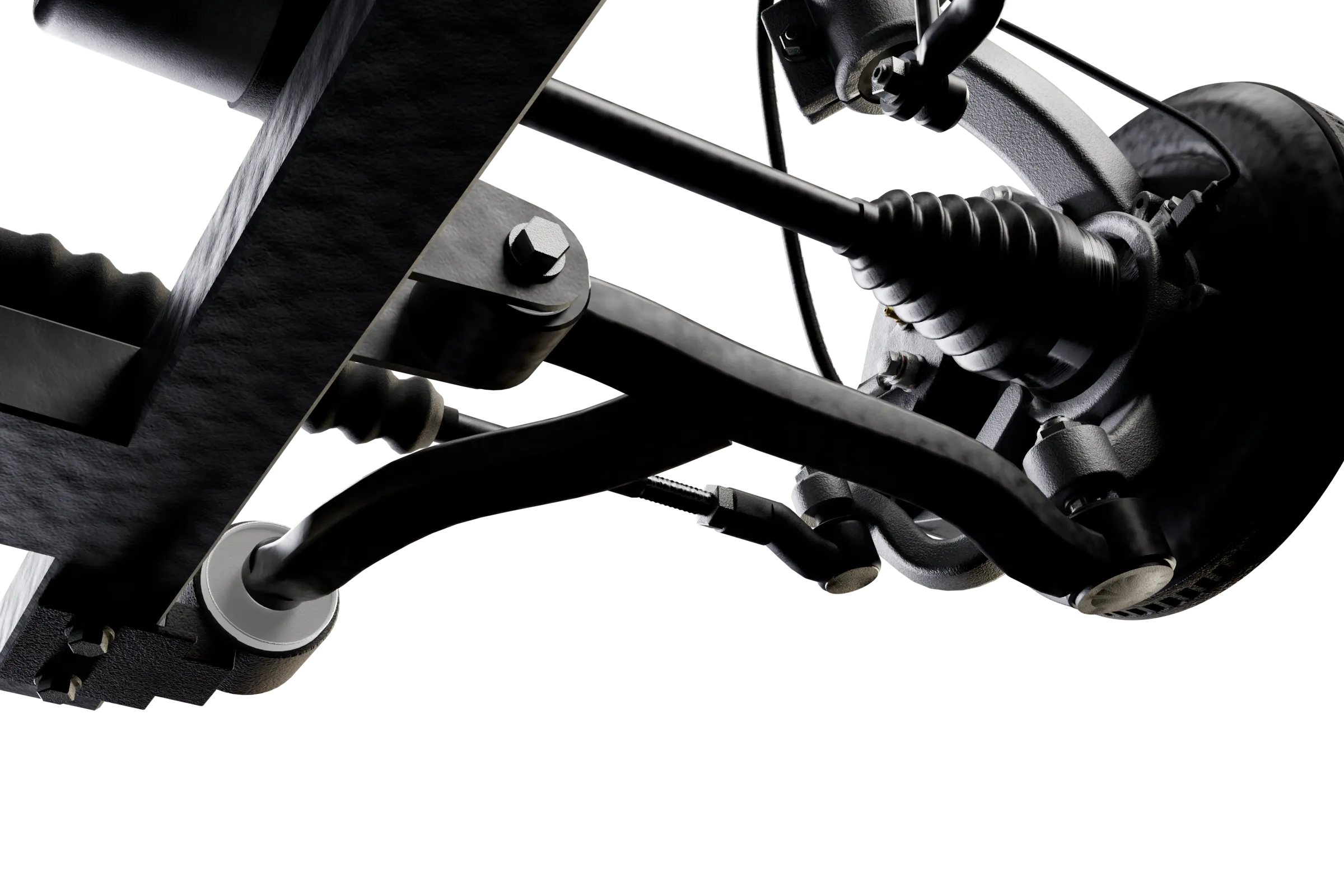
- Track control arm bush, front US: Lower control arm bushing, front
- Track control arm bush, rear US: Lower control arm bushing, rear
- Track control arm US: Lower control arm
- Front subframe
How does a control arm bush work?
A control arm has to swing up and down over every bump while staying exactly in place, and its bushes make that possible. Each is usually a ring of rubber bonded inside the eye of the arm around a steel sleeve, and the pivot bolt clamps that sleeve to the subframe. Nothing slides: the rubber flexes as the arm swings, so the pivot needs no grease, and it soaks up small vibrations from the road before they reach the body.
Most arms have two bushes, and they are often different. On the app's MacPherson strut the front bush is stiff, to hold the wheel in line when the car corners, and the rear one is soft, so the wheel can move back a few millimetres over a sharp bump. That small give does a lot for the ride. It is also why worn bushes show up most under braking, which pushes the wheel back against the soft rear bush.
What are the symptoms of worn control arm bushes?
- A clunk over bumps. Most noticeable over speed bumps and potholes at low speed, as the arm knocks about in the worn rubber. What causes a knocking noise over bumps?
- A clunk as you brake or pull away. The arm shifts forwards or back in a split bush, often with a knock you can feel through the floor.
- A pull or a shimmy when you brake. Braking drags the wheel back, and on worn bushes it moves far enough to steer itself slightly, so the car pulls and the steering wheel can shake. Why does my car pull to one side when braking?
- Vague steering at speed. With the arm no longer held firmly, the car feels loose on the motorway and needs small corrections to hold its lane.
- Uneven tyre wear. As the arm shifts, the wheel's toe changes every time you brake or corner, which feathers the tread or wears one shoulder. What causes uneven tyre wear?
- Split or perished rubber. With the car raised, look for deep cracks, rubber torn away from its sleeve, or the arm sitting off centre in its eye. Oil softens rubber, so look for leaks above the bushes too.
Is it safe to drive with worn control arm bushes?
Have it checked before you drive far
For a short while, if the wear is slight: rubber with fine surface cracks still holds the arm, and the MOT only fails a bush whose rubber or bonding has badly deteriorated. Once a bush has split or lets the arm move, the wheel shifts under braking and cornering, so the car can pull in a hard stop and wander at speed, and the play wears the tyres and the ball joint. Have it checked before you drive far.
What noise do worn control arm bushes make?
Mostly a dull clunk or thud, deeper than the light rattle of a worn drop link. It comes as the arm shifts in a bush that has split or worn loose: over speed bumps and potholes, as the brakes come on or off, and when you pull away hard in a front-wheel-drive car. Rubber that has dried out and cracked can creak or groan instead, most often over speed bumps at walking pace.
One clue is timing. A clunk just as the car comes to a stop, and another as you pull away, points to the arm moving forwards and back in its bushes. A garage confirms it with a pry bar between the arm and the subframe, watching how far the rubber lets the arm move.
What does replacing control arm bushes involve?
- Raise the car onto axle stands, take the wheel off and support the arm with a jack.
- Undo the pivot bolts, or the bracket that holds the rear bush on some cars, and free the ball joint if the arm has to come off.
- Press or draw the old bush out of the arm's eye, with a press on the bench or a bush puller with the arm still on the car.
- Press the new bush in squarely and the right way round: many have voids or marks that must face a set direction.
- Refit the arm with its pivot bolts finger tight, then raise the suspension to ride height before tightening them.
- Refit the wheel, lower the car and have the alignment checked.
Tighten every nut and bolt to the figure in the maker's manual for your car.
Pressing bushes out needs a press or a puller, so many garages fit a new arm instead, with its bushes and ball joint already in it. The bushes on both sides have done the same miles and are often renewed together.
Questions people ask
Can you replace just the bushes on a control arm?
On many cars, yes: the old bushes are pressed out of the arm and new ones pressed in. Where the bushes are hard to reach, or the ball joint is worn as well, a new arm with everything fitted is often the quicker repair.
Are polyurethane bushes better than rubber ones?
They are firmer and last longer, and they sharpen the steering, which suits a car used on track. But they pass more noise and vibration into the car and some need grease to stay quiet, so for everyday driving the original rubber bushes usually ride better.
Why are control arm bushes tightened at ride height?
Because the rubber twists rather than slides. Tightened with the arm hanging down, a bush is already twisted when the car sits at its normal height, so it works harder over every bump and tears early. Tightened at ride height, the rubber rests untwisted where the car spends most of its time.
Will worn control arm bushes fail an MOT?
Only when the wear is serious. The tester fails a bush when its rubber or the bond to its sleeve has clearly broken down, or when the arm moves in it. Fine cracks on the surface are usually only an advisory.
Related
Symptoms
- What causes a knocking noise over bumps? A knocking or clunking noise over bumps usually comes from a worn joint in the front suspension.
- Why does my car pull to one side when braking? A car that pulls to one side when braking usually has a brake that grips harder on one side than the other.
- Why does my steering wheel shake when braking? A steering wheel that shakes when you brake usually means the front brake discs have worn unevenly, which is often called warped.
- What causes uneven tyre wear? Uneven tyre wear usually means the wheel alignment is out, the tyre pressures are wrong or a suspension part is worn, and the pattern points to which.
Parts nearby
- What is a control arm? A control arm is a hinged suspension link between the car's subframe or body and the wheel.
- What does a ball joint do? A ball joint is the ball-and-socket joint that connects a suspension arm to the wheel's steering knuckle.
- What is a drop link? A drop link (US: sway bar link) is a short rod with a ball joint at each end that connects the anti-roll bar to the suspension, so the bar can resist body roll in corners.
- What does a coil spring do? A coil spring holds the car up. Each corner rests on one, and when the wheel hits a bump the spring compresses, stores the energy and pushes the wheel back down, while its length sets the ride height.
Explained
- Toe in vs toe out: what's the difference? Toe is the angle of a pair of wheels seen from above. With toe in, their fronts point slightly towards each other; with toe out, slightly apart.
The whole system
- How does a MacPherson strut work? The MacPherson strut, part by part, with an interactive diagram.
