
Why does my car squeak when I go over bumps?
A squeak or creak over bumps usually comes from rubber in the suspension that has dried out or worn: the control arm bushings, the sway bar bushings or the strut mount. A ball joint that has lost its grease squeaks too, as does a coil spring rubbing on its seat. Most squeaks are an early warning rather than a danger.
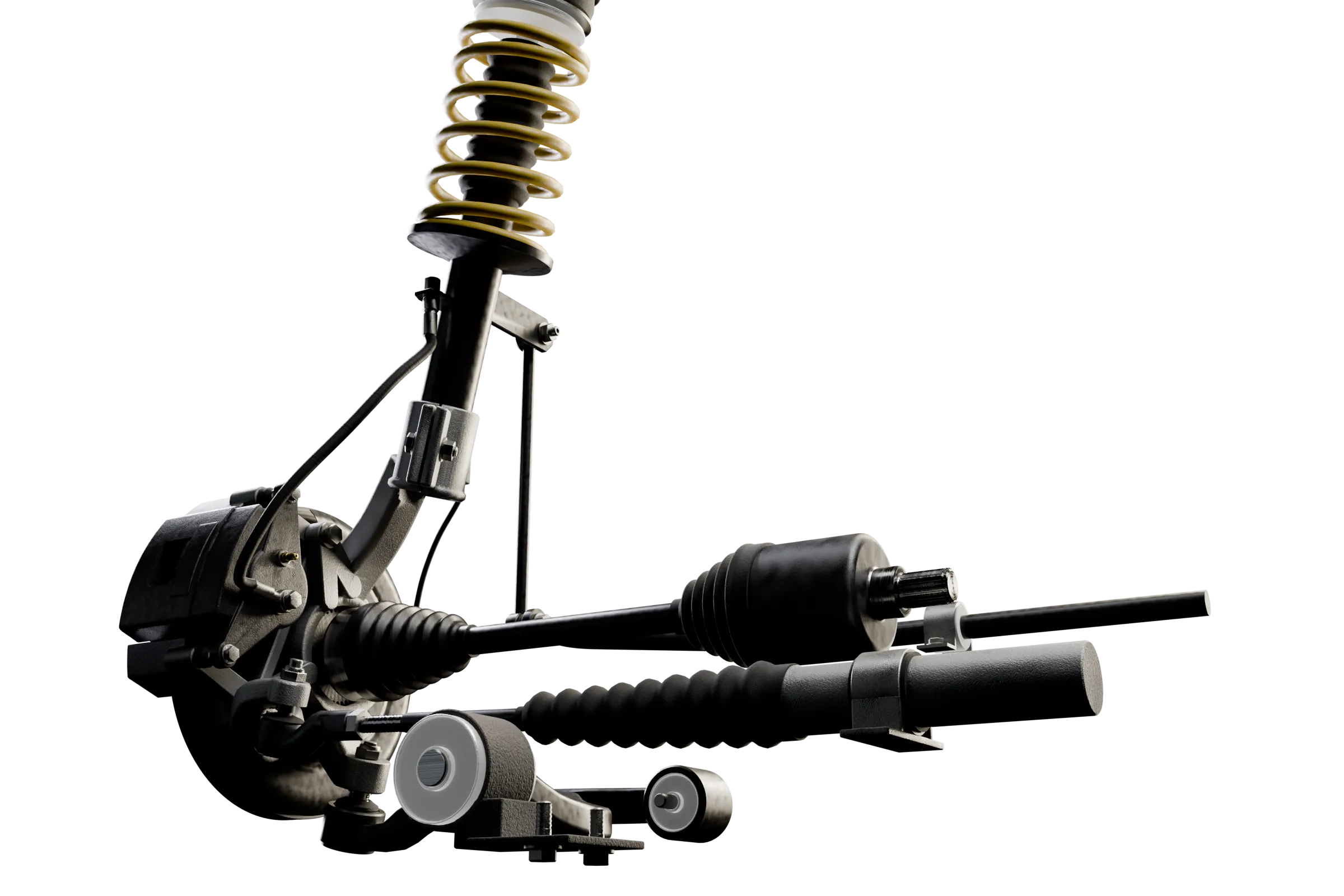
- Lower control arm bushing, front
- Lower control arm bushing, rear
- Sway bar bushing
- Strut mount bearing UK: Strut top bearing
The likely causes, most common first
-
Dry or hardened control arm bushings
Most likelyHow it shows A rubbery squeak or groan at walking pace over speed bumps and driveway ramps, often worse on cold, dry days.
Check With the car safely raised, look where each arm meets the subframe for rubber that is cracked, shiny or pushed out of its sleeve.
Fix it soon
-
Dry sway bar bushings
Most likelyHow it shows A squeak when one wheel rises more than the other, such as crossing a speed bump at an angle or turning into a driveway, and as the car leans in a turn.
Check Rock the car firmly side to side while a helper listens under the front, near where the sway bar is clamped to the car.
Fix it soon
-
How it shows A creak from high up at the front corner over bumps, often heard again when you turn the steering slowly at a standstill.
Check With the hood open, listen at the top of each strut while a helper pushes down on that corner, then while they turn the steering slowly.
Have it checked soon
-
How it shows A dry, high creak low down at the wheel, loudest as the wheel moves up and down and sometimes as you steer.
Check Look at the rubber boot on each ball joint. A torn boot and no grease mean the joint is running dry and will soon wear loose.
Have it checked soon
-
A coil spring rubbing on its seat
Less likelyHow it shows A creak or a short squeal as the body rises and falls, from the end of the spring turning against its rubber seat.
Check Look at both ends of each spring for a worn or missing rubber insulator, bare metal, rust or a broken end coil.
Fix it soon
-
A worn shock absorber
Less likelyHow it shows A squeak or groan from the shock itself as it moves, with the car floating or bouncing more than it used to.
Check Look for oil on the shock's body, and push down hard on each corner: it should rise once and settle.
Fix it soon
-
Trim, seats or body panels
Less likelyHow it shows A squeak that seems to come from inside the car, or that also comes when the body twists, such as driving up a curb at an angle.
Check Drive over the same bumps with a passenger listening near the dashboard, the doors and the seats. Suspension squeaks come from the wheels.
Fix it soon
How to narrow it down
- Note when it squeaks: over small bumps or only big ones, at walking pace or at speed, in cold weather, or when you turn as well.
- With the car parked, push down hard on each front corner several times and listen for where the squeak comes from.
- Rock the car firmly side to side, which works the sway bar in its bushings, then turn the steering slowly from lock to lock with the car standing still, listening at the top of each strut.
- With the car safely on jack stands, look over every rubber bushing and ball joint boot for cracks, tears, squeezed-out rubber and missing grease.
- If the squeak might be inside the car, have a passenger listen near the dashboard and the doors while you drive over the same bumps.
Is it safe to drive with a squeaking suspension?
Fix it soon
Usually yes, for now. A squeak from dry rubber is a sign of age more than a fault, and it can stay a nuisance for months. Have the cause found at the next service, because the same parts keep wearing: a ball joint with a torn boot wears loose quickly, and a squeak that turns into a knock means a part now has play in it. If the squeak comes with a knock, vague steering or a pull, have it checked before you drive far.
Is a creak the same as a squeak or a knock?
They come from different stages of wear. A squeak is short and high, rubber or metal rubbing on itself as a part moves; a creak is the slower, lower version, like an old door, from a joint turning under load. Both can come from parts that are still tight, only dry or hardened. A knock is different: it is a part with free play hitting the end of that play, so the wear has gone further. A knock or clunk over bumps has its own list of causes, led by worn sway bar links: see what causes a knocking noise over bumps.
Why is the squeak worse when it is cold?
Rubber stiffens as it cools. Most suspension bushings are bonded rubber that twists as the arm swings, with nothing sliding, and stiff rubber that has started to crack or come away from its sleeve squeaks more as it twists. Sway bar bushings work differently: the bar turns inside them, so a dry one squeaks in any weather and loudest when it is cold. A squeak that only comes on cold mornings usually points to rubber; one that is there in all weather points more to a dry ball joint or a strut mount bearing.
Can you stop a squeak by greasing the bushings?
Not for long, and it can do harm. A bonded bushing squeaks because its rubber has hardened, cracked or let go of its sleeve, and a lubricant does not undo that. Most rubber also swells and softens in contact with petroleum oils and greases, so a spray of general-purpose lubricant can shorten a bushing’s life. Bushings that are meant to be greased, such as many replacement sway bar bushings and most polyurethane ones, come with the grease their maker specifies, usually silicone or another rubber-safe grease. For the rest, the lasting fix for a squeak from dry rubber is a new bushing.
Questions people ask
Why does my car squeak over bumps and when turning?
When the squeak also comes as you steer, look first at the parts that turn with the steering: the strut mount bearing at the top of each front strut, the ball joints and the tie rod ends. A dry strut bearing creaks even with the car standing still while the wheel is turned, which makes it easy to pick out.
Why does my car only squeak at low speed over bumps?
At walking pace the suspension moves slowly through its whole travel, which is when rubber and dry joints squeak, and there is little road or wind noise to cover it. At speed the same squeak is usually still there, just drowned out.
Can new suspension parts squeak?
Yes. Polyurethane bushings squeak if they were installed without their grease, and rubber bushings tightened with the suspension hanging down are already twisted at ride height, so they can creak and wear early. A squeak that starts right after suspension work is worth taking back to the shop that did it.
Related
The parts
- What do control arm bushings do? Control arm bushings are the rubber mountings where a control arm pivots on the subframe.
- What do sway bar bushings do? Sway bar bushings are the rubber sleeves that hold the sway bar to the subframe or body, one on each side, each clamped by a bracket.
- What is a strut mount? A strut mount is the rubber-bonded mounting that bolts the top of a MacPherson strut into the car's body and carries that corner's weight.
- What does a ball joint do? A ball joint is the ball-and-socket joint that connects a suspension arm to the wheel's steering knuckle.
- What does a coil spring do? A coil spring holds the car up. Each corner rests on one, and when the wheel hits a bump the spring compresses, stores the energy and pushes the wheel back down, while its length sets the ride height.
- What does a shock absorber do? A shock absorber controls the spring. Without it the car would keep bouncing after every bump; with it, the body settles after one movement and the tire stays pressed on the road.
Similar symptoms
- What causes a knocking noise over bumps? A knocking or clunking noise over bumps usually comes from a worn joint in the front suspension.
- Why does my car click when turning? A clicking noise when you turn, loudest at full lock as you start moving, is usually a worn outer CV joint on a front CV axle, most often after its boot has torn.
- Why does my car clunk when I turn the steering wheel? A clunk when you turn the steering wheel usually means something in the steering or front suspension has worn loose: a tie rod end or inner tie rod, the steering rack's mounting bushings, a U-joint on the intermediate shaft or a strut mount bearing.
- What causes a grinding noise when braking? A grinding noise when you brake usually means the brake pads have worn through their friction material, so their steel backing plates are scraping the brake rotors.
