
Brakes · Floating disc caliper
What does an ABS sensor do?
An ABS sensor (US: wheel speed sensor) measures how fast its wheel is turning by reading a toothed or magnetic ring that turns with the hub. The ABS unit compares the four wheels to spot one that is about to lock. A faulty sensor turns on the ABS warning light, usually with the traction control light.
US wheel speed sensor Also called ABS wheel speed sensor
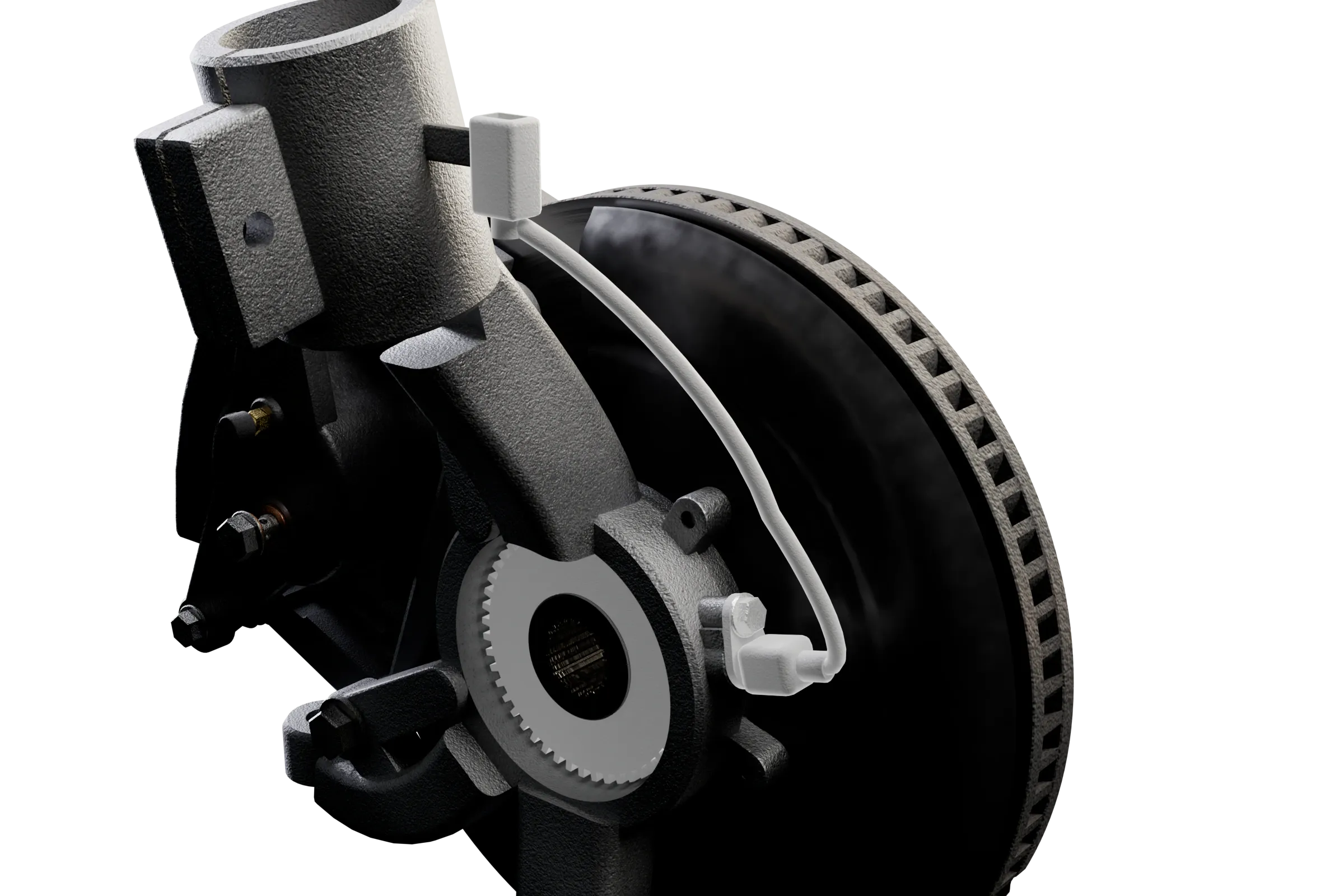
- ABS wheel-speed sensor
- ABS tone ring
- Wheel hub
- Brake disc US: Brake rotor
How does an ABS sensor work?
Each wheel has its own sensor, fixed to the steering knuckle or hub carrier with its tip just clear of a ring that turns with the wheel. Every tooth of the ring that passes makes one pulse, so the faster the wheel turns, the faster the pulses come. On the app's model the ring has 48 teeth and the sensor sits 0.8 mm from it.
The ABS unit compares the wheels with each other and with how quickly the car could really be slowing. A wheel slowing much faster than that is about to lock, and the unit eases its brake for a moment. Traction control and stability control work from the same signals, and on many cars so does the speedometer.
The model's sensor is the older passive kind, which makes its own signal from the passing iron teeth. Many newer cars use active sensors, powered by the ABS unit, which read a magnetic ring often built into the wheel bearing's seal and can measure speed right down to a crawl.
What are the symptoms of a bad ABS sensor?
- The ABS warning light stays on. The unit has found a fault and switched ABS off. The normal brakes still work.
- Traction and stability control lights on as well. They rely on the same wheel speed signals, so they switch off too.
- ABS that works when it should not. A weak or patchy signal can make a wheel seem to lock, so the pedal pulses and buzzes in a gentle stop at low speed.
- A warning light that comes and goes. Often over bumps or in the wet: a cracked cable, a corroded connector or a sensor tip caked in dirt.
- A speedometer that drops out. On cars that take road speed from the wheel sensors, a failed sensor can make it flicker or stop.
- The ABS light with a hum from one wheel. A worn wheel bearing lets the hub move and changes the sensor's gap, and where the magnetic ring is part of the bearing, it can fail with it. Why is my car humming when I drive?
Is it safe to drive with a bad ABS sensor?
Have it checked before you drive far
Usually, carefully, as far as a garage. With the ABS light on, the normal brakes work as they always did, but ABS, and usually traction and stability control, are switched off. In a hard stop or on a slippery road the wheels can lock, and the car cannot be steered while they are locked, so leave more room and brake progressively. If the red brake warning light is on as well, have the car checked before you drive on: the system that balances braking front to rear may be off too. An ABS light that stays on fails an MOT.
What goes wrong with ABS sensors?
The sensor is sealed, so most faults are around it rather than inside it. Brake dust and rust build up on its tip, or on a magnetic ring, and weaken the signal. The cable flexes with the suspension and the steering and can crack where it leaves the knuckle, and the connector can corrode. Sensors are also damaged during brake or bearing work, when they are knocked or pulled by their cables.
The ring causes faults too. Rust can swell under a pressed-on ring until it cracks, and a ring with a missing or damaged tooth gives a signal that drops out once every turn.
How do you find which ABS sensor is faulty?
Read the fault codes with a code reader that can talk to the ABS unit, because a basic engine code reader often cannot. The code usually names the wheel. Live data then shows each wheel’s speed as the car moves: the faulty sensor reads zero or jumps about while the other three agree. Look at that sensor, its cable and the ring for damage and dirt before buying parts, because cleaning sometimes cures it.
What does replacing an ABS sensor involve?
- Read the fault code to confirm which wheel, then raise that corner safely, and take the wheel off if it gives better access.
- Follow the sensor's cable back to its connector, unclip it from its brackets and unplug it.
- Take out the sensor's fixing bolt and ease the sensor out of the knuckle. A seized one can snap, so penetrating oil and patience help.
- Clean the bore, and look at the ring for missing teeth, cracks or packed dirt.
- Fit the new sensor and route its cable exactly as the old one ran, clear of the disc and anything that moves.
- Clear the codes and drive the car: the ABS light should go out once the unit has seen a good signal from every wheel.
Tighten every nut and bolt to the figure in the maker's manual for your car.
A sensor is replaced on its own, not in pairs. Where the magnetic ring is part of the wheel bearing, a damaged ring means a new bearing.
Questions people ask
Can you clear an ABS light without fixing the fault?
Only for a moment. A code reader can clear the code, but the ABS unit checks its sensors each time the car moves off and turns the light straight back on while the fault is there.
Will an ABS warning light fail an MOT?
Yes. An ABS light that stays on, or one that does not light up at all when the ignition is switched on, is a major fault. So is a missing or damaged wheel speed sensor.
What is an ABS ring?
The ring the sensor reads, also called a tone ring or reluctor ring. It is pressed onto the hub or the outer CV joint, or on many newer cars built into the wheel bearing's seal as a magnetic ring. A cracked or rusty ring turns on the same warning light as a failed sensor.
Related
Parts nearby
- What does a wheel bearing do? A wheel bearing lets the wheel spin freely while carrying the car's weight and the cornering and braking loads.
- What do brake discs do? Brake discs (US: rotors) are the iron discs that turn with the wheels.
- What does a brake caliper do? A brake caliper is the clamp at each disc brake. When you brake, fluid pressure pushes its piston out and the caliper squeezes the two pads against the disc.
- What do brake pads do? Brake pads are the friction blocks the caliper squeezes against the brake disc, turning the car's movement into heat to slow it down.
The whole system
- How do disc brakes and ABS work? The disc brakes and ABS, part by part, with an interactive diagram.
