
Brakes · Floating disc caliper
What do brake discs do?
Brake discs (US: rotors) are the iron discs that turn with the wheels. When you brake, the pads clamp both faces of the disc and the friction slows the car. A disc that has worn unevenly, usually called warped, makes the brake pedal pulse and the steering wheel shake when you brake from speed.
US brake rotor
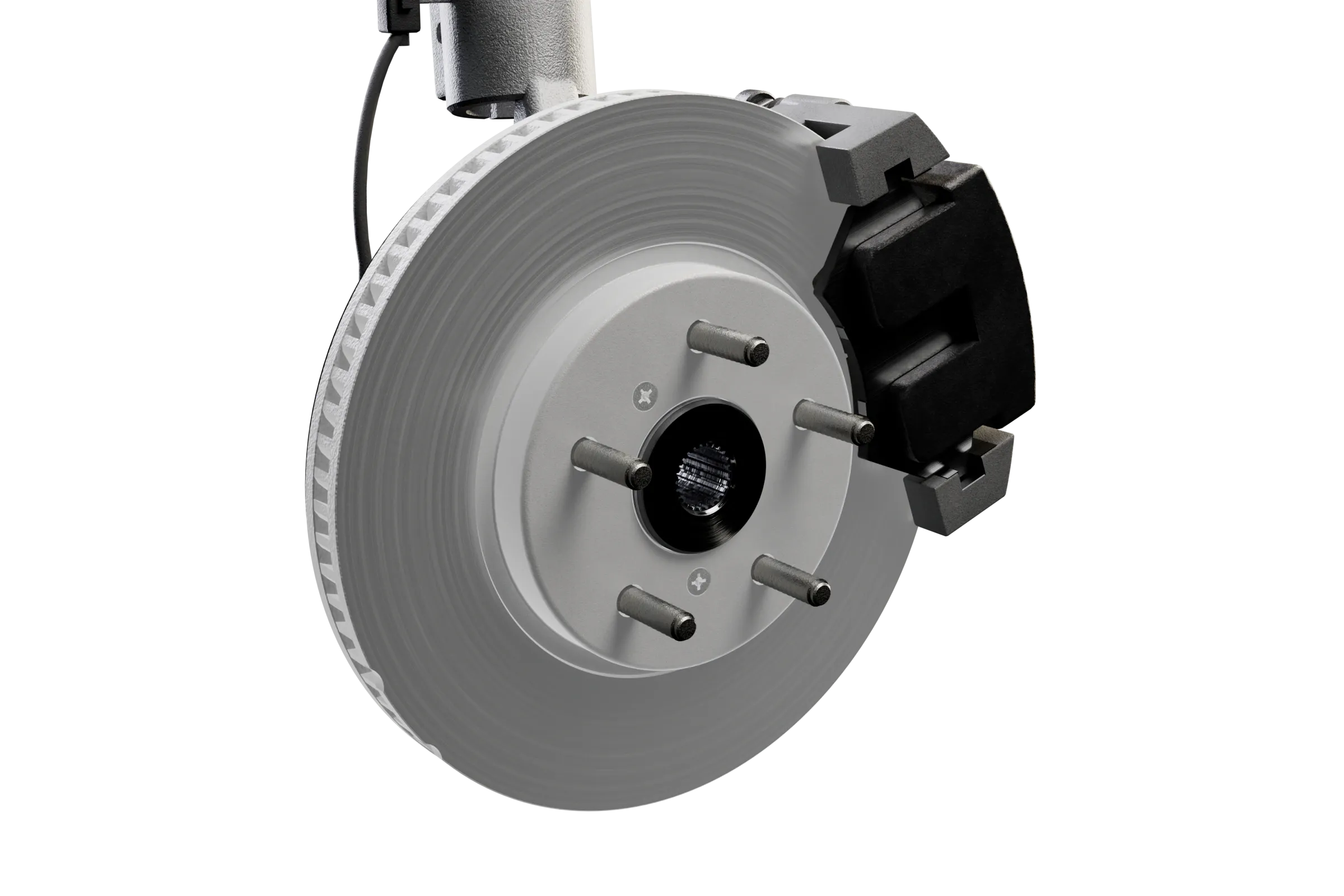
- Brake disc US: Brake rotor
- Caliper housing US: Brake caliper
- Wheel hub
How does a brake disc work?
The disc is clamped to the wheel hub by the wheel and its nuts, and turns with the wheel. The caliper straddles its edge, and when you brake, the pads squeeze its two faces. Most of the heat from that friction goes into the disc, so it needs enough iron to soak it up and a way to shed it.
Front discs on most cars are vented: two friction faces joined by vanes, which pump air outwards between them as the disc turns. The app's 300 mm disc has 37 long and 37 short curved vanes. Rear brakes do less of the work, so rear discs are often solid, and some small cars have drum brakes at the back instead.
What are the symptoms of a warped brake disc?
- A pulsing brake pedal when slowing from speed. The pads meet a disc that is thicker in places, which pushes the pistons in and out on every turn of the wheel.
- A shaking steering wheel under braking. Uneven front discs shake the steering; a judder felt mainly in the seat more often comes from the rear. Why does my steering wheel shake when braking?
- A lip round the outer edge. The pads do not reach the outer few millimetres, so the ridge there shows how far the faces have worn. A deep lip means a thin disc.
- Deep grooves or scoring. Fine rings are normal. Deep grooves come from worn-out pads or trapped grit, and grinding means a backing plate has reached the disc. What causes a grinding noise when braking?
- Blue patches or cracks. Blue or dark patches show the disc has overheated, often because a brake was dragging. A cracked disc must be replaced straight away.
- Thinner than the minimum stamped on it. The minimum thickness is marked on the disc, often after MIN TH. The model's disc is 26 mm thick when new and is replaced below 24 mm.
Can you drive with warped brake discs?
Fix it soon
Usually, for a short while and with care. The brakes still stop the car, but less smoothly, and the shaking gets worse with time and wears the steering and suspension joints. Have the discs measured soon. If the judder came on suddenly, or comes with grinding, a burning smell or a pull to one side, have the brakes checked before you drive far, and never drive on a cracked disc.
Are warped brake discs really warped?
Rarely, in the literal sense. Most judder comes from uneven thickness: the disc has worn, or picked up pad material, unevenly, so it is slightly thicker in some places than others, by far too little to see.
It usually starts with runout, a slight wobble as the disc turns. The pads brush the high spots on every turn, even with the brakes off, and over thousands of miles those spots wear thin; the app’s model allows 0.04 mm. The wobble often comes from rust or dirt between the disc and the hub, or from wheel nuts tightened unevenly. Holding the pedal down hard after a hot stop can also print pad material onto the disc in one place. Discs can distort from heat, but far less often than they wear unevenly.
How long do brake discs last?
Longer than pads: often through every second set, or 40,000 to 80,000 miles, though on some cars the discs are replaced with every set of pads. They are measured at each pad change, in the middle of the pad track rather than on the lip. Cars that stand for weeks are hard on discs too: rust eats into the faces, and the rear discs, which do less work, suffer most.
What does replacing brake discs involve?
- Raise the car safely onto axle stands and take the wheel off.
- Undo the caliper from its bracket and tie it up out of the way, never hanging on its hose, then take out the pads.
- Unbolt the caliper bracket: its arms straddle the disc, so it has to come off first.
- Take out the disc's retaining screw, where there is one, and pull the disc off the hub; a rusted-on disc may need a soft mallet.
- Clean the hub face back to bare metal: rust or dirt behind the new disc makes it run out of true and starts the judder again.
- Clean the oil film off the new disc's faces with brake cleaner, fit it with the bracket, new pads and caliper, and do the other side the same way.
- Pump the pedal until it is firm before you move the car, and bed the new pads and discs in with several firm stops.
Tighten every nut and bolt to the figure in the maker's manual for your car.
Discs are always replaced in pairs across an axle, with new pads, so both sides brake the same.
Questions people ask
Are brake discs and rotors the same?
Yes. Brake disc is the usual name in Britain and brake rotor in the US, for the same iron disc that turns with the wheel. Parts catalogues use both, so a disc and a rotor listed for the same car are the same part.
What is the legal limit for brake discs?
The figure that counts is the maker's minimum thickness, stamped on the disc and often marked MIN TH: 24 mm on the app's model. The MOT sets no thickness of its own. It fails a disc that is significantly and obviously worn, and a cracked or insecure disc is a dangerous fault.
Do you need new pads with new discs?
Yes. Old pads have worn to the shape of the old discs, so on new ones they touch only in places, grip poorly at first and can glaze. New discs always get new pads, on both wheels of the axle.
Can warped brake discs be skimmed?
Sometimes. A brake lathe can cut both faces true again if enough metal will be left above the minimum thickness. Most discs on everyday cars are simply replaced instead, because a skimmed disc is thinner and heats up faster.
Related
Symptoms
- Why does my steering wheel shake when braking? A steering wheel that shakes when you brake usually means the front brake discs have worn unevenly, which is often called warped.
- What causes a grinding noise when braking? A grinding noise when you brake usually means the brake pads have worn through their friction material, so their steel backing plates are scraping the discs.
Parts nearby
- What do brake pads do? Brake pads are the friction blocks the caliper squeezes against the brake disc, turning the car's movement into heat to slow it down.
- What does a brake caliper do? A brake caliper is the clamp at each disc brake. When you brake, fluid pressure pushes its piston out and the caliper squeezes the two pads against the disc.
- What does a wheel bearing do? A wheel bearing lets the wheel spin freely while carrying the car's weight and the cornering and braking loads.
- What does an ABS sensor do? An ABS sensor (US: wheel speed sensor) measures how fast its wheel is turning by reading a toothed or magnetic ring that turns with the hub.
Explained
- Disc vs drum brakes: what's the difference? A disc brake squeezes pads against a disc that turns with the wheel; a drum brake pushes curved shoes outwards against the inside of a drum.
The whole system
- How do disc brakes and ABS work? The disc brakes and ABS, part by part, with an interactive diagram.
