
Brakes · Floating disc caliper
Disc vs drum brakes: what's the difference?
A disc brake squeezes pads against a disc that turns with the wheel; a drum brake pushes curved shoes outwards against the inside of a drum. Discs shed heat faster and fade less, so almost every car has them at the front. Drums are cheaper and make a simple handbrake, so many small cars keep them at the rear.
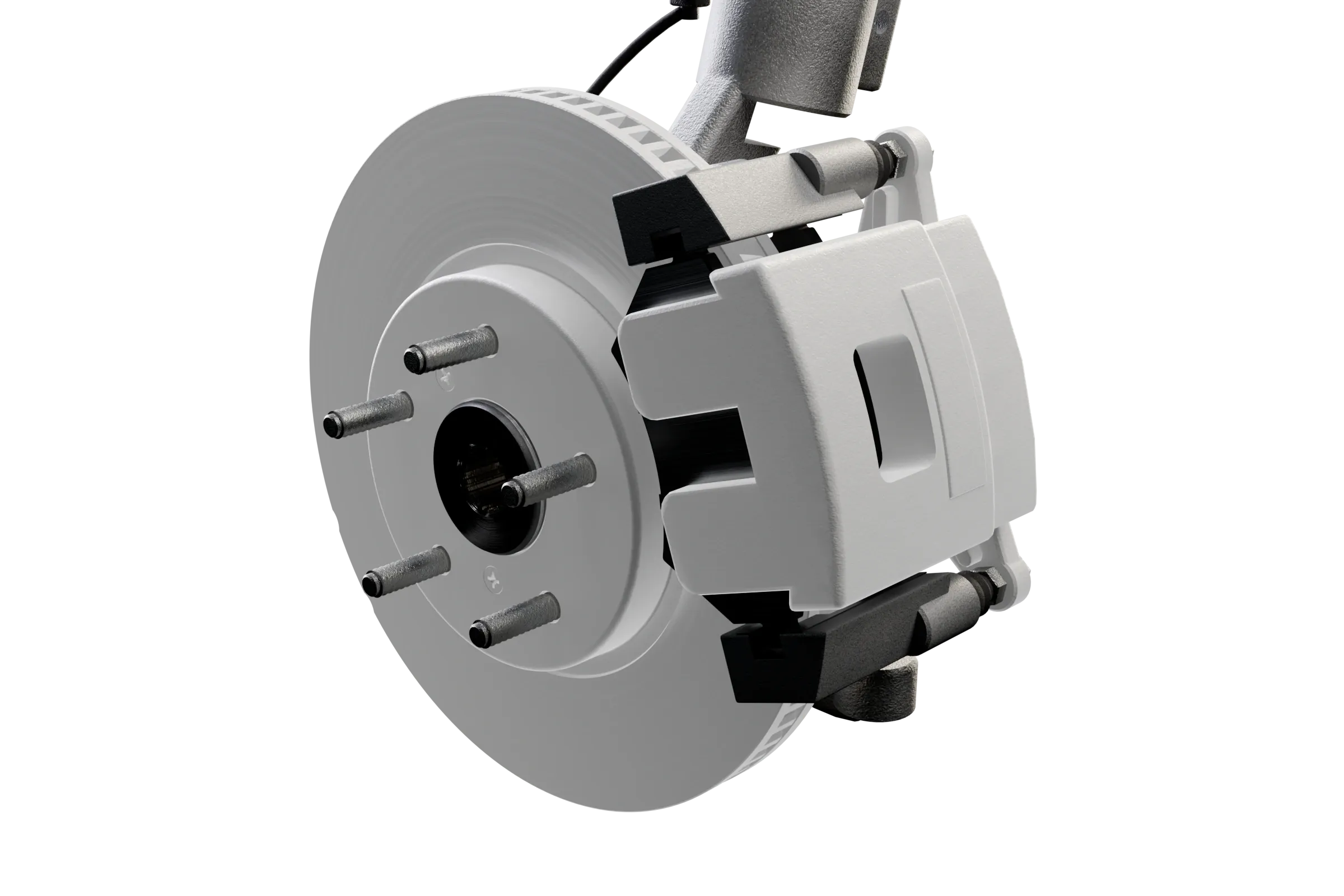
- Brake disc US: Brake rotor
- Caliper housing US: Brake caliper
At a glance
| Disc brake | Drum brake | |
|---|---|---|
| How it grips | Two pads clamp both faces of a disc | Two curved shoes press outwards on the inside of a drum |
| Getting rid of heat | Easily: the disc is open to the air, and a vented disc pumps air through its vanes | Slowly: the heat is shut inside the drum |
| On a long descent | Fades little | Fades sooner, as the hot drum grows away from the shoes |
| After driving through water | The water is flung off and the pads wipe the disc dry | The water stays inside for longer and cuts the grip |
| Handbrake | Needs a mechanism in the caliper, an electric motor or a small drum inside the disc | Simple and strong: a lever spreads the same shoes |
| Checking the wear | The pads can often be seen through the wheel | The drum has to come off |
| Usually found | At the front of almost every car, and at the rear of many | At the rear of many small cars and some electric cars |
How does a drum brake work?
The drum is a cast-iron bowl that turns with the wheel. Inside it, two curved shoes faced with friction material sit on a fixed backplate. When you press the pedal, fluid pushes two small pistons out of a wheel cylinder between the shoes, and they spread the shoes against the inside of the drum. Springs pull the shoes back when you let go, and a self-adjuster moves them outwards as the linings wear, so the pedal travel stays the same.
The shoe facing the direction of rotation, the leading shoe, is dragged into the drum by the drum itself, which adds to the force from the cylinder. That self-servo effect makes a small drum brake powerful for its size, but it also makes its grip more sensitive to heat and to the state of the linings.
Why do disc brakes cope with heat better?
Because the heat has somewhere to go. Braking turns the car’s movement into heat, and a disc sits out in the airflow with both friction faces exposed. The app’s brake model has a 300 mm vented disc, 26 mm thick, with 37 long and 37 short curved vanes between its faces that pump air outwards as it turns. A drum keeps its heat inside, around the shoes.
Heat changes the shape of each brake as well. A hot disc grows slightly thicker, towards the pads, so the pedal stays where it was. A hot drum grows larger in diameter, away from the shoes, so the pedal has to travel further to reach them, and overheated linings grip less too. That is fade, and on a long descent a drum reaches it sooner.
Why do many small cars still have rear drum brakes?
Because the rear brakes do much less of the work. When a car brakes, its weight shifts forwards onto the front tyres, so on a small front-wheel-drive car the front brakes do most of the stopping and the rears rarely get hot. A drum is enough for that, and it costs less to make. It also makes a simple, strong handbrake (US: parking brake): a lever inside the drum, pulled by the cable, spreads the same shoes, where a rear disc needs a separate mechanism.
There is another reason. A rear disc that is rarely used hard tends to corrode, while a drum keeps the weather out. Some electric cars, whose regenerative braking does most of the everyday slowing, have gone back to rear drums for that reason.
How do drum brakes wear?
Slowly on most cars, because the rear brakes do so little: rear shoes often outlast several sets of front pads. The faults are more often around the shoes than on them. A wheel cylinder starts to leak fluid onto the linings, a self-adjuster seizes so the handbrake lever travels further, or the drum wears a lip. The drum has to come off to see any of it, so drums are checked at a service rather than through the wheel. Like a disc, a drum has a wear limit: a maximum inside diameter, usually marked on it.
Questions people ask
Are drum brakes less safe than disc brakes?
Not at the rear of a car designed for them. They are sized for the small share of the braking the rear axle does, and the car has to meet the same braking standards either way. Their weakness is heat in long or repeated hard stops, and the front discs take most of that.
Can you convert rear drum brakes to discs?
On many cars, often with the parts from a higher-spec version of the same model. It can mean new hubs or carriers, a different handbrake and a change to the brake balance, so it should be done as a complete, matched set, and it counts as a modification for insurance.
Do drum brakes work with ABS?
Yes. ABS works by controlling the fluid pressure at each wheel, so it releases and reapplies a drum's wheel cylinder in the same way as a caliper, using the same wheel speed sensors.
Related
The parts
- What do brake discs do? Brake discs (US: rotors) are the iron discs that turn with the wheels.
- What do brake pads do? Brake pads are the friction blocks the caliper squeezes against the brake disc, turning the car's movement into heat to slow it down.
- What does a brake caliper do? A brake caliper is the clamp at each disc brake. When you brake, fluid pressure pushes its piston out and the caliper squeezes the two pads against the disc.
- What does brake fluid do? Brake fluid carries the push from the brake pedal to the calipers.
