
Brakes · Floating disc caliper
What does brake fluid do?
Brake fluid carries the push from the brake pedal to the calipers. It hardly compresses, so pressure from the master cylinder reaches every wheel at once and moves the pistons that clamp the pads. It is usually changed every two years, because it slowly absorbs water from the air; check the service schedule for your car.
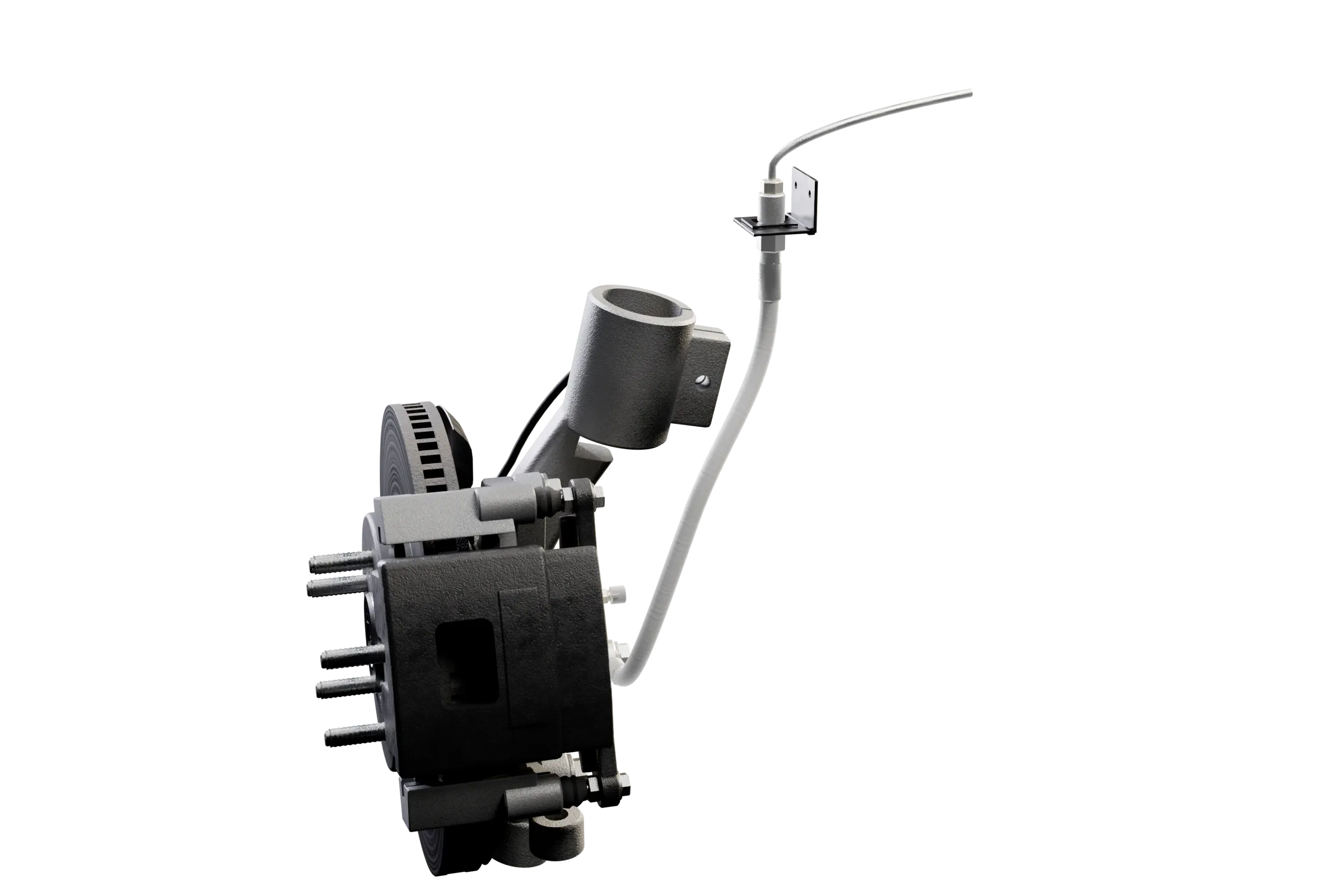
- Flexible brake hose US: Brake hose
- Brake pipe US: Brake line
- Caliper housing US: Brake caliper
How does brake fluid work?
The brakes are hydraulic. The pedal, helped by the brake servo, pushes a piston into the master cylinder, and the fluid carries that pressure to every caliper. Because the pressure is the same all through a sealed system, a modest push on the master cylinder's small piston becomes a much bigger force on the larger pistons at the wheels. Most cars split the system into two circuits, so one leak leaves half the brakes working.
It also has to cope with heat. Hard braking heats the calipers, and if the fluid boils, it turns to vapour that squashes like air, so the pedal goes soft. Brake fluid is made to boil far above water and to stay thin in deep cold, and it protects the seals and the metal it touches from corrosion.
What are the signs of low or old brake fluid?
- The red brake warning light comes on. A float in the reservoir lights it when the level falls to MIN. On many cars the same light also shows the handbrake is on.
- A soft or sinking pedal. Fluid lost through a leak, or air drawn in after the level ran too low. What causes a spongy brake pedal?
- The level below MIN in the reservoir. Pad wear lowers it slowly and only a little. A level that keeps falling, or needs topping up, means a leak.
- Wet patches near a wheel or under the car. Brake fluid is thin, slippery and nearly clear. Look inside each wheel, along the pipes and below the master cylinder.
- A pedal that goes soft on a long descent. Old fluid that holds water boils sooner, and the vapour softens the pedal until the brakes cool.
Can you drive with low brake fluid?
Don't drive it
No, not until you know why it is low. Pad wear lowers the level only slowly, so fluid below MIN, or the red brake warning light, usually means a leak, and a leak can empty one circuit and leave a long, soft pedal without warning. Topping up hides the problem rather than fixing it. Have the car checked where it is, or recovered.
How often should brake fluid be changed?
Usually every two years. Check the service schedule for your car, because some makers set a different interval, or a mileage as well. The reason is water. Brake fluid is hygroscopic: it draws moisture from the air, through the rubber hoses and seals and whenever the reservoir is open, and the water lowers its boiling point. New DOT 4 fluid must not boil below 230 °C, but once it holds about 3.7% water, which a few years in a car can bring, the minimum it has to meet is only 155 °C.
The water also corrodes the system from the inside, from the caliper pistons to the valves in the ABS unit, and a fluid change flushes it out before it can do that.
Which brake fluid does a car need?
The one named on the reservoir cap or in the handbook. Most cars sold in Britain take DOT 4, and some take DOT 3 or DOT 5.1. Those three are glycol-based and will mix, though topping up with a lower grade brings the boiling point down. DOT 5 is different, despite its number: it is silicone-based and must never be mixed with them. Use fluid from a sealed bottle, because an opened one absorbs water while it waits on the shelf.
What does bleeding the brakes involve?
- Time
- About 30 minutes
- Difficulty
- Moderate
- Parts
-
- Fresh DOT 4 brake fluid
- A helper, or a one-man bleed kit
- Top the reservoir up to MAX with fresh fluid from a sealed bottle, then raise the car safely onto axle stands and take the front wheels off.
- Pull the dust cap off the bleed screw, fit a ring spanner and push on a clear tube that runs into a bottle with a little fresh fluid in the bottom.
- With a helper pressing the pedal down and holding it, open the bleed screw slightly so fluid and bubbles run down the tube, then close it before the pedal comes back up.
- Repeat until the fluid runs clean with no bubbles, checking the reservoir every few presses so it never drops below MIN and lets air in.
- Tighten the small bleed screw gently, refit its cap and bleed the other front caliper the same way.
- With the engine off, check the pedal feels firm and high, and bleed again if it is spongy. Refit the wheels, top up to MAX and test the brakes at low speed.
Tools
- Brake fluid (DOT 4)
- Wheel chocks
- Breaker bar
- Socket and ratchet
- Trolley jack (US: Floor jack)
- Axle stand (US: Jack stand)
- Ring spanner (US: Box-end wrench)
- Bleed tube and bottle (US: Bleeder hose and bottle)
- Torque wrench
Work safely
- Work on firm, level ground with the handbrake on and the other wheels chocked.
- Never work under a car held only by a jack: set it on an axle stand.
- Brake fluid strips paint and harms skin and eyes: wear gloves and glasses, wipe up spills at once.
- Brake dust is harmful: clean it with brake cleaner, never with an air line.
Tighten every nut and bolt to the figure in the maker's manual for your car.
A full fluid change does the same at every wheel, usually starting at the one furthest from the master cylinder, until fresh fluid comes through at each. If air reaches the ABS unit, some cars need a diagnostic tool to bleed it out.
Questions people ask
Should you top up brake fluid when the pads are worn?
Usually not. The level falls as the pads wear and rises again when the pistons are pushed back for new pads, so topping up now can make it overflow then. A level below MIN is different: have the system checked for a leak.
What colour should brake fluid be?
Fresh fluid is clear to pale amber. It darkens with age and heat, so brown fluid is due a change, but colour alone does not show how much water it holds. A garage tests that with a meter or a boiling point tester.
Is clutch fluid the same as brake fluid?
On most cars with a hydraulic clutch, yes. Many share the brake fluid reservoir, and most others take the same fluid in a small reservoir of their own, named on its cap. Where the reservoir is shared, a clutch leak lowers the level the brakes rely on.
What happens if you never change brake fluid?
It keeps taking in water. Its boiling point falls, so the pedal can go soft after hard braking or a long descent, and the water corrodes the caliper pistons, the pipes and the ABS unit from the inside, which can mean replacing them.
Related
Symptoms
- What causes a spongy brake pedal? A spongy or soft brake pedal usually means air in the brake fluid, which compresses where fluid does not.
Parts nearby
- What does a brake caliper do? A brake caliper is the clamp at each disc brake. When you brake, fluid pressure pushes its piston out and the caliper squeezes the two pads against the disc.
- What does a clutch slave cylinder do? A clutch slave cylinder is the small hydraulic cylinder on the gearbox that releases the clutch.
- What do brake pads do? Brake pads are the friction blocks the caliper squeezes against the brake disc, turning the car's movement into heat to slow it down.
- What do brake discs do? Brake discs (US: rotors) are the iron discs that turn with the wheels.
Explained
- Disc vs drum brakes: what's the difference? A disc brake squeezes pads against a disc that turns with the wheel; a drum brake pushes curved shoes outwards against the inside of a drum.
The whole system
- How do disc brakes and ABS work? The disc brakes and ABS, part by part, with an interactive diagram.
