
Why is my car pulling to one side?
A car that pulls to one side on a straight, level road usually has a tire problem or wheels out of alignment. Uneven tire pressure is the first thing to check, because it is common and quick to fix. A tire with a built-in pull, a dragging brake, worn control arm bushings and a bent steering part come next.
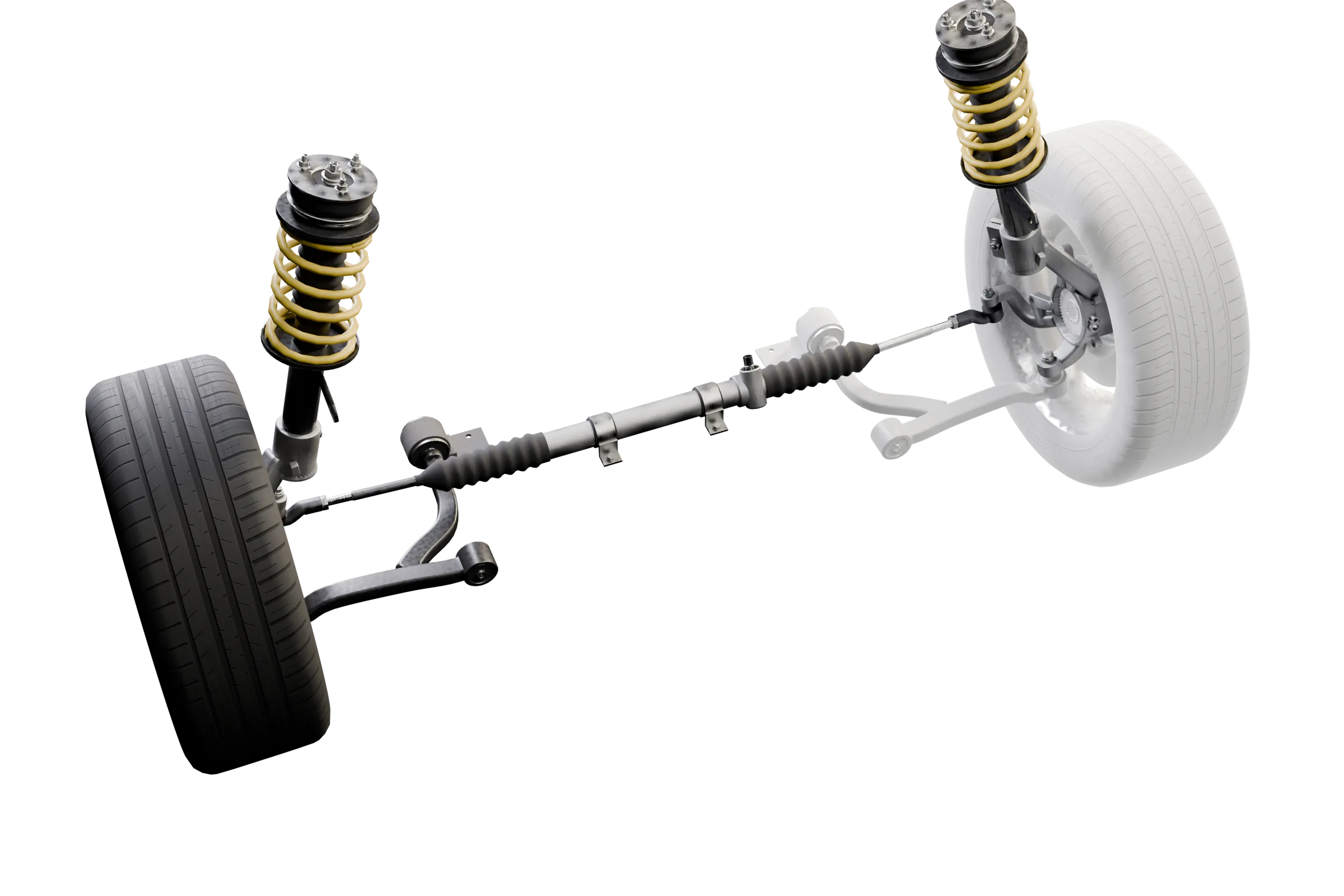
- Wheel and tire UK: Road wheel and tyre
- Inner tie rod UK: Track rod
- Lower control arm
- Hub and brake rotor
The likely causes, most common first
-
Uneven tire pressures
Most likelyHow it shows A steady drift toward the side with the softer front tire, sometimes with heavier steering.
Check Check all four pressures with the tires cold, against the figures on the driver's door jamb, and look for a nail or a slow leak in a tire that keeps losing air.
Fix it soon
-
Wheels out of alignment
Most likelyHow it shows A pull on every road, often since a curb strike or a deep pothole, with the steering wheel off center or a front tire wearing on one edge.
Check Have the alignment measured. A pull usually comes from camber or caster that differ from one side to the other, which the shop's printout of the angles shows at once.
Fix it soon
-
A tire with a built-in pull
CommonHow it shows A pull that started right after new tires, a tire repair or a rotation, with the pressures set right.
Check Swap the two front tires left to right. If the pull moves to the other side, one of those tires is the cause.
Fix it soon
-
A dragging brake
CommonHow it shows A pull toward one side even with your foot off the pedal, with that wheel much hotter after a drive and sometimes a burning smell.
Check After a short drive, hold a hand near each front wheel without touching it. A wheel far hotter than the other has a brake that is not letting go.
Have it checked soon
-
Worn control arm bushings
Less likelyHow it shows A pull that changes as you speed up and slow down, often with a clunk over bumps or a dart to one side under braking.
Check Look for split or cracked rubber where the arms meet the subframe, and have the suspension checked for play.
Have it checked soon
-
A bent steering knuckle, arm or tie rod
Less likelyHow it shows A pull that began after a hard hit on a curb or a pothole, often with the steering wheel sitting crooked.
Check A shop compares the angles side to side. If the alignment cannot be brought back into range, a part is bent and needs replacing.
Have it checked soon
-
An electric power steering fault
Less likelyHow it shows The steering pushes one way on its own, or turns more easily one way than the other, sometimes with a power steering warning.
Check Have the power steering module scanned for codes. A torque sensor that reads a twist that is not there can be recalibrated or replaced.
Don't drive it
-
The slope of the road
Less likelyHow it shows A gentle drift toward the curb on most roads that disappears on a flat parking lot.
Check Drive slowly in a straight line across a flat, empty lot with your hands light on the wheel. If the car holds its line there, nothing is wrong.
Fix it soon
How to narrow it down
- Set all four tire pressures cold to the figures on the driver's door jamb, and look over the front tires for uneven wear, a bulge or a nail.
- Find a flat, empty parking lot and drive slowly in a straight line with your hands light on the wheel. Most roads slope toward the curb to drain, so judge the pull on the flat.
- Note when it pulls: all the time, only under braking, only when you accelerate, or since new tires, a rotation, an alignment or an impact.
- After a drive, hold a hand near each front wheel without touching it, to find a brake that drags.
- Swap the front tires left to right. If the pull follows the tires, a tire is the cause; if it stays, have the alignment and the steering and suspension joints checked.
Is it safe to drive a car that pulls to one side?
Have it checked before you drive far
A slight, steady pull from the tires or the alignment is safe for a short while, but it wears the front tires and makes the car less settled in a sudden swerve or a hard stop. Set the pressures right away and have the alignment checked soon. A pull that came on suddenly is different: a tire losing air, a dragging brake or a part bent by an impact all need checking before you drive far. If the steering pushes by itself and a power steering warning is on, pull over where it is safe and have the car checked there.
Which way does a car pull, and why?
Toward the side that drags or leans. A soft tire has a bigger footprint and more rolling resistance, so the car drifts toward it. Camber and caster pull too: the car drifts toward the side with more positive camber, where the wheel leans out further at the top, and toward the side with less caster. In the app’s MacPherson strut the steering axis leans back 4.5° from vertical, and that caster is what makes the front wheels want to run straight; when one side has less of it, the other side wins. A dragging brake pulls the car toward its own side, and a tire with a built-in pull, from a belt laid slightly off center when it was made, rolls like a shallow cone and steers itself.
If the car pulls only when you brake, the cause is almost always in the brakes: see why a car pulls to one side when braking.
Why does my car pull after an alignment?
Usually because a side-to-side difference was left in. An alignment can put each wheel within the maker’s range and still leave the camber or the caster higher on one side, and that difference, more than any single figure, is what makes a car pull. Many specifications also call for a little more caster on one side to cancel the slope of the road, so the car can feel slightly different on a flat lot than on the street. Ask for the printout, which shows each angle for each wheel, and the shop can correct a split it left behind.
A pull that starts after an alignment can also come from something done at the same visit, such as new tires or a rotation, or from a worn joint that let the settings move as soon as the car was driven. A steering wheel that sits crooked after an alignment is a separate fault, covered in why a steering wheel is off center.
What about a pull only when you accelerate?
That is torque steer, and it belongs to front-wheel drive. The engine’s torque reaches the front wheels through half-shafts of different lengths or angles, so under hard acceleration the steering tugs toward one side. A little is normal. A lot, or more than the car used to have, points to worn engine mounts, control arm bushings or inner CV joints that let the drivetrain shift. If the car shakes as well, see why a car shakes when you accelerate.
Questions people ask
Why does my car pull to the right on most roads?
Because US roads are crowned, built higher in the middle so rain drains to the edges, and the slope toward the right-hand curb makes most cars drift that way. Alignment settings allow for some of it. If the car also pulls to the right on a flat, empty lot, look at the right front tire's pressure, the alignment and the brakes.
Why does my car pull to one side after a tire rotation?
Usually because a tire with a slight built-in pull has moved to the front, where it steers the car. The same tire hardly shows it at the rear. Swap the two front tires left to right: if the pull changes sides, move that pair back to the rear or have the shop that sold the tires check them. Check the pressures too, since some cars call for different pressures front and rear.
Why is my car pulling to one side and shaking?
A pull with a shake usually means a damaged tire or wheel: a belt coming apart inside the tire, a bulge in its sidewall, or a wheel bent by a pothole. A brake that is dragging hard can do it too. Stop and look at the tires before you drive any farther, because a tire with a bulge or a separated belt can fail without warning.
Does a wheel alignment fix a car that pulls?
Only when the angles are the cause. A good shop checks the tire pressures, the tires and the steering and suspension joints first, because an alignment cannot cancel a soft tire, a tire that pulls or a dragging brake, and settings made on worn joints do not hold.
Related
The parts
- What does a brake caliper do? A brake caliper is the clamp at each disc brake. When you brake, fluid pressure pushes its piston out and the caliper squeezes the two pads against the brake rotor.
- What do control arm bushings do? Control arm bushings are the rubber mountings where a control arm pivots on the subframe.
- What is a steering knuckle? A steering knuckle is the cast part at each front wheel that carries the wheel bearing and hub.
- What does a steering torque sensor do? A steering torque sensor measures how hard you are turning the steering wheel, from the twist of a slim torsion bar in the column or the rack.
Similar symptoms
- Why does my car pull to one side when braking? A car that pulls to one side when braking usually has a brake that grips harder on one side than the other.
- Why is my steering wheel off center? A steering wheel that sits off center while the car drives straight usually means the front toe is out of adjustment, or the tie rods were set unevenly at the last alignment.
- What causes uneven tire wear? Uneven tire wear usually means the wheel alignment is off, the tire pressures are wrong or a suspension part is worn, and the pattern points to which.
- What causes a grinding noise when braking? A grinding noise when you brake usually means the brake pads have worn through their friction material, so their steel backing plates are scraping the brake rotors.
Explained
- What is camber? Camber is the lean of a wheel seen from the front of the car.
- Toe in vs toe out: what's the difference? Toe is the angle of a pair of wheels seen from above. With toe in, their fronts point slightly toward each other; with toe out, slightly apart.
