
What does a steering torque sensor do?
A steering torque sensor measures how hard you are turning the steering wheel, from the twist of a slim torsion bar in the column or the rack. The power steering control module uses that reading, with the road speed, to set how much the electric motor helps. A bad sensor makes the assist heavy, uneven or pull to one side, and lights a warning.
Also called power steering torque sensor, EPS torque sensor
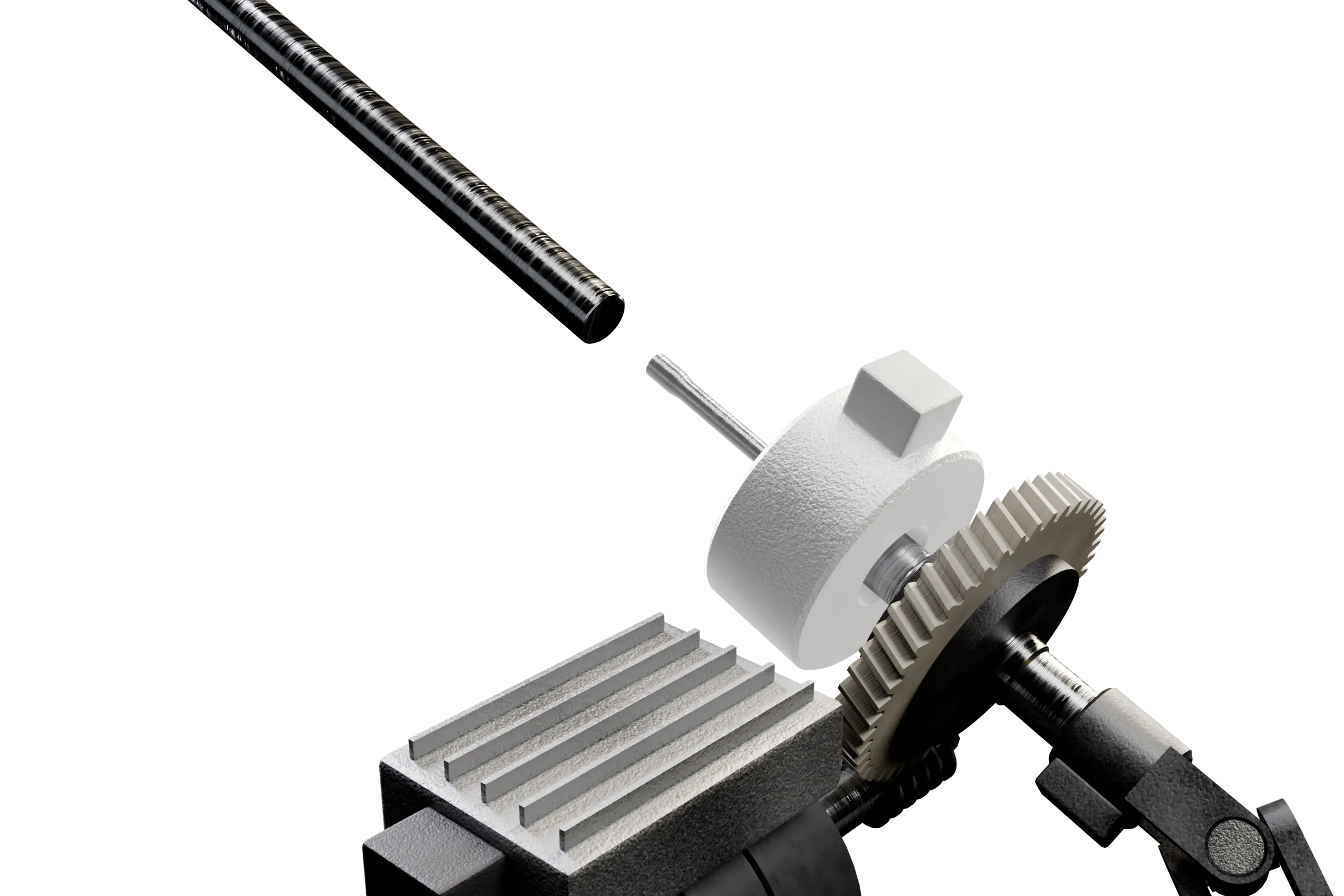
- Steering torque sensor
- Torsion bar
- Steering shaft UK: Steering column upper shaft
- Steering shaft UK: Steering column lower shaft
- Power steering motor UK: EPS motor
What does a steering torque sensor do?
It measures your effort. The steering shaft is split in two, and the only link between the upper half, which the steering wheel turns, and the lower half, which drives the rack, is a slim torsion bar. Your effort twists the bar a little before the lower shaft moves, and the sensor reads that twist. In the app's model the bar twists at 1.5 lb-ft (2 N·m) per degree, so a light push at the rim is a few degrees.
The control module turns the reading into assist: the harder you push, the more the motor helps, in the direction you are turning. Past 4.5° of twist, stops lock the two shafts together, so the steering stays a direct mechanical link if the sensor or the motor fails. Most sensors read the twist magnetically, with no contact, and many have two channels so the module can tell when one is wrong.
What are the symptoms of a bad steering torque sensor?
- Heavy steering with a warning light. The module cannot trust the reading, so it reduces or cuts the assist and lights the power steering warning. Why is my steering wheel hard to turn?
- Steering lighter one way than the other. A sensor out of calibration reads a twist that is not there, so the help is uneven between left and right turns.
- A pull or self-steer. The car tugs to one side with your hands off, or the wheel moves on its own when stopped: the motor is helping a push that is not there.
- Steering that does not return to center. The wheel stays turned after a corner instead of unwinding, because the assist fights the self-centering.
- A code stored in the module. A scan tool shows a torque sensor code, often for signal range, correlation between the two channels or an implausible signal.
Can you drive with a bad steering torque sensor?
Have it checked before you drive far
Carefully, and only to have it fixed. If the module has cut the assist, the car steers like one without power steering: heavy but predictable. A sensor that gives a wrong reading without being caught is more dangerous, because the motor can push the steering when you are not, so a pull or self-steering is a reason to stop and have it checked where the car is.
Is it the torque sensor or the power steering motor?
The stored code usually says. Power steering modules keep separate codes for the torque sensor, the motor and its position sensor, the module itself and the power supply, and a scan tool also shows the sensor’s live reading. With the steering wheel centered and your hands off, the reading should sit near zero and rise smoothly and evenly as you push the wheel each way.
A sensor problem shows as a reading that sits away from zero, jumps or disagrees between its two channels, and as a pull or uneven effort. A motor problem shows as assist that cuts out under load, often with the steering going heavy after a lot of parking, and as a clunk from a worn worm gear. Low battery voltage can mimic both, so it is checked first.
What does replacing a steering torque sensor involve?
- Scan the power steering module for codes and look at the sensor's live readings with the wheel centered and turned each way.
- Check the battery voltage and the sensor's connector and wiring before condemning the sensor.
- Disconnect the battery and lock the steering wheel centered.
- Remove the lower dashboard trim and the column or motor assembly that houses the sensor, or the rack on rack-mounted systems.
- Fit the new sensor or, on most cars, the new column or rack assembly with the sensor built in.
- Calibrate the torque sensor's zero and the steering angle sensor with a scan tool.
Tighten every nut and bolt to the torque spec in the manufacturer's service manual for your car.
On most cars the sensor is part of the column or rack assembly and is not sold on its own. It always needs a scan tool to calibrate, so it is done by a shop.
Questions people ask
Where is the steering torque sensor?
On column-mounted electric power steering it is in the column, under the dashboard, between the steering wheel and the motor. On rack-mounted systems it sits at the pinion end of the rack.
Can a steering torque sensor be recalibrated?
Often, yes. After a battery change, a steering repair or an alignment, the zero point can drift, and a scan tool can reset it. A sensor whose two channels disagree has to be replaced.
Is the torque sensor the same as the steering angle sensor?
No. The torque sensor measures how hard you are turning; the steering angle sensor measures how far the wheel is turned. Stability control and lane keeping use the angle sensor, and the power steering uses both.
Related
Symptoms
- Why is my steering wheel hard to turn? A steering wheel that is hard to turn usually means the power steering assist has failed or been cut back.
- Why is my steering wheel off center? A steering wheel that sits off center while the car drives straight usually means the front toe is out of adjustment, or the tie rods were set unevenly at the last alignment.
Parts nearby
- What does a power steering motor do? A power steering motor is the electric motor that helps you turn the steering wheel on cars with electric power steering.
- What does an intermediate steering shaft do? The intermediate steering shaft is the short shaft that runs from the bottom of the steering column, through the firewall, to the pinion on the steering rack.
- What does a steering rack do? A steering rack is a toothed steel bar that slides sideways in a housing across the front of the car.
- What do steering rack bushings do? Steering rack bushings are the rubber or polyurethane mounts that clamp the steering rack's housing to the subframe.
The whole system
- How does rack and pinion steering work? The rack and pinion steering, part by part, with an interactive diagram.
