
What does an intermediate steering shaft do?
The intermediate steering shaft is the short shaft that runs from the bottom of the steering column, through the firewall, to the pinion on the steering rack. A universal joint at each end lets it turn the corners between them. A worn U-joint or a dry slip joint gives a clunk, a notchy feel or free play as you turn the wheel.
UK intermediate shaft Also called steering U-joint, steering coupler, lower steering shaft
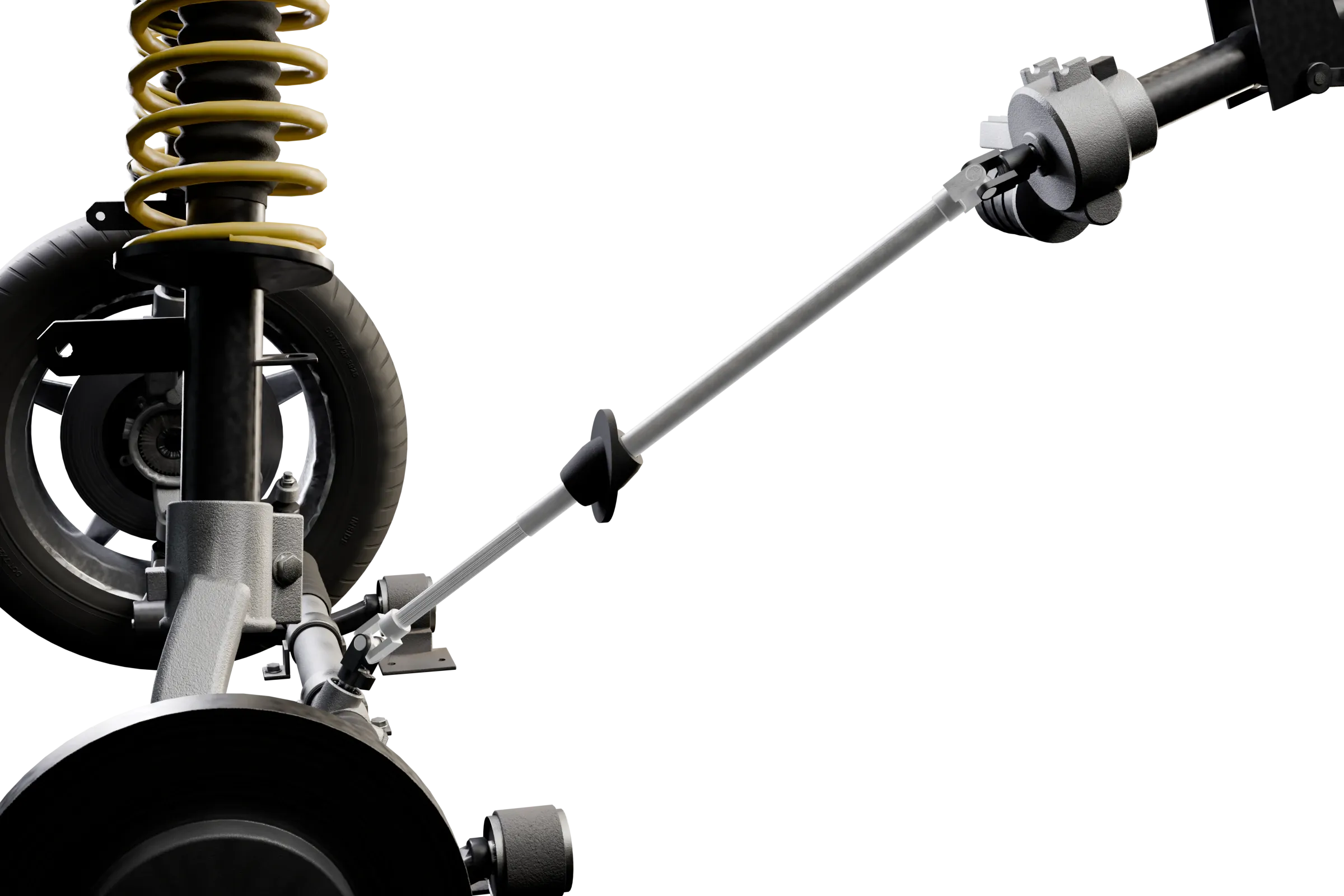
- Intermediate steering shaft UK: Intermediate shaft
- Upper u-joint cross UK: Upper universal joint spider
- Lower u-joint cross UK: Lower universal joint spider
- Firewall seal UK: Bulkhead grommet
- Steering pinion UK: Pinion
What does an intermediate steering shaft do?
It carries the steering around corners. The column points down toward the driver at an angle, 22° below horizontal in the app's model, and the rack sits low across the subframe, so the column cannot point straight at the pinion. The intermediate shaft bridges the gap, passing through a rubber seal in the firewall, with a universal joint at each end, 26.2° apiece in the app's model.
A single U-joint at an angle makes the shaft beyond it run slightly ahead of and behind the steering wheel twice in every turn. With two joints and the yokes lined up correctly, the second joint undoes the first, so the pinion follows the wheel smoothly. The shaft also slides in a splined slip joint, so it can be fitted and so it shortens in a frontal crash instead of pushing the column toward the driver.
What are the symptoms of a bad intermediate steering shaft?
- A clunk when turning the steering wheel. A clunk or click from under the dashboard or near the firewall, most noticeable when turning the wheel back and forth while parked or at low speed. Why does my car clunk when I turn the steering wheel?
- Free play at the center. The wheel turns a little before the car responds, felt as a dead spot around straight ahead.
- A notchy or binding feel. The steering catches at certain points in a turn, from a dry or rusted U-joint that no longer swivels freely.
- A knock over bumps you feel in the wheel. A worn slip joint rattles as the shaft flexes over rough roads, sometimes worse in cold weather. What causes a knocking noise over bumps?
Can you drive with a bad intermediate steering shaft?
Have it checked before you drive far
Not for long. A worn joint still turns the rack, but the play grows, and a binding joint can make the steering catch partway through a turn. A loose pinch bolt is the most serious case: if a yoke slides off its spline, the steering wheel no longer turns the wheels. Have a clunk from the shaft checked before you drive far, and stop if the steering jumps, binds or feels disconnected.
How do you check an intermediate steering shaft?
With the engine off and the car on its wheels, have a helper turn the steering wheel a little each way, back and forth through the center, while you hold each U-joint on the shaft in turn. In the engine bay the lower joint sits on top of the steering rack, near the firewall; the upper joint is under the dashboard, above the pedals. A joint that clicks or moves before the shaft beyond it is worn.
Then hold the shaft itself and feel for play as it slides in its slip joint. A clunk you can feel there, with tight U-joints, points to the slip joint. If the shaft is tight but the clunk is still there, the next places to look are the rack and its mounting bushings, the inner joints, and on column-mounted electric power steering the worm gear behind the power steering motor.
What does replacing an intermediate steering shaft involve?
- Center the front wheels and lock the steering wheel straight, so the airbag clock spring cannot be wound while the shaft is off.
- Mark both ends of the shaft against the column and the pinion, so it goes back on the same splines.
- Remove the pinch bolts at each U-joint yoke, from under the dashboard and in the engine bay.
- Slide the shaft's slip joint shorter to free the yokes from their splines and lift the shaft out through the firewall seal.
- Fit the new shaft on the same marks, with the yokes phased as the old one was, and install new pinch bolts.
- Check that the steering wheel is centered when the wheels are straight, and that the steering turns smoothly lock to lock.
Tighten every nut and bolt to the torque spec in the manufacturer's service manual for your car.
Some cars have a known slip joint clunk that is fixed with an updated shaft or grease. Getting the shaft back on the same splines matters, or the steering wheel ends up off center.
Questions people ask
Is the intermediate steering shaft part of the steering column?
No. The column is the part inside the car that holds the steering wheel and, on many cars, the power steering motor. The intermediate shaft is the separate shaft below it that runs through the firewall to the rack.
Why do some intermediate shafts clunk in cold weather?
Usually the slip joint. Its splines and plastic coating wear, and cold grease makes the shaft stick and then slip as the body flexes, which gives a clunk. Some makers released a greased or updated shaft for it.
Can a bad U-joint make the steering wheel off center?
Not by wear alone, but refitting a shaft one spline off moves the steering wheel off center while the wheels stay straight. That is why both ends are marked before the shaft comes off.
Related
Symptoms
- Why does my car clunk when I turn the steering wheel? A clunk when you turn the steering wheel usually means something in the steering or front suspension has worn loose: a tie rod end or inner tie rod, the steering rack's mounting bushings, a U-joint on the intermediate shaft or a strut mount bearing.
- What causes a knocking noise over bumps? A knocking or clunking noise over bumps usually comes from a worn joint in the front suspension.
Parts nearby
- What does a steering rack do? A steering rack is a toothed steel bar that slides sideways in a housing across the front of the car.
- What does a power steering motor do? A power steering motor is the electric motor that helps you turn the steering wheel on cars with electric power steering.
- What does a steering torque sensor do? A steering torque sensor measures how hard you are turning the steering wheel, from the twist of a slim torsion bar in the column or the rack.
- What do steering rack bushings do? Steering rack bushings are the rubber or polyurethane mounts that clamp the steering rack's housing to the subframe.
The whole system
- How does rack and pinion steering work? The rack and pinion steering, part by part, with an interactive diagram.
