
What does a power steering motor do?
A power steering motor is the electric motor that helps you turn the steering wheel on cars with electric power steering. A torque sensor measures how hard you steer, and a control module sets the motor to add force through a gear on the column or the rack. When it fails, the steering goes heavy and a warning light comes on, but the car still steers.
UK EPS motor Also called electric power steering motor, EPS motor, power steering assist motor
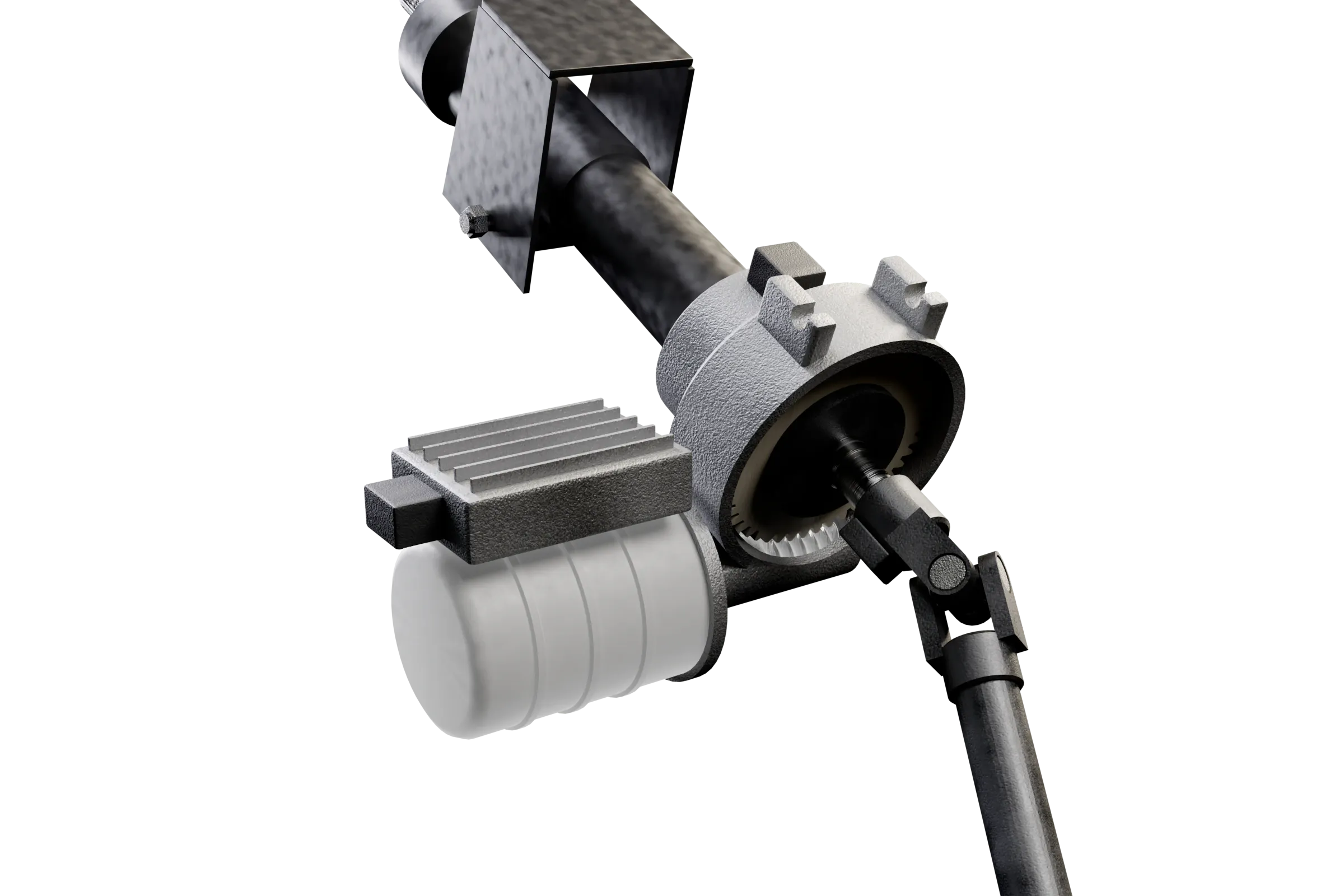
- Power steering motor UK: EPS motor
- EPS worm wheel
- Power steering control module UK: EPS control unit
- Steering torque sensor
- Steering column jacket UK: Steering column tube
What does a power steering motor do?
It adds force in the direction you are steering. Electric power steering replaced the hydraulic pump on most cars sold since the 2010s. A torque sensor reads how hard you are turning the wheel, and the control module, using that and the road speed, sets the motor's current: a lot of help when parking, very little at highway speed so the steering stays steady.
In the app's model the motor sits on the steering column and drives a worm that turns a 46-tooth worm wheel, 15.3:1, so 3.3 lb-ft (4.5 N·m) from the motor becomes up to 43 lb-ft (59 N·m) at the column: about 37 lb-ft (50 N·m) of help when parking. Other cars mount the motor on the rack itself. Either way, the gear can be driven backward, so with the motor off the steering is heavy but still works.
What are the symptoms of a bad power steering motor?
- Steering that suddenly goes heavy. The wheel needs much more effort, most noticeably when parking, often with a warning light. The control module ramps the help out when it detects a fault. Why is my steering wheel hard to turn?
- A power steering warning light or message. A steering wheel symbol, an EPS light or a message such as power steering assist fault. The module stores a code that a scan tool can read.
- Assist that comes and goes. The steering turns heavy then light again, sometimes after a cold start or in wet weather, often from a connector, the wiring or a weak battery.
- A clunk or knock from the column. A worn worm wheel or a loose motor mounting knocks as you turn or over bumps, felt through the steering wheel. Why does my car clunk when I turn the steering wheel?
- A pull or uneven effort left and right. Steering lighter one way than the other, often from the torque sensor's reading rather than the motor itself.
Can you drive without power steering assist?
Have it checked before you drive far
Yes, but with care. When the assist fails the car still steers through a direct mechanical link, but the wheel needs far more effort, especially at low speed and when parking, and a sudden loss in a turn can catch you out. Drive gently to a shop or have it checked where it is if the effort is too high to steer safely. Check the battery and charging system as well: low voltage is a common cause of the assist dropping out.
What is the difference between electric and hydraulic power steering?
Where the force comes from. Hydraulic power steering uses an engine-driven pump to push fluid into a piston inside the rack, with a valve in the pinion that sends fluid to one side or the other as you steer. It works all the time the engine runs, which costs fuel, and its faults are leaks, a whining pump and low fluid.
Electric power steering uses a motor that only draws power while you are steering, and the help can change with speed, which is how features like lane keeping and parking assistance steer the car. Its faults are electrical: a sensor, a connector, the module or the motor, and they show up as a warning light and heavy steering rather than a leak. The torque sensor is what tells the motor how much to help.
What does replacing a power steering motor involve?
- Have the system scanned first: the stored code says whether the motor, the sensor, the module or the power supply is at fault.
- Check the battery, the main fuse and the motor's connectors, since low voltage or a poor connection causes many assist faults.
- Disconnect the battery before working on the steering, and lock the steering wheel centered.
- On a column-mounted system, remove the lower dashboard trim and unbolt the motor or the whole column assembly; on a rack-mounted system, the motor comes off with or on the rack.
- Fit the new motor or assembly and reconnect everything.
- Calibrate the steering angle and torque sensors with a scan tool, as the car's service information requires.
Tighten every nut and bolt to the torque spec in the manufacturer's service manual for your car.
On many cars the motor, sensor and module are sold only as one column or rack assembly. It needs a scan tool to set up afterward, so it is usually done by a shop.
Questions people ask
Do electric power steering systems use fluid?
No. Electric power steering has no pump, hoses or fluid: the motor does the work. Searches for electric power steering fluid usually come from cars with an electro-hydraulic pump, an electric motor driving a hydraulic pump, which does use fluid.
Why does my power steering go heavy and then come back?
Often because the system protects itself. If the motor gets hot from a lot of parking maneuvers, or the voltage drops, the module reduces the help for a while. A loose connector or a failing torque sensor can do it too, and those store a code.
Can a weak battery cause power steering problems?
Yes. The motor draws a large current when parking, and if the battery or alternator cannot supply it the module cuts the assist. Testing the battery and charging system is one of the first checks.
Related
Symptoms
- Why is my steering wheel hard to turn? A steering wheel that is hard to turn usually means the power steering assist has failed or been cut back.
- Why does my car clunk when I turn the steering wheel? A clunk when you turn the steering wheel usually means something in the steering or front suspension has worn loose: a tie rod end or inner tie rod, the steering rack's mounting bushings, a U-joint on the intermediate shaft or a strut mount bearing.
Parts nearby
- What does a steering torque sensor do? A steering torque sensor measures how hard you are turning the steering wheel, from the twist of a slim torsion bar in the column or the rack.
- What does a steering rack do? A steering rack is a toothed steel bar that slides sideways in a housing across the front of the car.
- What does an intermediate steering shaft do? The intermediate steering shaft is the short shaft that runs from the bottom of the steering column, through the firewall, to the pinion on the steering rack.
- What do steering rack bushings do? Steering rack bushings are the rubber or polyurethane mounts that clamp the steering rack's housing to the subframe.
The whole system
- How does rack and pinion steering work? The rack and pinion steering, part by part, with an interactive diagram.
