
Drivetrain · CV axle and differential
What does a CV boot do?
A CV boot is the rubber or thermoplastic bellows over each CV joint on a driveshaft. It keeps the grease in and water and grit out as the joint bends with the steering and suspension. A split boot flings grease round the inside of the wheel, and a joint left open to the road can be ruined within weeks.
Also called CV gaiter, driveshaft gaiter
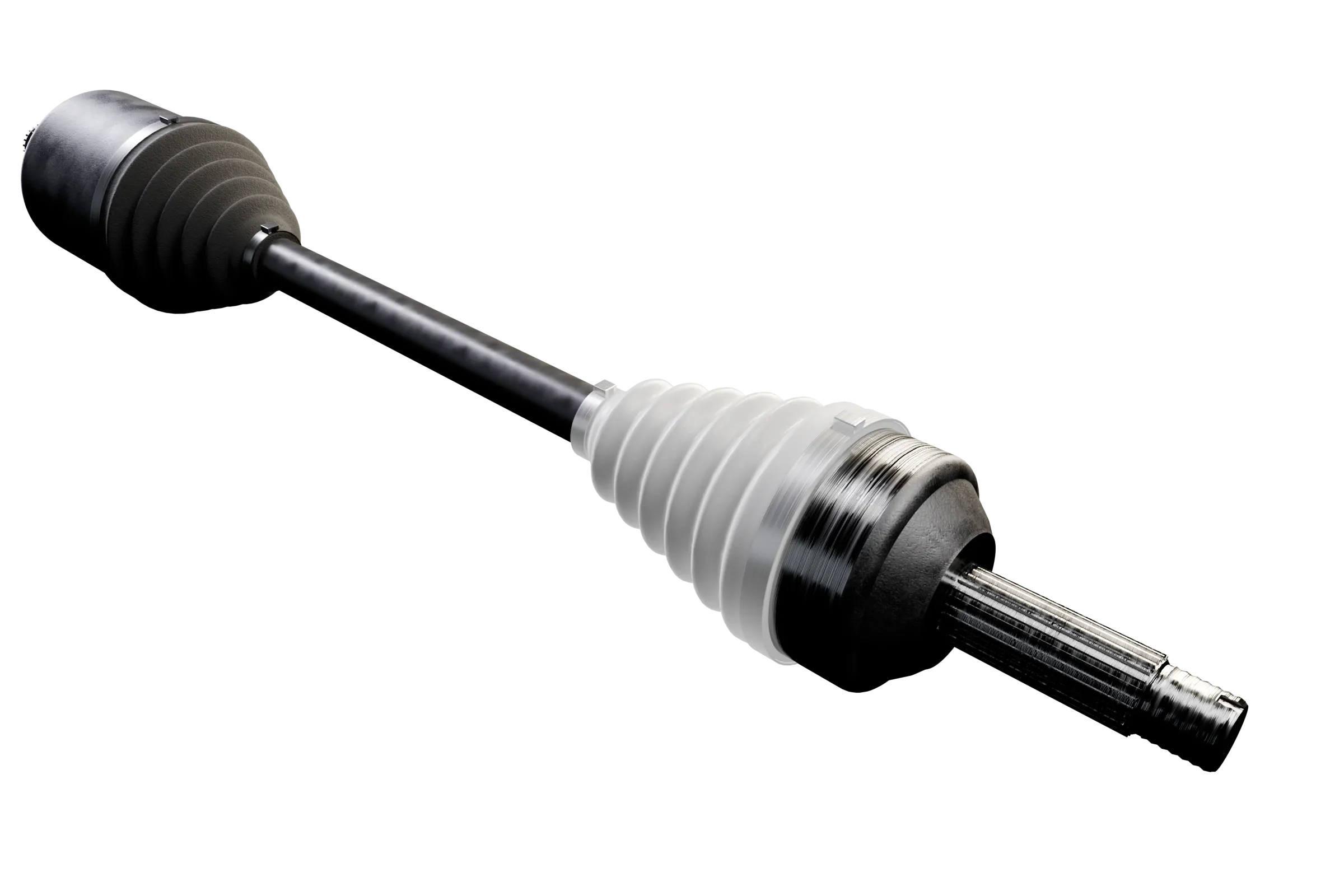
- Outer CV boot
- Outer CV joint housing
- Driveshaft US: Half-shaft
- Inner CV boot
How does a CV boot protect the joint?
Each CV joint has its own boot, clamped at its big end to the joint's housing and at its small end to the shaft, and packed with special CV grease. Its folds let it flex as the joint works at an angle. The outer boot has the hardest life, because the outer joint bends furthest for the steering; the inner boot has longer folds, because it also stretches and squashes as the shaft plunges in and out.
The joint depends on it completely. Its balls and tracks are hardened and polished to run in clean grease; once water and grit get in, they grind the tracks and the joint starts to click. Catch a split early and only the boot needs replacing, not the joint, which is why the boots are looked at in every service.
How can you tell if a CV boot is split?
- Grease flung round the inside of the wheel. Dark grease spattered over the wheel's inner rim, the brake parts and the suspension, thrown out by the boot as it spins.
- A crack or split in the folds. Turn the steering to full lock and look into the folds of each outer boot: splits usually start at the bottom of a fold, where it bends most.
- A loose or missing clamp. A boot that has slipped off its seat lets the grease out as surely as a split.
- A click on full lock. If the joint has started to click, grit has already worn it, and a new boot alone will not cure it. Why does my car click when turning?
Can you drive with a torn CV boot?
Fix it soon
Yes, for a short while, but replace it soon, before grit gets into the joint. Once the grease has gone and water and grit are in, a joint can be ruined within weeks, sooner on wet, salted winter roads. If the joint already clicks, a boot will not save it, and the repair becomes a new joint or a whole driveshaft. A split boot also fails the MOT.
Is a split CV boot an MOT failure?
Yes. A constant velocity joint boot that is missing, split or so insecure that it no longer keeps dirt out is a major defect, so the car fails. A boot that is badly deteriorated but still sealed is a minor defect: the car passes, with the defect recorded. The tester also looks for a joint that is excessively worn, which is a major defect too.
Why do CV boots split?
Age and flexing, mostly. The outer boot bends every time you steer, and the material hardens with heat and age until a fold cracks; stone chips, a clamp pinching the boot and careless jacking add to it. Many outer boots on modern cars are thermoplastic, like the one in the app’s CV axle and differential, which stands up to heat and stones better than rubber, but they crack in the end too.
What does replacing a CV boot involve?
- Time
- About 2 hours
- Difficulty
- Demanding
- Parts
-
- An outer CV boot kit: boot, two clamps, circlip and grease
- A new axle nut
- Rags and brake cleaner
- With the car on its wheels, take off the centre cap, free the staked collar of the axle nut and break the nut loose, then loosen the wheel nuts.
- Raise the car onto an axle stand, take off the wheel and the axle nut, split the lower ball joint and draw the hub off the joint's splines, then support the driveshaft.
- Cut off the old clamps, fold the boot back and knock the joint off the end of the shaft with a soft drift on its inner race, which closes the circlip.
- Clean out the old grease and look at the balls and tracks: pitting, or a joint that was already clicking, means a new joint, not just a boot.
- Fit the new small clamp, boot and circlip, work the grease into the joint and tap it home until the circlip holds, then seat the boot, let the trapped air out and crimp the clamps.
- Refit the hub and ball joint with a new axle nut, refit the wheel and lower the car. With its weight on the wheel, tighten the wheel nuts and the axle nut, stake the nut and test drive on full lock both ways.
Tools
- Wheel chocks
- Flat screwdriver (US: Flat-blade screwdriver)
- Breaker bar
- Socket and ratchet
- Punch
- Trolley jack (US: Floor jack)
- Axle stand (US: Jack stand)
- Ball-joint splitter (US: Ball joint separator)
- Side cutters (US: Diagonal cutters)
- Hammer
- Brake cleaner (US: Brake parts cleaner)
- CV joint grease
- Boot clamp pliers (US: CV boot clamp pliers)
- Torque wrench
Work safely
- Work on firm, level ground with the handbrake on and the other wheels chocked.
- Never work under a car held only by a jack: set it on an axle stand.
- The axle nut is very tight: crack it and torque it with the car's weight on the wheel, never with the car on the stand.
- Support the driveshaft once the hub is off: never let it hang on the inner joint.
Tighten every nut and bolt to the figure in the maker's manual for your car.
The inner boot is changed in much the same way, often with the driveshaft out. Fitting a new boot while the joint is still quiet saves replacing the joint as well.
Questions people ask
Can you fit a CV boot without removing the joint?
Yes, with a split boot, which wraps round the shaft and is sealed along a seam, or a stretch boot pulled over the joint on a cone. They save time, but most mechanics prefer a one-piece boot fitted with the joint off, which seals better and lasts longer.
Should both CV boots be replaced at the same time?
Not as a rule. The boots on the other side have done the same miles, so look at them closely, but a sound boot can stay. On one shaft the outer boot usually goes first, because it flexes most.
What grease goes in a CV joint?
The grease that comes with the boot or joint kit, made for CV joints: it has to cope with the very high pressure between the balls and their tracks, and general-purpose grease is no substitute. Use all of it, most in the joint and the rest in the boot.
Is a CV boot the same as a CV gaiter?
Yes. CV gaiter and driveshaft gaiter are UK names for the same part, and the MOT manual calls it a constant velocity joint boot. The gaiters on a steering rack are different parts, though they keep the dirt out in the same way.
Related
Symptoms
- Why does my car click when turning? A clicking noise when you turn, loudest on full lock as you pull away, is usually a worn outer CV joint on a front driveshaft, most often after its boot has split.
Parts nearby
- What does a CV joint do? A CV (constant velocity) joint lets a driveshaft turn a wheel through an angle without the speed pulsing.
- What does a ball joint do? A ball joint is the ball-and-socket joint that connects a suspension arm to the wheel's steering knuckle.
- What does a wheel bearing do? A wheel bearing lets the wheel spin freely while carrying the car's weight and the cornering and braking loads.
The whole system
- How do a CV axle and a differential work? The CV axle and differential, part by part, with an interactive diagram.
