
Why is my clutch pedal stuck to the floor?
A clutch pedal that sinks to the floor or stays there is nearly always a hydraulic fault: a fluid leak, air in the line or a failed seal in the master or slave cylinder. A broken pedal spring, or on older cars a snapped clutch cable, can do it too. Do not drive until it is fixed.
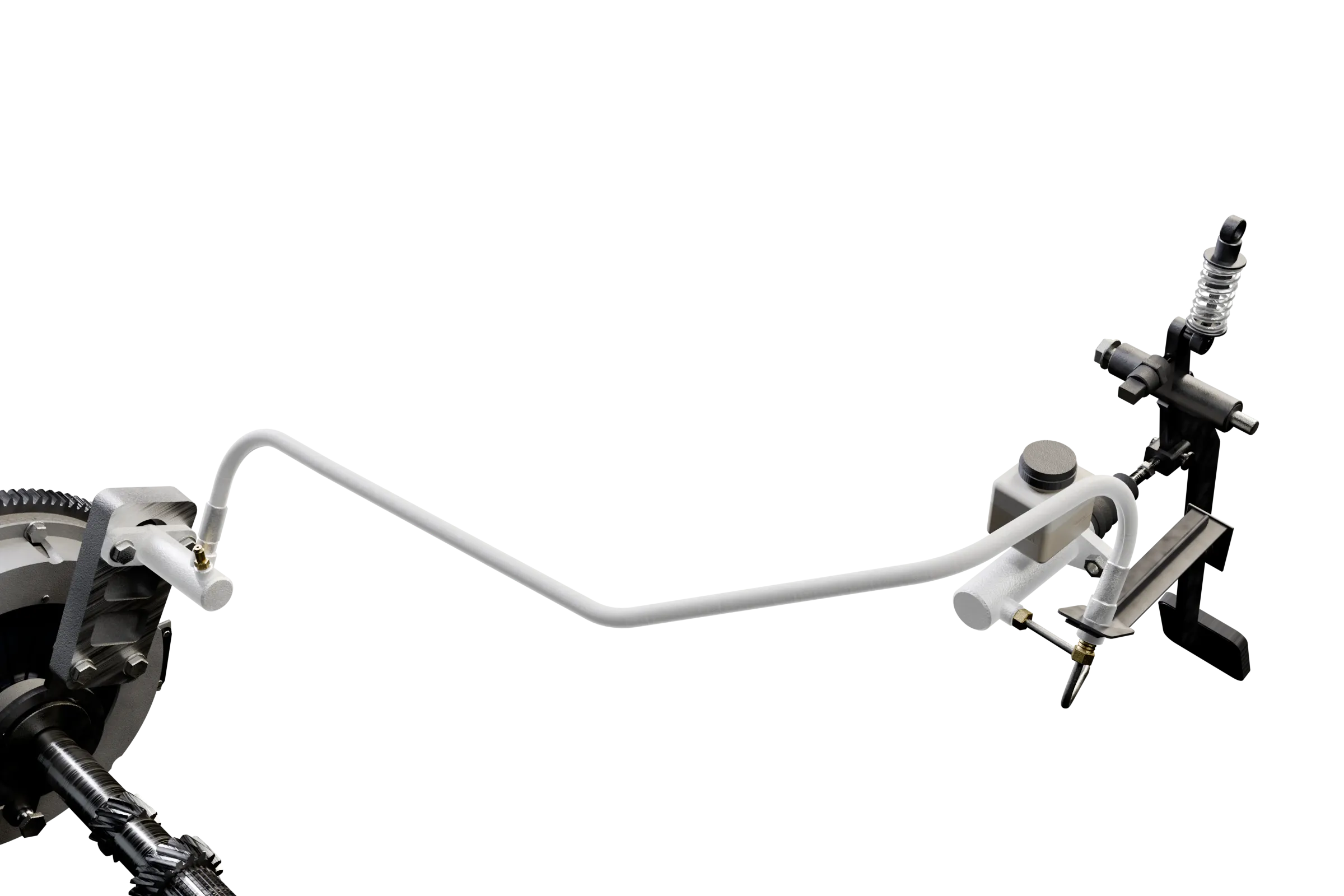
- Master cylinder
- Slave cylinder
- Clutch hose
- Over-centre helper spring US: Over-center helper spring
The likely causes, most common first
-
A leaking slave cylinder
Most likelyHow it shows The pedal went soft over days or weeks, then dropped to the floor, and the fluid level is low.
Check Look for fluid on the bellhousing, inside the slave cylinder's dust boot and along the pipe and hose. A concentric slave cylinder leaks inside the bellhousing, so look for a drip below it.
Don't drive it
-
A failed master cylinder
CommonHow it shows The pedal sinks slowly while you hold it, or stays down, with no fluid lost: worn seals let it slip back past the piston.
Check If the reservoir is full and nothing is wet, suspect the master cylinder. Look on the bulkhead and the carpet behind the pedal for a drip.
Don't drive it
-
Air in the hydraulics
CommonHow it shows A spongy pedal that may come back up after a few quick presses, often after work on the clutch or brakes, or after the fluid ran low.
Check If pumping brings the pedal back, there is air in the system: it needs bleeding, and whatever let the air in needs finding.
Don't drive it
-
A broken or unhooked pedal spring
Less likelyHow it shows The pedal stays down, or stops short of the top, but comes up when you hook it with your toe, and the clutch then works normally.
Check Look in the footwell at the pedal box for a broken or unhooked helper spring or return spring.
Have it checked soon
-
A snapped clutch cable
Less likelyHow it shows On older cars with a cable, the pedal falls to the floor with no resistance at all, often after a twang.
Check Look for a slack cable at the gearbox end, or a broken self-adjuster at the pedal.
Don't drive it
-
A broken release fork or bearing
Less likelyHow it shows The pedal goes down with little resistance even though the hydraulics are full, sometimes after a crack or a grinding noise.
Check Needs the gearbox out to confirm: the fork, its pivot and the bearing are inside the bellhousing.
Don't drive it
How to narrow it down
- If it happens while driving, pull over where it is safe, select neutral if you can and switch off: a clutch with no hydraulic pressure stays engaged whatever the pedal does.
- Hook the pedal up with your toe and press it again. If the clutch now works normally, a pedal spring is the likely cause; if the pedal drops straight back to the floor, the fault is almost always hydraulic.
- Open the bonnet and check the fluid level. Many cars feed the clutch from the brake fluid reservoir.
- Look for wet fluid on the bellhousing and the slave cylinder, along the pipe and hose, and on the carpet behind the pedal.
- Pump the pedal a few times. If it firms up for a moment, there is air in the system or a seal letting fluid by.
Can you drive with the clutch pedal stuck to the floor?
Don't drive it
No. With no pressure in the hydraulics the clutch stays engaged, so you cannot release it to change gear or to stop without stalling, and a car started in gear will lurch. Pumping the pedal can sometimes bring it back for a moment, but it can fail again at the next junction. Have the car recovered, or the fault fixed where it stands.
Why does the pedal stay down instead of springing back?
Most of the force that lifts a clutch pedal off the floor comes from the clutch itself. The diaphragm spring pushes back on the release bearing, and the fluid carries that push back up the line to the master cylinder and the pedal. Many pedal boxes also have an over-centre helper spring: in the app’s model it pushes the pedal up for the first 42% of its travel and helps your foot down beyond that, with 32 N at the floor.
Lose the fluid and the push from the clutch goes with it. Nothing is left to lift the pedal back past the helper spring’s over-centre point, so a pedal pressed to the floor stays there. Hooking it up with your toe brings it back to the top, but the next press drops it straight to the floor again. The clutch guide follows that push from the pedal to the fingers.
Questions people ask
Can low brake fluid stop the clutch working?
It can, on cars where the clutch shares the brake reservoir. The clutch often takes its fluid from higher up the reservoir, so that a clutch leak cannot drain the brakes, which also means a low level starves the clutch first.
Will topping up the fluid fix a clutch pedal on the floor?
Only for a while, if at all. The fluid went somewhere, so there is a leak to find, and once air is in the system the clutch needs bleeding before the pedal works properly.
Why does the clutch pedal come back up after a few presses?
Pumping it pushes fluid into the line faster than it leaks away, or squeezes the air in it, so for a few presses there is enough to move the fork. It is a sign of air or a failing seal, not a fix.
Can you start a car with the clutch pedal on the floor?
Usually, yes: on cars that only crank with the pedal pressed, the switch reads it as pressed. But the clutch itself is still engaged, so in gear the car will lurch as the engine turns. Make sure it is in neutral with the handbrake on.
Related
The parts
- What does a clutch slave cylinder do? A clutch slave cylinder is the small hydraulic cylinder on the gearbox that releases the clutch.
- What is a clutch release bearing? A clutch release bearing (US: throw-out bearing) presses the clutch's diaphragm spring when you push the pedal.
Similar symptoms
- Why does my gearbox grind when I change gear? A gearbox grinds when the gear you select is still turning at a different speed from the shaft it is being locked to.
- What causes a spongy brake pedal? A spongy or soft brake pedal usually means air in the brake fluid, which compresses where fluid does not.
- How can you tell if a clutch is slipping? A slipping clutch lets the engine's revs rise without the car speeding up to match, most clearly when you accelerate hard in a high gear or climb a hill.
- Why does my car make a noise when I press the clutch? A whirr, squeal or chirp that starts when you press the clutch pedal is usually a worn release bearing (US: throw-out bearing), which works only while the pedal is down.
